Fabregat-Sanjuan Albert, Rodríguez-Ballabriga Ángel, Rigo-Vidal Agnès, Pàmies-Vilà Rosa, Larrosa-Capaces Susana, Rius-Costa Vanesa, Pascual-Rubio Vicenç
FUNCMAT, Mechanical Engineering Department, Universitat Rovira i Virgili, Tarragona, Spain.
NeuroÈpia, Institut d'Investigació Sanitària Pere Virgili, Clinical Neurophysiology Department, Hospital Sant Joan de Reus, Reus, Spain.
Front Pediatr. 2024 Oct 3;12:1452862. doi: 10.3389/fped.2024.1452862. eCollection 2024.
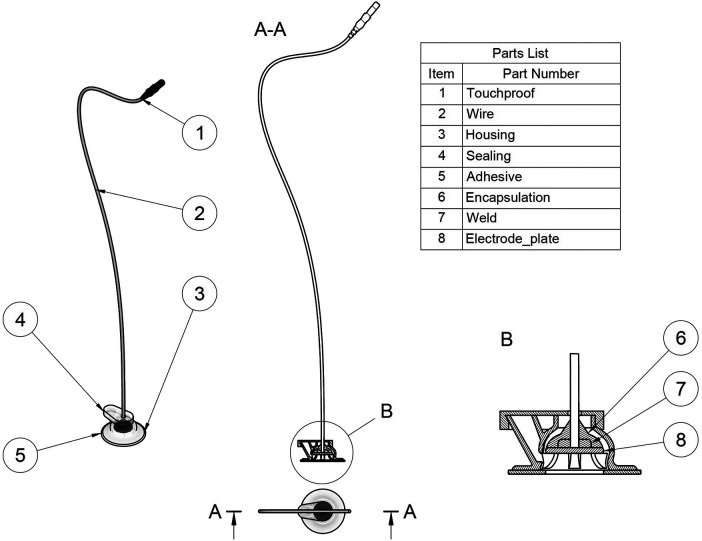
Neonatologists and clinical neurophysiologists face challenges with the current electrodes used for long-duration amplitude-integrated electroencephalography (aEEG) in neonatal intensive care units (NICU), limiting the capacity to diagnose brain damage.
The objectives of this study were to develop methods for comparing the performance of different electrodes to be used in aEEG. The comparison was done between a newly designed neonate-specific electrode, aCUP-E, with commercial liquid gel electrodes used in amplitude-integrated electroencephalography (aEEG). The comparison included impedance stability, electrode survival, recording quality, usability, and satisfaction of NICU staff.
aEEG recordings with bipolar montage was used, with one hemisphere fitted with commercial electrodes and the other with aCUP-E electrodes, alternated among subjects. Continuous impedance and raw EEG data were collected over a minimum of 24 h, and signal processing was performed using Python and MATLAB.
aCUP-E electrodes demonstrated superior performance, including: Increased impedance stability and electrode survival, enhanced recording quality with fewer artifacts, high correlation in signal capture between electrodes during optimal brain activity segments, higher signal-to-noise ratio (SNR) across varying impedance levels, greater staff satisfaction and ease of use. Moreover, Kaplan-Meier curves indicated a higher survival rate for aCUP-E electrodes over 24 h compared to commercial electrodes. Impedance variability analysis showed statistically significant stability improvements for aCUP-E.
aCUP-E electrodes outperform commercial liquid gel electrodes in impedance stability, electrode survival, and recording quality. These results suggest that aCUP-E electrodes could significantly enhance aEEG utilization in diagnosing and treating neonatal brain conditions in NICUs. Future improvements to the aCUP-E electrode may further reduce artifacts and increase electrode longevity, potentially leading to a significant improvement in neonatal brain monitoring by means of aEEG.
新生儿科医生和临床神经生理学家在新生儿重症监护病房(NICU)中使用的用于长时间振幅整合脑电图(aEEG)的现有电极面临挑战,这限制了诊断脑损伤的能力。
本研究的目的是开发比较用于aEEG的不同电极性能的方法。将新设计的针对新生儿的电极aCUP-E与用于振幅整合脑电图(aEEG)的商用液体凝胶电极进行比较。比较内容包括阻抗稳定性、电极耐用性、记录质量、易用性以及NICU工作人员的满意度。
采用双极导联进行aEEG记录,在受试者之间交替进行,一个半球使用商用电极,另一个半球使用aCUP-E电极。至少持续24小时收集连续阻抗和原始脑电图数据,并使用Python和MATLAB进行信号处理。
aCUP-E电极表现出卓越的性能,包括:更高的阻抗稳定性和电极耐用性,记录质量提高且伪迹减少,在最佳脑电活动段电极之间的信号捕获具有高度相关性,在不同阻抗水平下具有更高的信噪比(SNR),工作人员满意度更高且易用性更好。此外,Kaplan-Meier曲线表明,与商用电极相比,aCUP-E电极在24小时内的存活率更高。阻抗变异性分析显示aCUP-E在统计学上具有显著的稳定性改善。
aCUP-E电极在阻抗稳定性、电极耐用性和记录质量方面优于商用液体凝胶电极。这些结果表明,aCUP-E电极可显著提高aEEG在NICU中诊断和治疗新生儿脑部疾病的应用。aCUP-E电极未来的改进可能会进一步减少伪迹并延长电极使用寿命,有可能通过aEEG显著改善新生儿脑监测。