Akshayraj Vanrajbhai Chavda, Thorat Vandana M, Patel Vedant S, Patil Kartiki P, Chawla Leesha L
Department of Pharmacology, Krishna Institute of Medical Sciences, Krishna Vishwa Vidyapeeth (Deemed to be University), Karad, IND.
Cureus. 2024 Sep 20;16(9):e69798. doi: 10.7759/cureus.69798. eCollection 2024 Sep.
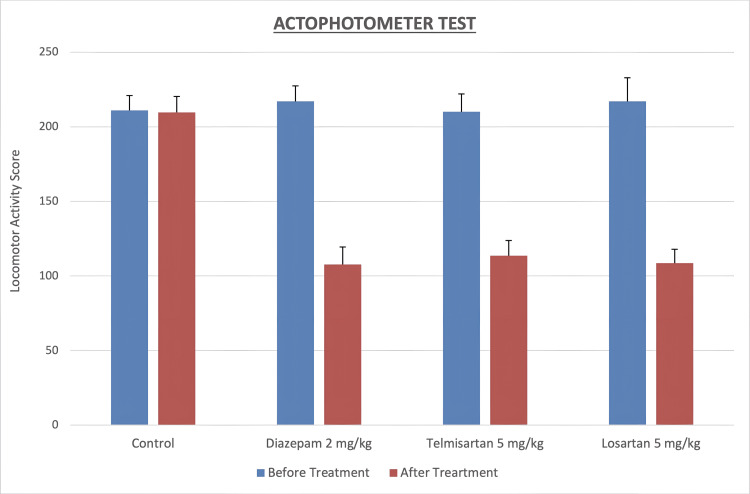
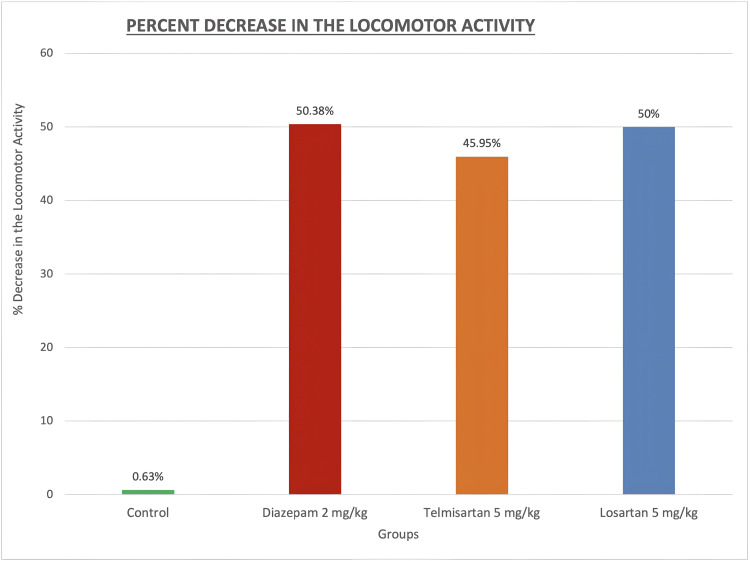
Introduction Anxiety disorders are common mental illnesses impacting quality of life, with current treatments like benzodiazepines and selective serotonin reuptake inhibitors (SSRIs) facing limitations due to side effects. Angiotensin receptor blockers (ARBs), used primarily for hypertension, have shown potential neuropsychiatric benefits, including anxiolytic effects. This study explores the anxiolytic effects of two ARBs, telmisartan and losartan, by evaluating locomotor activity in Wistar rats, aiming to identify new treatment options for anxiety through modulation of the renin-angiotensin system. Aim To evaluate the anxiolytic activity of telmisartan and losartan in experimental Wistar rats. Materials and methods The study was carried out after consent was obtained from the Institutional Animal Ethics Committee (IAEC). The rats were divided into four groups: group 1 (control group) received distilled water (2 ml/kg), group 2 (diazepam 2 mg/kg group) received diazepam (2 mg/kg), group 3 (telmisartan 5 mg/kg group) received telmisartan (5 mg/kg), and group 4 (losartan 5 mg/kg group) received losartan (5 mg/kg). The actophotometer test, which measures the locomotor activity levels of rats, was utilized to evaluate their anxiolytic activity. The percent decrease in locomotor activity was calculated for statistical evaluation. Results Our investigation found that the telmisartan 5 mg/kg and losartan 5 mg/kg groups had considerable anxiolytic activity (p<0.05) compared to the control group, and it was comparable to the diazepam 2 mg/kg (p>0.05) group. Conclusion The findings of our study indicate that ARBs, specifically telmisartan 5 mg/kg and losartan 5 mg/kg, exhibit potential anxiolytic effects, evidenced by a significant reduction in locomotor activity in the actophotometer test. These results imply that ARBs could be considered as possible therapeutic agents for anxiety, providing a new perspective on their use beyond traditional cardiovascular applications.
引言
焦虑症是影响生活质量的常见精神疾病,目前诸如苯二氮䓬类药物和选择性5-羟色胺再摄取抑制剂(SSRIs)等治疗方法因副作用而存在局限性。主要用于治疗高血压的血管紧张素受体阻滞剂(ARBs)已显示出潜在的神经精神益处,包括抗焦虑作用。本研究通过评估Wistar大鼠的运动活动,探索两种ARBs(替米沙坦和氯沙坦)的抗焦虑作用,旨在通过调节肾素-血管紧张素系统确定焦虑症的新治疗选择。
目的
评估替米沙坦和氯沙坦在实验性Wistar大鼠中的抗焦虑活性。
材料和方法
本研究在获得机构动物伦理委员会(IAEC)的同意后进行。大鼠分为四组:第1组(对照组)给予蒸馏水(2 ml/kg),第2组(地西泮2 mg/kg组)给予地西泮(2 mg/kg),第3组(替米沙坦5 mg/kg组)给予替米沙坦(5 mg/kg),第4组(氯沙坦5 mg/kg组)给予氯沙坦(5 mg/kg)。采用测量大鼠运动活动水平的光电计测试来评估其抗焦虑活性。计算运动活动减少的百分比以进行统计学评估。
结果
我们的研究发现,与对照组相比,替米沙坦5 mg/kg组和氯沙坦5 mg/kg组具有显著的抗焦虑活性(p<0.05),并且与地西泮2 mg/kg组相当(p>0.05)。
结论
我们的研究结果表明,ARBs,特别是替米沙坦5 mg/kg和氯沙坦5 mg/kg,具有潜在的抗焦虑作用,光电计测试中运动活动的显著减少证明了这一点。这些结果表明,ARBs可被视为焦虑症的可能治疗药物,为其在传统心血管应用之外的使用提供了新视角。