Huang Bo-Yang, Lü Qi-Xin, Tang Zhi-Xian, Tang Zhong, Chen Hong-Ping, Yang Xin-Ping, Zhao Fang-Jie, Wang Peng
Jiangsu Collaborative Innovation Center for Solid Organic Waste Resource Utilization, College of Resources and Environmental Sciences, Nanjing Agricultural University, Nanjing 210095, China.
Centre for Agriculture and Health, Academy for Advanced Interdisciplinary Studies, Nanjing Agricultural University, Nanjing 210095, China.
Fundam Res. 2023 Mar 10;4(5):1196-1205. doi: 10.1016/j.fmre.2023.02.016. eCollection 2024 Sep.
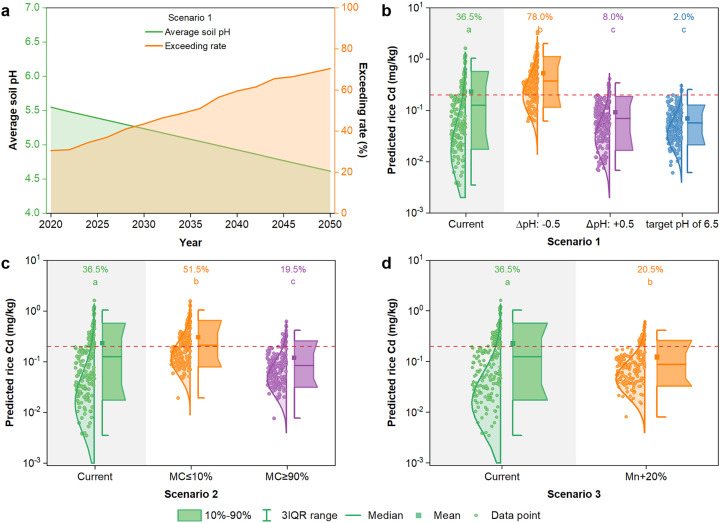
Rice is a major dietary source of the toxic metal cadmium (Cd). Concentration of Cd in rice grain varies widely at the regional scale, and it is challenging to predict grain Cd concentration using soil properties. The lack of reliable predictive models hampers management of contaminated soils. Here, we conducted a three-year survey of 601 pairs of soil and rice samples at a regional scale. Approximately 78.3% of the soil samples exceeded the soil screening values for Cd in China, and 53.9% of rice grain samples exceeded the Chinese maximum permissible limit for Cd. Predictive models were developed using multiple linear regression and machine learning methods. The correlations between rice grain Cd and soil total Cd concentrations were poor ( < 0.17). Both linear regression and machine learning methods identified four key factors that significantly affect grain Cd concentrations, including Fe-Mn oxide bound Cd, soil pH, field soil moisture content, and the concentration of soil reducible Mn. The machine learning-based support vector machine model showed the best performance ( = 0.87) in predicting grain Cd concentrations at a regional scale, followed by machine learning-based random forest model ( = 0.67), and back propagation neural network model ( = 0.64). Scenario simulations revealed that liming soil to a target pH of 6.5 could be one of the most cost-effective approaches to reduce the exceedance of Cd in rice grain. Taken together, these results show that machine learning methods can be used to predict Cd concentration in rice grain reliably at a regional scale and to support soil management and safe rice production.
大米是有毒金属镉(Cd)的主要膳食来源。水稻籽粒中镉的含量在区域尺度上差异很大,利用土壤性质预测籽粒镉含量具有挑战性。缺乏可靠的预测模型阻碍了对污染土壤的管理。在此,我们在区域尺度上对601对土壤和水稻样本进行了为期三年的调查。约78.3%的土壤样本超过了中国土壤镉筛选值,53.9%的水稻籽粒样本超过了中国镉最大允许限量。使用多元线性回归和机器学习方法建立了预测模型。水稻籽粒镉与土壤总镉浓度之间的相关性较差(<0.17)。线性回归和机器学习方法都确定了四个显著影响籽粒镉浓度的关键因素,包括铁锰氧化物结合态镉、土壤pH值、田间土壤湿度和土壤可还原锰的浓度。基于机器学习的支持向量机模型在区域尺度上预测籽粒镉浓度方面表现最佳(=0.87),其次是基于机器学习的随机森林模型(=0.67)和反向传播神经网络模型(=0.64)。情景模拟表明,将土壤pH值调节至目标值6.5可能是降低水稻籽粒镉超标最具成本效益的方法之一。综上所述,这些结果表明,机器学习方法可用于在区域尺度上可靠地预测水稻籽粒中的镉浓度,并支持土壤管理和安全水稻生产。