Infection and Immunity in Pediatric Patients Research Group, Vall d'Hebron Institut de Recerca (VHIR), Barcelona, Catalonia, Spain.
Pediatric Infectious Diseases and Immunodeficiencies Unit, Hospital Infantil I de La Dona Vall d'Hebron, Vall d'Hebron Barcelona Hospital Campus, Barcelona, Catalonia, Spain.
J Clin Immunol. 2024 Oct 21;45(1):26. doi: 10.1007/s10875-024-01825-3.
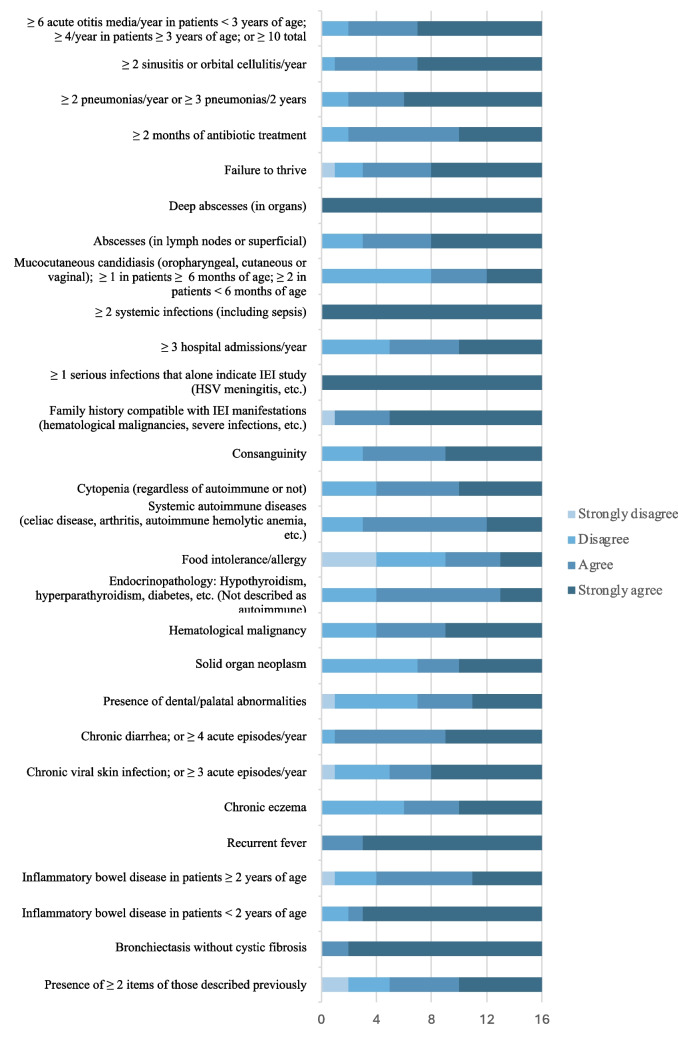
Early diagnosis of inborn errors of immunity (IEIs) has been shown to reduce mortality, morbidity, and healthcare costs. The need for early diagnosis has led to the development of computational tools that trigger earlier clinical suspicion by physicians. Primary care professionals serve as the first line for improving early diagnosis. To this end, a computer-based tool (based on extended Jeffrey Modell Foundation (JMF) Warning Signs) was developed to assist physicians with diagnosis decisions for IEIs in the primary care setting. Two expert-guided scoring systems (one pediatric, one adult) were developed. IEI warning signs were identified and a panel of 36 experts reached a consensus on which signs to include and how they should be weighted. The resulting scoring system was tested against a retrospective registry of patients with confirmed IEI using primary care EHRs. A pilot study to assess the feasibility of implementation in primary care was conducted. The scoring system includes 27 warning signs for pediatric patients and 24 for adults, adding additional clinically relevant criteria established by expert consensus to the JMF Warning Signs. Cytopenias, ≥ 2 systemic infections, recurrent fever and bronchiectasis were the leading warning signs in children, as bronchiectasis, autoimmune diseases, cytopenias, and > 3 pneumonias were in adults. The PIDCAP (Primary Immune Deficiency "Centre d'Atenció Primària" that stands for Primary Care Center in Catalan) tool was implemented in the primary care workstation in a pilot area. The expert-based approach has the potential to lessen under-reporting and minimize diagnostic delays of IEIs. It can be seamlessly integrated into clinical primary care workstations.
早期诊断先天性免疫缺陷(IEI)已被证明可降低死亡率、发病率和医疗保健成本。早期诊断的需求促使开发了计算工具,通过这些工具可以更早地引起医生的临床怀疑。初级保健专业人员是提高早期诊断的第一线。为此,开发了一种基于计算机的工具(基于扩展的 Jeffrey Modell 基金会(JMF)警告标志),以帮助初级保健环境中的医生做出 IEI 的诊断决策。开发了两个专家指导评分系统(一个儿科,一个成人)。确定了 IEI 警告标志,并由 36 名专家组成的小组就纳入哪些标志以及如何加权达成共识。所得评分系统针对使用初级保健 EHR 的经确认的 IEI 患者的回顾性登记进行了测试。进行了一项评估在初级保健中实施可行性的试点研究。评分系统包括 27 个儿科患者的警告标志和 24 个成人的警告标志,除了 JMF 警告标志外,还增加了专家共识确定的其他与临床相关的标准。儿童中主要的警告标志是血细胞减少症、≥2 种全身感染、反复发热和支气管扩张症,而成人则是支气管扩张症、自身免疫性疾病、血细胞减少症和>3 次肺炎。PIDCAP(加泰罗尼亚语中代表初级保健中心的 Primary Immune Deficiency "Centre d'Atenció Primària")工具已在试点地区的初级保健工作站中实施。基于专家的方法有可能减少漏报并最大程度地减少 IEI 的诊断延迟。它可以无缝集成到临床初级保健工作站中。