de Lange Melanie A, Richmond Rebecca C, Birnie Kate, Shapland Chin Yang, Tilling Kate, Davies Neil M
MRC Integrative Epidemiology Unit, University of Bristol, Bristol, UK.
Population Health Sciences, Bristol Medical School, University of Bristol, Bristol, UK.
J Sleep Res. 2025 Jun;34(3):e14335. doi: 10.1111/jsr.14335. Epub 2024 Oct 21.
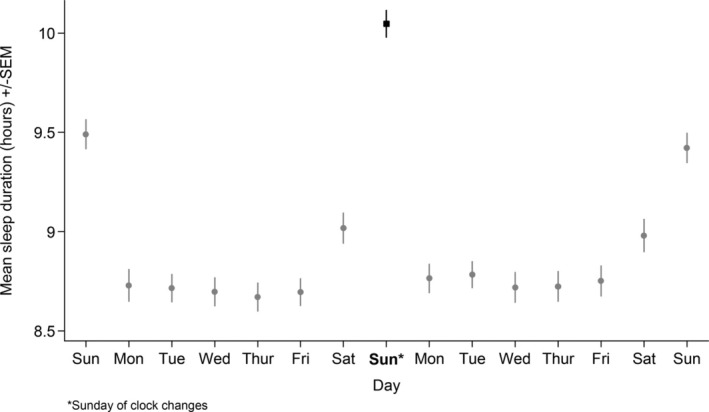
We explored the effects of daylight saving time clock changes on sleep duration in a large accelerometer dataset. Our sample included UK Biobank participants (n = 11,780; aged 43-78 years) with accelerometer data for one or more days during the 2 weeks surrounding the Spring and Autumn daylight saving time transitions from October 2013 and November 2015. Between-individual t-tests compared sleep duration on the Sunday (midnight to midnight) of the clock changes with the Sunday before and the Sunday after. We also compared sleep duration on all other days (Monday-Saturday) before and after the clock changes. In Spring, mean sleep duration was 65 min lower on the Sunday of the clock changes than the Sunday before (95% confidence interval -72 to -58 min), and 61 min lower than the Sunday after (95% confidence interval -69 to -53). In Autumn, the mean sleep duration on the Sunday of the clock changes was 33 min higher than the Sunday before (95% confidence interval 27-39 min), and 38 min higher than the Sunday after (95% confidence interval 32-43 min). There was some evidence of catch-up sleep after both transitions, with sleep duration a little higher on the Monday-Friday than before, although this was less pronounced in Autumn. Future research should use large datasets with longer periods of accelerometer wear to capture sleep duration before and after the transition in the same individuals, and examine other aspects of sleep such as circadian misalignment, sleep fragmentation or daytime napping.
我们在一个大型加速度计数据集中探究了夏令时时间变化对睡眠时间的影响。我们的样本包括英国生物银行的参与者(n = 11780;年龄在43 - 78岁之间),他们在2013年10月至2015年11月春秋季夏令时转换前后的2周内有一天或多天的加速度计数据。个体间t检验比较了时钟变化当天周日(午夜至午夜)的睡眠时间与前一个周日和后一个周日的睡眠时间。我们还比较了时钟变化前后所有其他日子(周一至周六)的睡眠时间。在春季,时钟变化当天周日的平均睡眠时间比前一个周日低65分钟(95%置信区间为 -72至 -58分钟),比后一个周日低61分钟(95%置信区间为 -69至 -53分钟)。在秋季,时钟变化当天周日的平均睡眠时间比前一个周日高33分钟(95%置信区间为27 - 39分钟),比后一个周日高38分钟(95%置信区间为32 - 43分钟)。有证据表明在两次转换后都存在补觉现象,周一至周五的睡眠时间比之前略高,尽管在秋季这种情况不太明显。未来的研究应使用加速度计佩戴时间更长的大型数据集,以获取同一人群在转换前后的睡眠时间,并研究睡眠的其他方面,如昼夜节律失调、睡眠碎片化或白天小睡。