Department of Biomedical Engineering, University of California, Irvine, CA 92697.
Center for Advanced Design & Manufacturing of Integrated Microfluidics, University of California, Irvine, CA 92697.
Proc Natl Acad Sci U S A. 2024 Oct 29;121(44):e2408567121. doi: 10.1073/pnas.2408567121. Epub 2024 Oct 22.
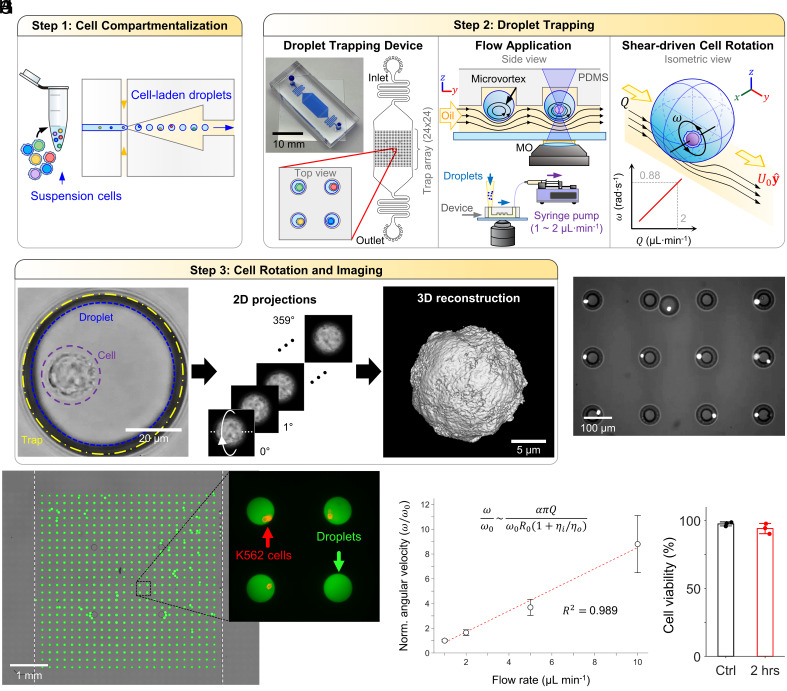
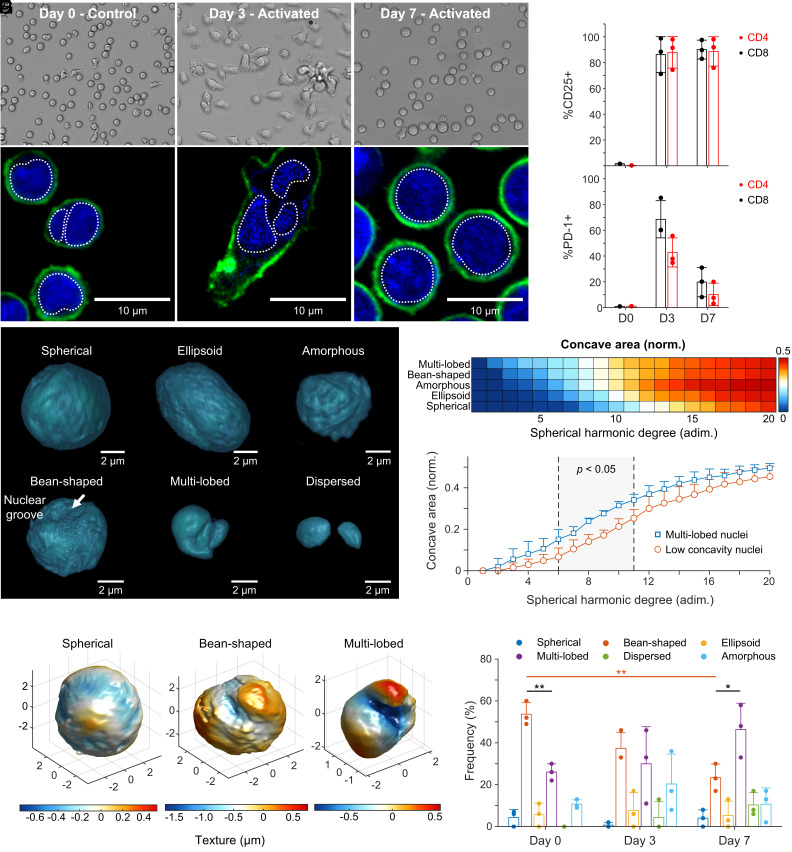
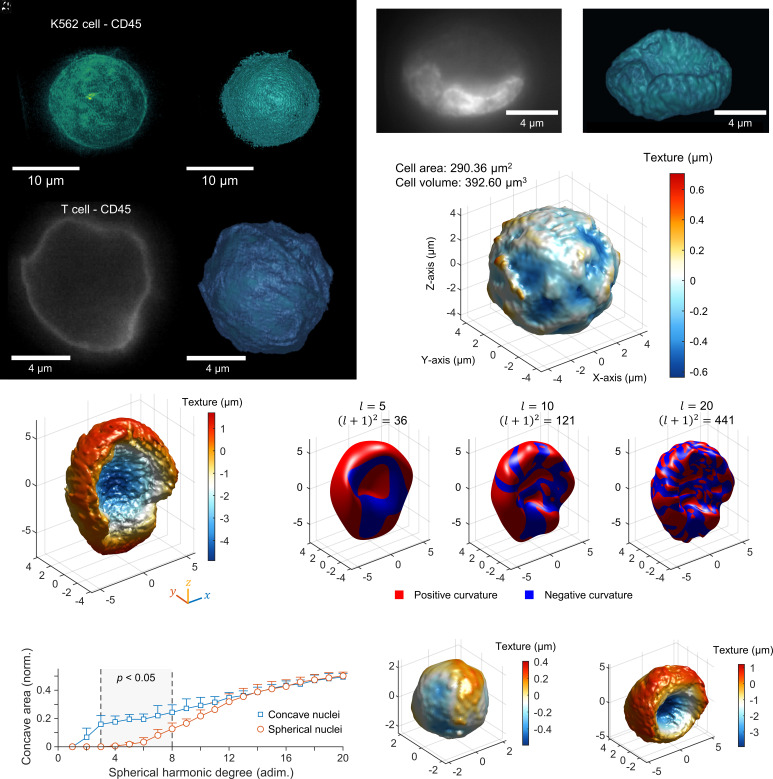
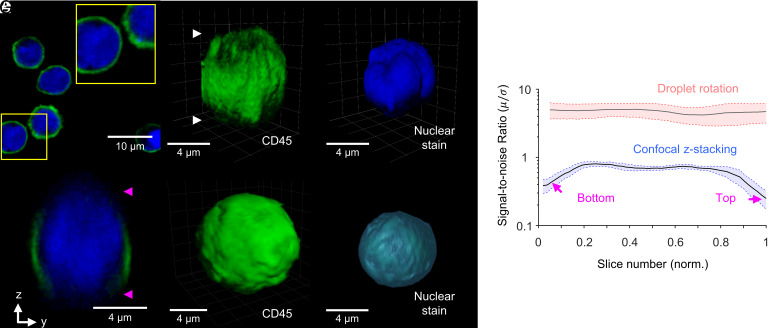
Fast, nondestructive three-dimensional (3D) imaging of live suspension cells remains challenging without substrate treatment or fixation, precluding scalable single-cell morphometry with minimal alterations. While optical sectioning techniques achieve 3D live cell imaging, lateral versus depth resolution differences further complicate analysis. We present a scalable microfluidic method capable of 3D fluorescent isotropic imaging of live, nonadherent cells suspended inside picoliter droplets with high-speed single-cell volumetric readout (800 to 1,200 slices in 5 to 8 s) and near-diffraction limit resolution (216 nm). The platform features a droplet trap array that leverages flow-induced droplet interfacial shear to generate intradroplet microvortices, which rotate single cells on their axis to enable optical projection tomography (OPT)-based imaging. This allows gentle (1 mPa shear stress) observation of cells encapsulated inside nontoxic isotonic buffer droplets, facilitating scalable OPT acquisition by simultaneous spinning of hundreds of cells. We demonstrate 3D imaging of live myeloid and lymphoid cells in suspension, including K562 cells, as well as naive and activated T cells-small cells prone to movement in their suspended phenotype. Our fully suspended, orientation-independent cell morphometry, driven by isotropic imaging and spherical harmonic analysis, enabled the study of primary T cells across various immunological activation states. This approach unveiled six distinct nuclear content distributions, contrasting with conventional 2D images that typically portray spheroid and bean-like nuclear shapes associated with lymphocytes. Our arrayed-droplet OPT technology is capable of isotropic, single live-cell 3D imaging, with the potential to perform large-scale morphometry of immune cell effector function states while providing compatibility with microfluidic droplet operations.
快速、无损的三维(3D)悬浮细胞成像仍然具有挑战性,如果不进行基底处理或固定,就无法进行可扩展的单细胞形态测量,而且变化最小。虽然光学切片技术可以实现 3D 活细胞成像,但横向与深度分辨率的差异进一步使分析复杂化。我们提出了一种可扩展的微流控方法,能够对悬浮在皮升级液滴内的非贴壁活细胞进行 3D 荧光各向同性成像,具有高速单细胞体积读取功能(5 到 8 秒内可读取 800 到 1200 个切片),且具有接近衍射极限的分辨率(216nm)。该平台具有液滴捕获阵列,利用流致液滴界面剪切力产生液滴内微涡旋,使单个细胞绕其轴旋转,从而实现基于光学投影层析术(OPT)的成像。这允许在无毒等渗缓冲液液滴中温和地观察(1mPa 剪切应力)包裹的细胞,通过同时旋转数百个细胞来促进可扩展的 OPT 采集。我们演示了悬浮液中活的髓样和淋巴样细胞的 3D 成像,包括 K562 细胞,以及原始和激活的 T 细胞-小细胞在悬浮表型中容易移动。我们的完全悬浮、无方向依赖性的细胞形态测量,由各向同性成像和球谐分析驱动,使我们能够研究各种免疫激活状态下的原代 T 细胞。这种方法揭示了六个不同的核内容分布,与通常描绘与淋巴细胞相关的球形和豆形核形状的传统 2D 图像形成对比。我们的阵列液滴 OPT 技术能够进行各向同性、单个活细胞 3D 成像,具有对免疫细胞效应功能状态进行大规模形态测量的潜力,同时与微流控液滴操作兼容。