Brand Michael C, Trowell Hamish G, Pegg James T, Greenfield Jake L, Odaybat Magdalena, Little Marc A, Haycock Peter R, Avci Gokay, Rankin Nicola, Fuchter Matthew J, Jelfs Kim E, Cooper Andrew I, Greenaway Rebecca L
Department of Chemistry and Materials Innovation Factory, University of Liverpool, 51 Oxford Street, Liverpool L7 3NY, U.K.
Department of Chemistry, Molecular Sciences Research Hub, Imperial College London, 82 Wood Lane, London W12 0BZ, U.K.
J Am Chem Soc. 2024 Nov 6;146(44):30332-30339. doi: 10.1021/jacs.4c10217. Epub 2024 Oct 22.
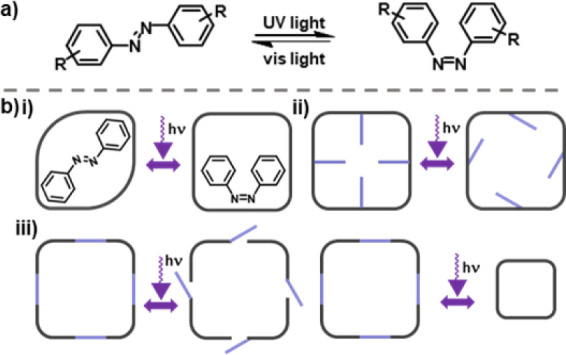
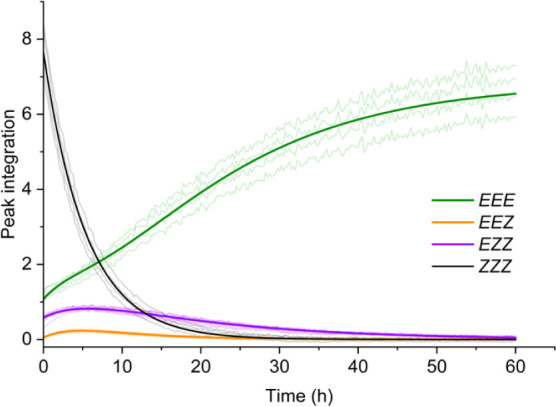
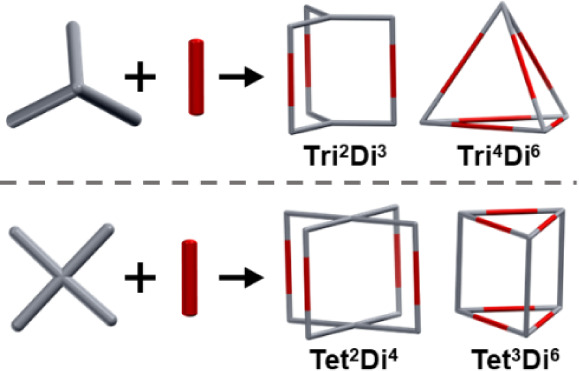
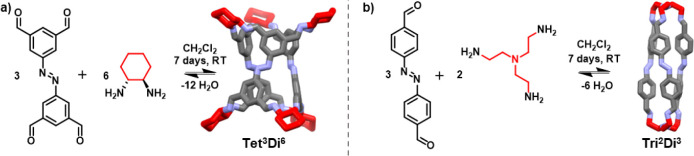
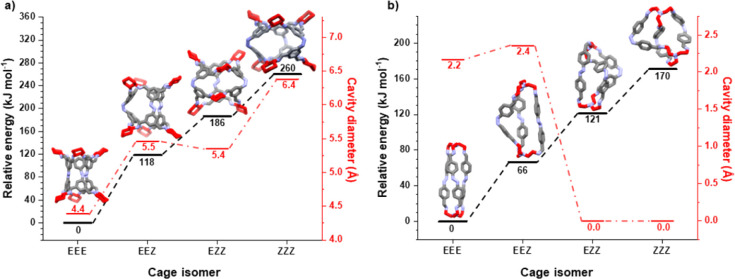
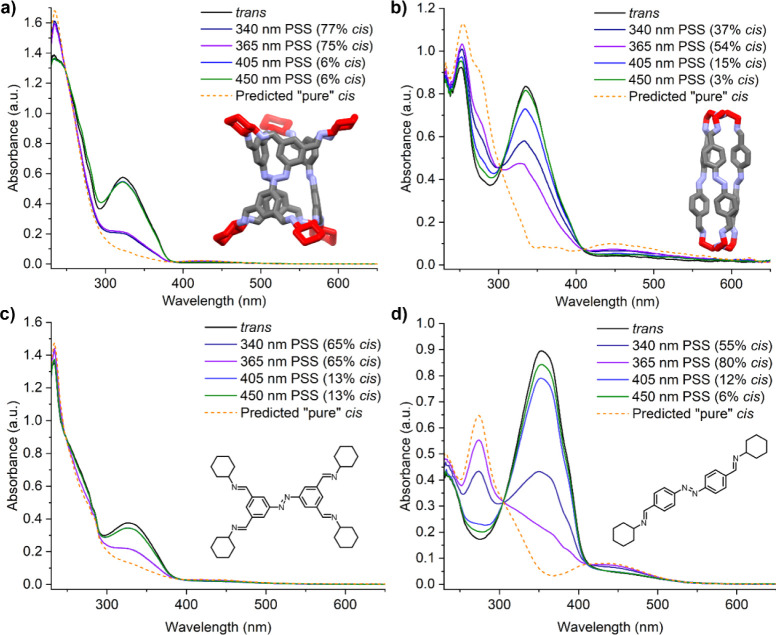
The incorporation of photoresponsive groups into porous materials is attractive as it offers potential advantages in controlling the pore size and selectivity to guest molecules. A combination of computational modeling and experiment resulted in the synthesis of two azobenzene-derived organic cages based on building blocks identified in a computational screen. Both cages incorporate three azobenzene moieties, and are therefore capable of 3-fold isomerization, using either ditopic or tetratopic aldehydes containing diazene functionality. The ditopic aldehyde forms a cage via a 6-fold imine condensation and the tritopic aldehyde forms a cage via a 12-fold imine condensation. The relative energies and corresponding intrinsic cavities of each isomeric state were computed, and the photoswitching behavior of both cages was studied by UV-Vis and H NMR spectroscopy, including a detailed kinetic analysis of the thermal isomerization for each of the , and metastable isomers of the cage. Both cages underwent photoisomerization, where a photostationary state of up to 77% of the -isomer and overall thermal half-life of 110 h was identified for the species. Overall, this work demonstrates the potential of computational modeling to inform the design of photoresponsive materials and highlights the contrasting effects on the photoswitching properties of the azobenzene moieties on incorporation into the different cage species.
将光响应基团引入多孔材料很有吸引力,因为它在控制孔径和对客体分子的选择性方面具有潜在优势。通过计算建模和实验相结合,基于计算筛选中确定的构建块合成了两种偶氮苯衍生的有机笼。两种笼都包含三个偶氮苯部分,因此能够使用含有二氮烯官能团的双位或四位醛进行三重异构化。双位醛通过六重亚胺缩合形成笼,三位醛通过十二重亚胺缩合形成笼。计算了每种异构状态的相对能量和相应的固有腔,并通过紫外可见光谱和核磁共振氢谱研究了两种笼的光开关行为,包括对笼的反式、顺式和亚稳顺式异构体的热异构化进行详细的动力学分析。两种笼都发生了光异构化,其中物种的光稳态下反式异构体含量高达77%,总热半衰期为110小时。总的来说,这项工作展示了计算建模在指导光响应材料设计方面的潜力,并突出了偶氮苯部分并入不同笼物种时对光开关特性的对比影响。