Department of Orthopaedics and Sports Medicine, Erasmus Medical Centre, Dr Molenwaterplein 40, 3015 GD, Rotterdam, The Netherlands.
Alps Surgery Institute, Clinique Générale Annecy, 4 Chemin de La Tour La Reine, 74000, Annecy, France.
J Orthop Traumatol. 2024 Oct 22;25(1):49. doi: 10.1186/s10195-024-00790-2.
To assess the results after elbow arthroplasty it is essential to gather patient-reported outcome measures (PROMs). However, the acquisition of PROMs poses a challenge because of potential low literacy, lengthiness and diversity of questionnaires, and questionnaire fatigue. Instead of a questionnaire, patient-reported outcomes can be collected using a single assessment numeric evaluation (SANE), the subjective elbow value (SEV). The aim of this pilot study is to assess the correlation between the SEV and conventionally used patient reported outcome measures (PROMs) after elbow arthroplasty.
The SEV was added to our follow-up system in 2021, consisting of a scale from 0 to 10 in which the patients are asked to rate the overall functionality of their elbow, 0 corresponds to very poor functionality and 10 to a perfectly functional or healthy elbow. All patients who underwent elbow arthroplasty (total or radial head) and responded to the SEV question were retrospectively identified and included. The correlation between the SEV at the final follow-up and the Oxford Elbow Score (OES), and between the SEV and the Quick Disbailities of the Arm, Shoulder, and Hand (quickDASH) score was assessed using Pearson's r.
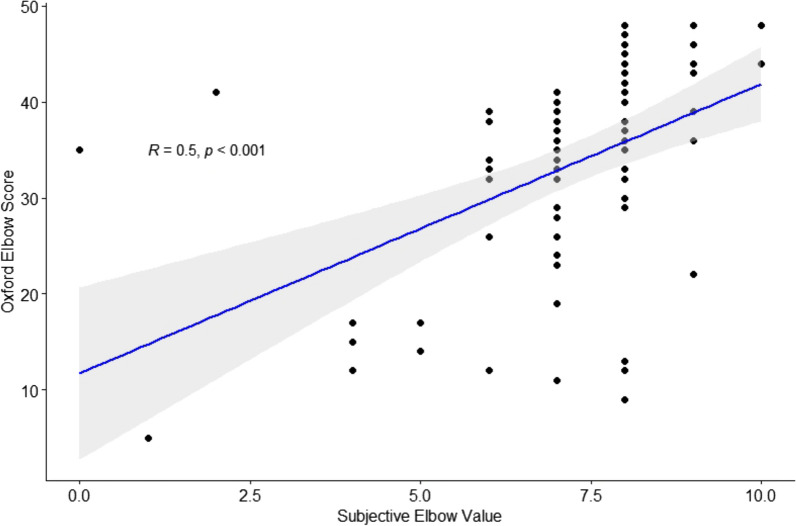
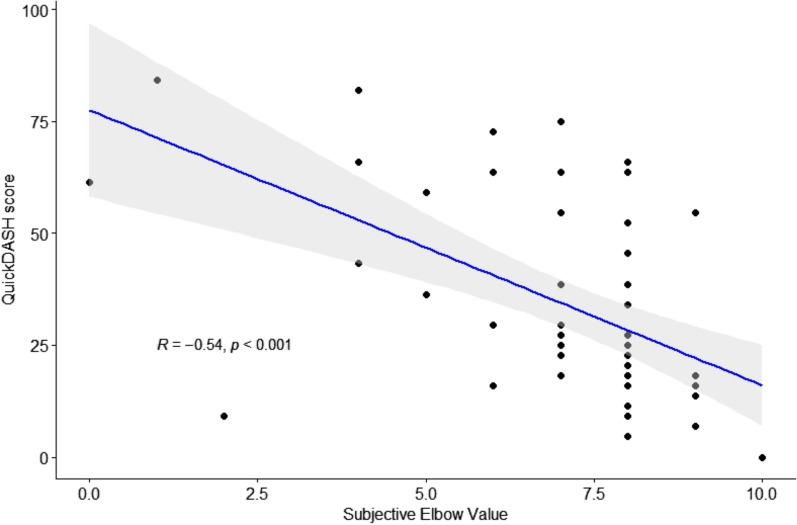
In total, 82 patients responded to the SEV question and were included in the study, with a median follow-up of 5 years [interquartile range (IQR) 3-7]. Of these patients, 17 (21%) underwent radial head arthroplasty and 65 (79%) total elbow arthroplasty. The Pearson's r for the correlation between SEV and OES was 0.502 (p < 0.001) and between the SEV and the QuickDASH -0.537 (p < 0.001), which correspond to a moderate correlation.
The SEV shows a moderate correlation with conventional PROMs, demonstrating its potential in simplifying the follow-up of elbow arthroplasty, possibly decreasing time, costs, and patients' questionnaire fatigue compared with conventional PROM questionnaires.
III.
评估肘部关节置换术后的结果,必须收集患者报告的结果测量(PROMs)。然而,由于潜在的低文化程度、问卷冗长和多样性以及问卷疲劳,获取 PROMs 具有挑战性。作为问卷的替代方法,可以使用单一评估数值评估(SANE),即主观肘部值(SEV)来收集患者报告的结果。本初步研究的目的是评估 SEV 与肘部关节置换术后常规使用的患者报告结果测量(PROMs)之间的相关性。
SEV 于 2021 年加入我们的随访系统,由 0 到 10 的量表组成,患者被要求对肘部的整体功能进行评分,0 表示功能非常差,10 表示功能完全正常或健康的肘部。所有接受肘部关节置换术(全关节或桡骨头)并回答 SEV 问题的患者均被回顾性识别并纳入研究。使用 Pearson r 评估最终随访时 SEV 与牛津肘部评分(OES)之间以及 SEV 与快速残疾上肢、肩部和手(quickDASH)评分之间的相关性。
共有 82 名患者回答了 SEV 问题并纳入研究,中位随访时间为 5 年[四分位距(IQR)3-7]。这些患者中,17 例(21%)接受桡骨头置换术,65 例(79%)接受全肘置换术。SEV 与 OES 之间的 Pearson r 为 0.502(p<0.001),SEV 与 quickDASH 之间的 Pearson r 为-0.537(p<0.001),这对应于中度相关性。
SEV 与常规 PROMs 呈中度相关性,表明其在简化肘部关节置换术的随访方面具有潜力,与常规 PROM 问卷相比,可能减少时间、成本和患者的问卷疲劳。
III 级。