Department of Anesthesiology, Pain and Perioperative Medicine, The First Affiliated Hospital of Zhengzhou University, Zhengzhou, People's Republic of China.
Department of Respiration, The First Affiliated Hospital of Zhengzhou University, Zhengzhou, People's Republic of China.
Drug Des Devel Ther. 2024 Oct 18;18:4615-4627. doi: 10.2147/DDDT.S483029. eCollection 2024.
This study aimed to compare the efficacy of remimazolam and propofol regarding postoperative anesthesia satisfaction in patients undergoing outpatient gynecological surgery.
This was a single-center, open-label, non-inferiority, randomized clinical trial. Patients aged ≥ 18 years who underwent outpatient gynecological surgery with sedation were enrolled. Participants were randomly assigned to be sedated with remimazolam or propofol. The primary endpoint was the immediate postoperative anesthesia satisfaction score, evaluated through the Iowa Satisfaction with Anesthesia Scale (ISAS).
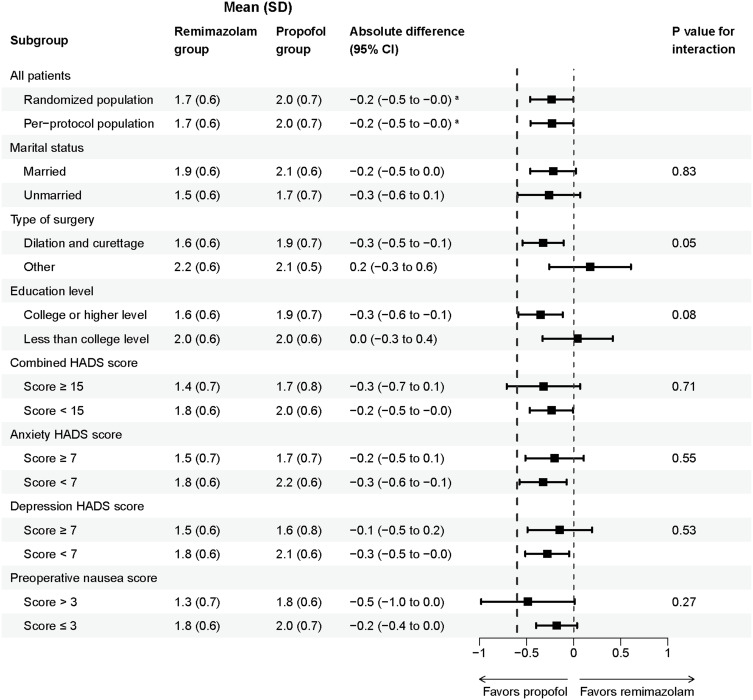
168 patients were randomly allocated to either the remimazolam group (n = 84) or the propofol group (n = 84). The mean (standard deviation) ISAS scores immediately after surgery were 1.7 (0.6) for the remimazolam group and 2.0 (0.7) for the propofol group (difference, -0.2; 97.5% confidence interval [CI]: -0.5 to -0.0; = 0.02), indicating non-inferiority. The length of post-anesthesia care unit (PACU) stay was longer in the remimazolam group than in the propofol group (27.6 [9.1] min vs 22.4 [7.0] min; difference, 5.2 [95% CI: 2.7 to 7.6] min; < 0.001). High-intensity injection pain was less frequently observed in the remimazolam group than in the propofol group (3.6% vs 45.2%; difference, -41.7% [95% CI: -54.2% to -29.1%]; < 0.001). The nausea score was higher in the remimazolam group immediately after surgery than in the propofol group. Pain, nausea, sleep quality, anxiety, and depression scores were higher in the remimazolam group than in the propofol group on postoperative day 1. The incidence of adverse events and other secondary endpoints was comparable between the two groups.
Remimazolam was non-inferior to propofol regarding postoperative anesthesia satisfaction in patients undergoing outpatient gynecological surgery. Therefore, it should be considered as a new sedation alternative in such procedures.
本研究旨在比较雷米唑仑和丙泊酚在接受门诊妇科手术患者中的术后麻醉满意度。
这是一项单中心、开放标签、非劣效性、随机临床试验。纳入年龄≥18 岁、接受镇静门诊妇科手术的患者。参与者被随机分配接受雷米唑仑或丙泊酚镇静。主要终点是通过爱荷华州麻醉满意度量表(ISAS)评估的即刻术后麻醉满意度评分。
168 例患者被随机分配至雷米唑仑组(n=84)或丙泊酚组(n=84)。术后即刻 ISAS 评分分别为雷米唑仑组 1.7(0.6)和丙泊酚组 2.0(0.7)(差值,-0.2;97.5%置信区间[CI]:-0.5 至-0.0; = 0.02),表明非劣效性。麻醉后监护室(PACU)停留时间在雷米唑仑组长于丙泊酚组(27.6[9.1]分钟比 22.4[7.0]分钟;差值 5.2[95%CI:2.7 至 7.6]分钟; < 0.001)。雷米唑仑组的高强度注射疼痛较丙泊酚组少见(3.6%比 45.2%;差值-41.7%[95%CI:-54.2%至-29.1%]; < 0.001)。术后即刻雷米唑仑组恶心评分高于丙泊酚组。术后第 1 天,雷米唑仑组疼痛、恶心、睡眠质量、焦虑和抑郁评分均高于丙泊酚组。两组不良事件发生率及其他次要终点无差异。
雷米唑仑在门诊妇科手术患者中的术后麻醉满意度不劣于丙泊酚。因此,它应被视为此类手术中一种新的镇静选择。