Garcia Mason J, Caro Daniela, Hammerle Maria Velasquez, Villarreal Juan B, DeAngelis Joseph P, Ramappa Arun J, Nazarian Ara
Musculoskeletal Translational Innovation Initiative, Carl J. Shapiro Department of Orthopaedic Surgery, Beth Israel Deaconess Medical Center, Harvard Medical School, Boston, Massachusetts.
Department of Mechanical Engineering, Boston University, Boston, Massachusetts.
JB JS Open Access. 2024 Oct 22;9(4). doi: 10.2106/JBJS.OA.24.00097. eCollection 2024 Oct-Dec.
While rotator cuff tears are prevalent in the general population, the natural history of this disease is unclear. Understanding rotator cuff tear progression is crucial for refining surgical indications and evaluating the necessity of early interventions. This study presents an in-depth analysis of the existing literature on the definitions and progression rates of rotator cuff tears, aiming to enhance clinical decision making and patient outcomes.
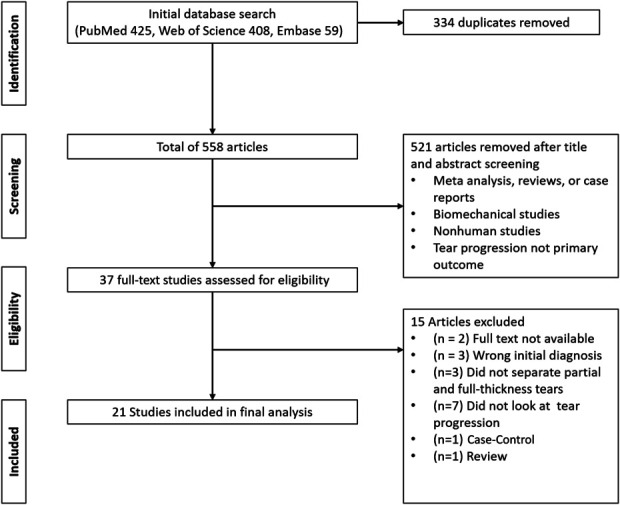
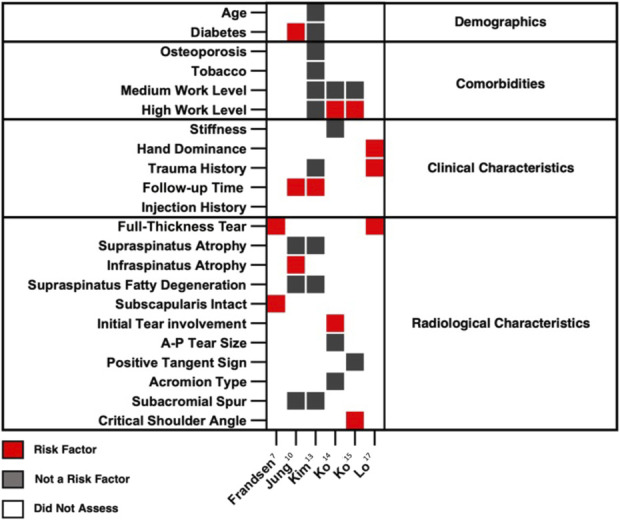
A systematic literature search was conducted based on Preferred Reporting Items for Systematic Reviews and Meta-Analyses guidelines, using Medline (PubMed), Embase (Elsevier), and Web of Science databases on January 12, 2023. Articles were identified as relevant to the natural history and progression of asymptomatic and symptomatic partial-thickness (PT) and full-thickness (FT) rotator cuff tears. Those written in English reporting rotator cuff progression rates of tears in adults, based on magnetic resonance imaging (MRI) or ultrasound, were included. After reviewing the articles, the data on the rates of tear progression and associated risk factors were extracted, compiled, and analyzed. The risk of bias was determined using the Newcastle-Ottawa Scale.
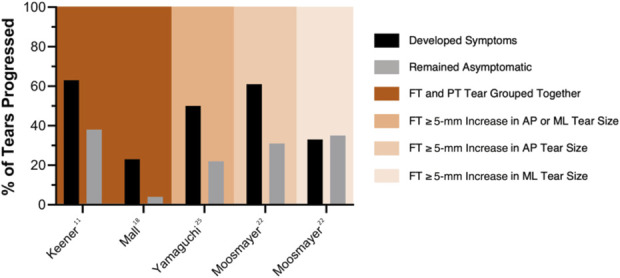
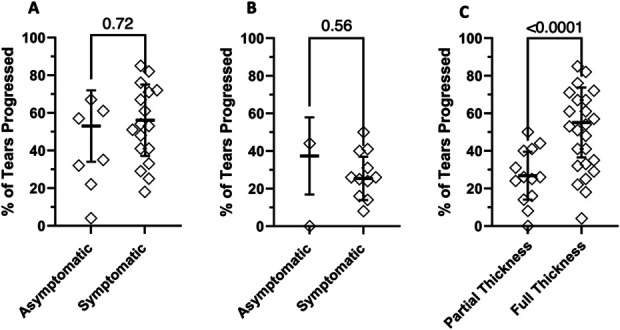
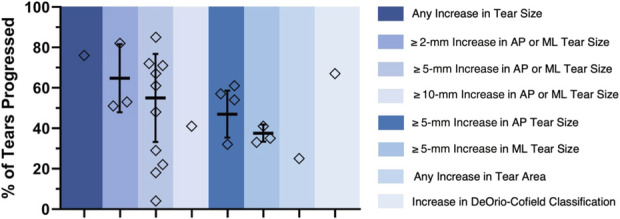
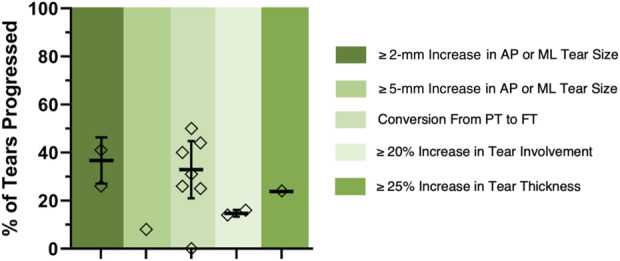
Twenty-one articles met the inclusion criteria, with 1,831 tears included. The progression rate for all partial thickness tears was 26.7% ± 12.8% at an average follow-up of 2.2 ± 0.9 years, with 5 definitions for tear progression. For FT tears, the progression rate was 54.9% ± 18.6% at a follow-up time of 3.0 ± 2.0 years, with 8 definitions for tear enlargement. A significant difference (p < 0.0001) was found between the progression rates of PT and FT tears. Patients who were initially asymptomatic and became symptomatic had higher progression rates (33%-63%) than those who remained asymptomatic (4%-38%).
Further research would benefit by identifying a clinically relevant and standardized definition of rotator cuff tear progression, to describe the natural history of rotator cuff disease, making results more comparable and optimizing treatment planning.
Level II. See Instructions for Authors for a complete description of levels of evidence.
虽然肩袖撕裂在普通人群中很常见,但这种疾病的自然病程尚不清楚。了解肩袖撕裂的进展对于完善手术指征和评估早期干预的必要性至关重要。本研究对现有关于肩袖撕裂的定义和进展率的文献进行了深入分析,旨在改善临床决策和患者预后。
根据系统评价和Meta分析的首选报告项目指南,于2023年1月12日在Medline(PubMed)、Embase(爱思唯尔)和科学网数据库中进行了系统的文献检索。确定与无症状和有症状的部分厚度(PT)和全层厚度(FT)肩袖撕裂的自然病程和进展相关的文章。纳入以英文撰写的、基于磁共振成像(MRI)或超声报告成人肩袖撕裂进展率的文章。在审阅文章后,提取、整理和分析有关撕裂进展率和相关危险因素的数据。使用纽卡斯尔-渥太华量表确定偏倚风险。
21篇文章符合纳入标准,共纳入1831例撕裂。在平均2.2±0.9年的随访中,所有部分厚度撕裂的进展率为26.7%±12.8%,撕裂进展有5种定义。对于全层厚度撕裂,在3.0±2.0年的随访时间里,进展率为54.9%±18.6%,撕裂扩大有8种定义。部分厚度和全层厚度撕裂的进展率之间存在显著差异(p<0.0001)。最初无症状而后出现症状的患者的进展率(33%-63%)高于那些一直无症状的患者(4%-38%)。
通过确定一个临床相关且标准化的肩袖撕裂进展定义,以描述肩袖疾病的自然病程,使结果更具可比性并优化治疗计划,将有助于进一步的研究。
二级。有关证据水平的完整描述,请参阅作者指南。