
冠状病毒刺突蛋白三聚体中七肽重复基序的包装和组装的生化分析。
Biochemical analysis of packing and assembling heptad repeat motifs in the coronavirus spike protein trimer.
机构信息
Research Center for Influenza and Respiratory Viruses, National Institute of Infectious Diseases, Tokyo, Japan.
Department of Quality Assurance, Radiation Safety, and Information Management, National Institute of Infectious Diseases, Tokyo, Japan.
出版信息
mBio. 2024 Nov 13;15(11):e0120324. doi: 10.1128/mbio.01203-24. Epub 2024 Oct 23.
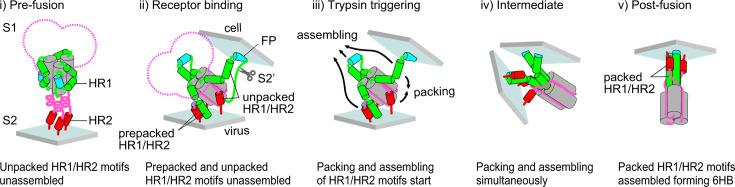
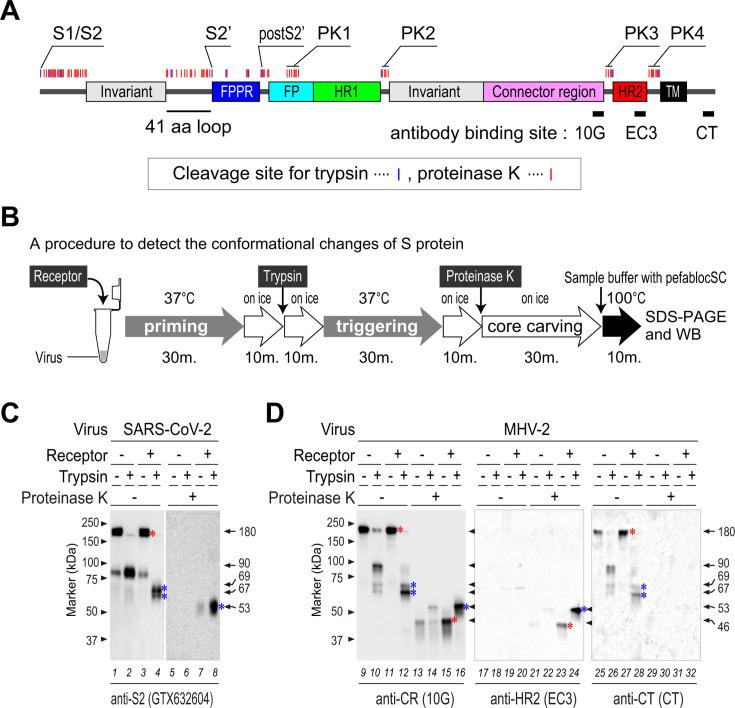
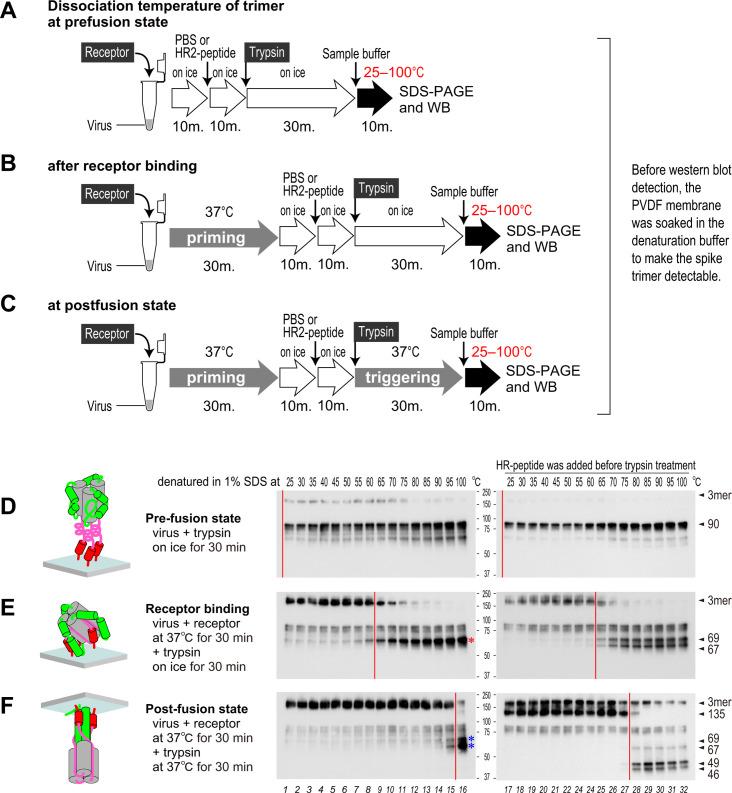
During a coronavirus infection, the spike protein undergoes sequential structural transitions triggered by its receptor and the host protease at the interface between the virus and cell membranes, thereby mediating membrane fusion. After receptor binding, the heptad repeat motif (HR1/HR2) within the viral spike protein bridges the viral and cellular membranes; however, the intermediate conformation adopted by the spike protein when drawing the viral and cellular membranes into close proximity remains unclear due to its transient and unstable nature. Here, we experimentally induced conformational changes in the spike protein of a murine coronavirus by incubating the virus with its receptor, followed by exposure to trypsin. We then treated the virus/receptor complex with proteinase K to probe the tightly packed core structure of the spike protein. The conformations of the spike protein were predicted from the sizes of the protease digestion products detected by western blot analysis. Upon receptor binding, two bands (each showing different reactivity with a fusion-inhibiting HR2-peptide) were detected; we propose that these bands correspond to the packed and unpacked HR1/HR2 motifs. After trypsin-mediated triggering, measurement of temperature and time dependency revealed that packing of the remaining unpacked HR1/HR2 motifs and assembly of three HR1 motifs in a trimer occur almost simultaneously. Thus, the trimeric spike protein adopts an asymmetric-unassembled conformation after receptor binding, followed by direct assembly into the post-fusion form triggered by the host protease. This biochemical study provides mechanistic insight into the previously unknown intermediate structure of the viral fusion protein.IMPORTANCEDuring infection by an enveloped virus, receptor binding triggers fusion between the cellular membrane and the virus envelope, enabling delivery of the viral genome to the cytoplasm. The viral spike protein mediates membrane fusion; however the molecular mechanism underlying this process is unclear. This is because using structural biology methods to track the transient conformational changes induced in the unstable spike trimer is challenging. Here, we harnessed the ability of protease enzymes to recognize subtle differences on protein surfaces, allowing us to detect structural differences in the spike protein before and after conformational changes. Differences in the size of the degradation products were analyzed by western blot analysis. The proposed model explaining the conformational changes presented herein is a plausible candidate that provides valuable insight into unanswered questions in the field of virology.
在冠状病毒感染过程中,刺突蛋白在病毒与细胞膜之间的受体和宿主蛋白酶的触发下经历连续的结构转变,从而介导膜融合。在受体结合后,病毒刺突蛋白中的七肽重复基序(HR1/HR2)在病毒和细胞膜之间架桥;然而,由于其短暂和不稳定的性质,当将病毒和细胞膜拉近时,刺突蛋白所采用的中间构象仍然不清楚。在这里,我们通过孵育病毒与其受体,然后用胰蛋白酶处理,实验诱导鼠冠状病毒刺突蛋白的构象变化。然后,我们用蛋白酶 K处理病毒/受体复合物,以探测刺突蛋白紧密包装的核心结构。通过 Western blot 分析检测到的蛋白酶消化产物的大小来预测刺突蛋白的构象。在受体结合后,检测到两条带(每条带与融合抑制 HR2-肽的反应性不同);我们提出这两条带对应于包装和未包装的 HR1/HR2 基序。在胰蛋白酶介导的触发后,测量温度和时间依赖性揭示了剩余未包装的 HR1/HR2 基序的包装和三个 HR1 基序在三聚体中的组装几乎同时发生。因此,在受体结合后,三聚体刺突蛋白采用不对称未组装的构象,然后直接组装成宿主蛋白酶触发的融合后形式。这项生化研究为病毒融合蛋白以前未知的中间结构提供了机制见解。
重要性
在包膜病毒感染过程中,受体结合触发细胞膜与病毒包膜之间的融合,使病毒基因组能够递送到细胞质中。病毒刺突蛋白介导膜融合;然而,这一过程的分子机制尚不清楚。这是因为使用结构生物学方法来跟踪不稳定的刺突三聚体中诱导的瞬时构象变化具有挑战性。在这里,我们利用蛋白酶酶识别蛋白质表面细微差异的能力,使我们能够在构象变化前后检测刺突蛋白的结构差异。通过 Western blot 分析分析降解产物大小的差异。本文提出的解释构象变化的模型是一个合理的候选模型,为病毒学领域的未解决问题提供了有价值的见解。



 Zotero 插件