Division of Pharmaceutical Sciences, School of Pharmacy, University of Wisconsin-Madison, Madison, WI 53705, United States.
Department of Insect Symbiosis, Max Planck Institute for Chemical Ecology, 07745 Jena, Germany.
ISME J. 2024 Jan 8;18(1). doi: 10.1093/ismejo/wrae211.
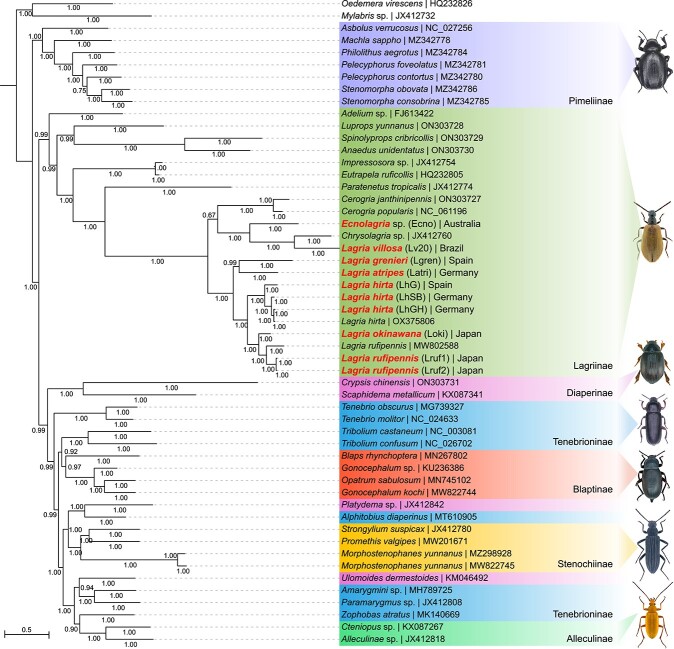
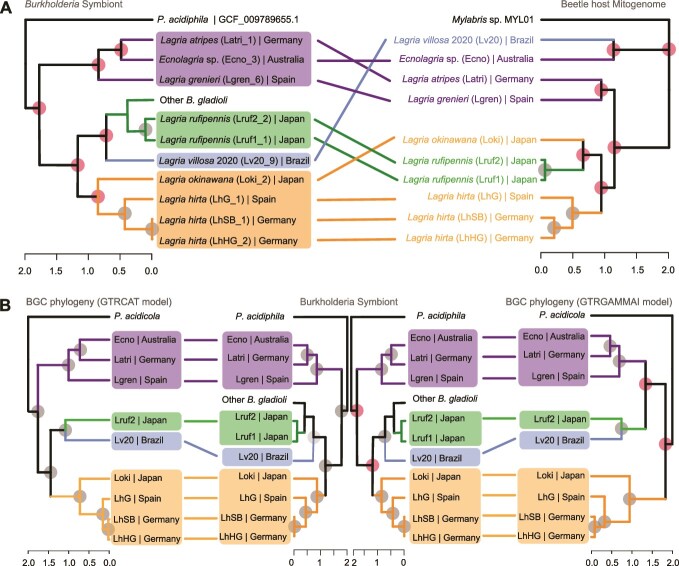
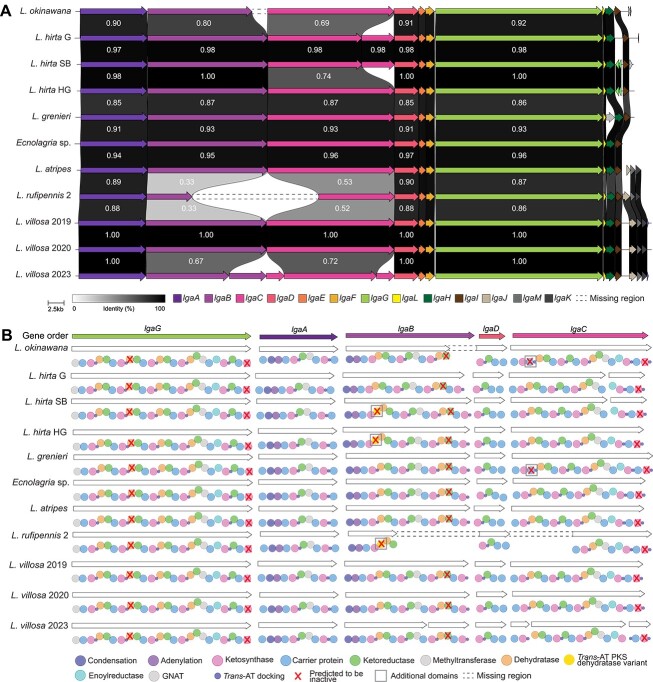
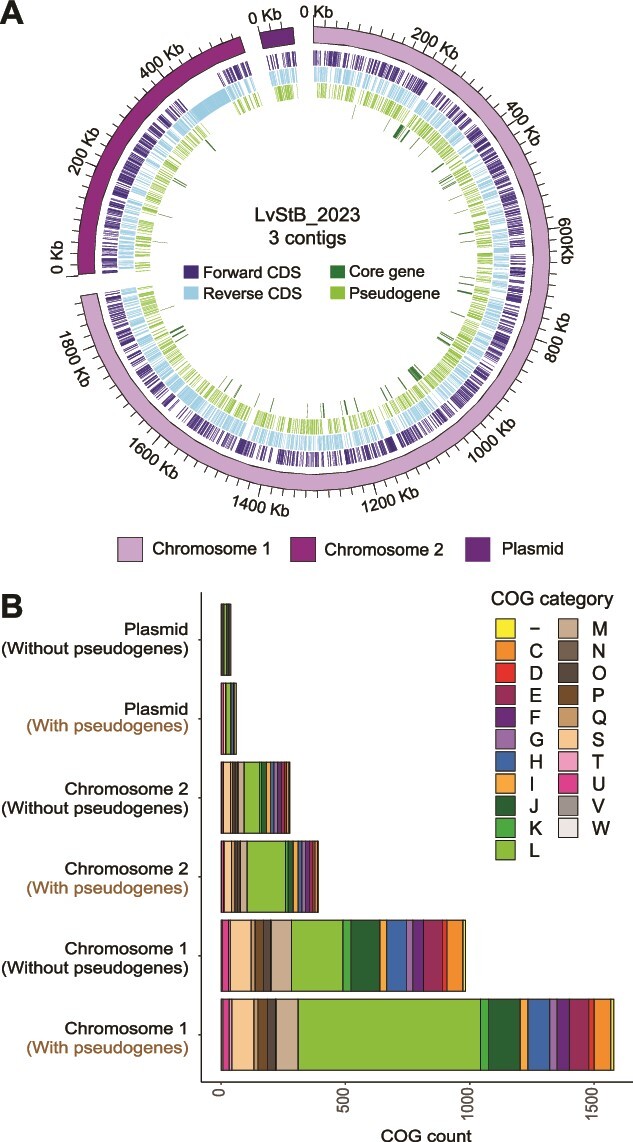
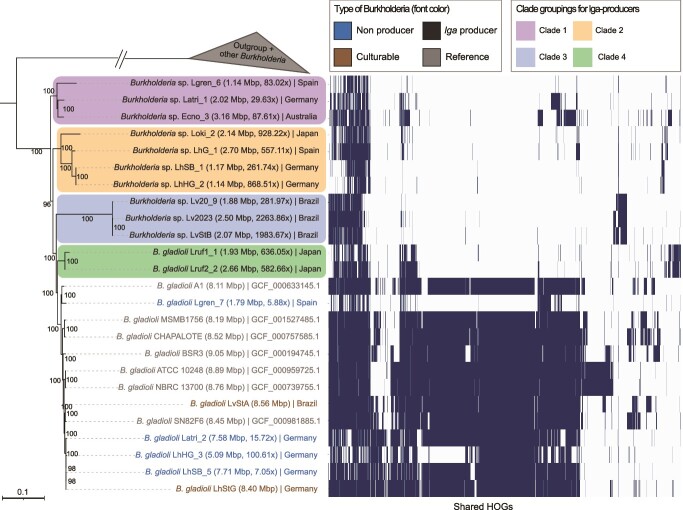
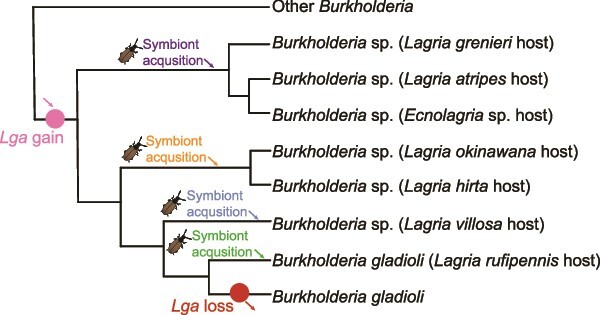
Microbial symbionts associate with multicellular organisms on a continuum from facultative associations to mutual codependency. In the oldest intracellular symbioses there is exclusive vertical symbiont transmission, and co-diversification of symbiotic partners over millions of years. Such symbionts often undergo genome reduction due to low effective population sizes, frequent population bottlenecks, and reduced purifying selection. Here, we describe multiple independent acquisition events of closely related defensive symbionts followed by genome erosion in a group of Lagriinae beetles. Previous work in Lagria villosa revealed the dominant genome-eroded symbiont of the genus Burkholderia produces the antifungal compound lagriamide, protecting the beetle's eggs and larvae from antagonistic fungi. Here, we use metagenomics to assemble 11 additional genomes of lagriamide-producing symbionts from 7 different host species within Lagriinae from 5 countries, to unravel the evolutionary history of this symbiotic relationship. In each host, we detected one dominant genome-eroded Burkholderia symbiont encoding the lagriamide biosynthetic gene cluster. However, we did not find evidence for host-symbiont co-diversification or for monophyly of the lagriamide-producing symbionts. Instead, our analyses support a single ancestral acquisition of the gene cluster followed by at least four independent symbiont acquisitions and subsequent genome erosion in each lineage. By contrast, a clade of plant-associated relatives retained large genomes but secondarily lost the lagriamide gene cluster. Our results, therefore, reveal a dynamic evolutionary history with multiple independent symbiont acquisitions characterized by a high degree of specificity and highlight the importance of the specialized metabolite lagriamide for the establishment and maintenance of this defensive symbiosis.
微生物共生体与多细胞生物的联系是连续的,从兼性共生到相互依存。在最古老的细胞内共生中,存在着专性的垂直共生体传递,共生伙伴在数百万年的时间里共同进化。由于有效种群规模较小、频繁的种群瓶颈和降低的纯化选择,这些共生体经常发生基因组减少。在这里,我们描述了一组 Lagriinae 甲虫中密切相关的防御共生体的多次独立获得事件,随后是基因组侵蚀。以前在 Lagria villosa 中的研究揭示了主要的基因组侵蚀共生体 Burkholderia 产生抗真菌化合物 lagriamide,保护甲虫的卵和幼虫免受拮抗真菌的侵害。在这里,我们使用宏基因组学从来自 5 个国家的 Lagriinae 中 7 个不同宿主物种中组装了 11 个额外的产生 lagriamide 的共生体基因组,以揭示这种共生关系的进化历史。在每个宿主中,我们检测到一个主导的基因组侵蚀 Burkholderia 共生体,编码 lagriamide 生物合成基因簇。然而,我们没有发现宿主-共生体共同进化或产生 lagriamide 的共生体单系的证据。相反,我们的分析支持基因簇的单一祖先获得,随后在每个谱系中至少有四次独立的共生体获得和随后的基因组侵蚀。相比之下,一个与植物相关的近亲分支保留了较大的基因组,但其次失去了 lagriamide 基因簇。因此,我们的研究结果揭示了一个动态的进化历史,具有多次独立的共生体获得,具有高度的特异性,并强调了专门代谢物 lagriamide 对建立和维持这种防御共生体的重要性。