University of Cologne, Institute of Zoology, Cologne, Germany.
PeerJ. 2023 Feb 23;11:e14848. doi: 10.7717/peerj.14848. eCollection 2023.
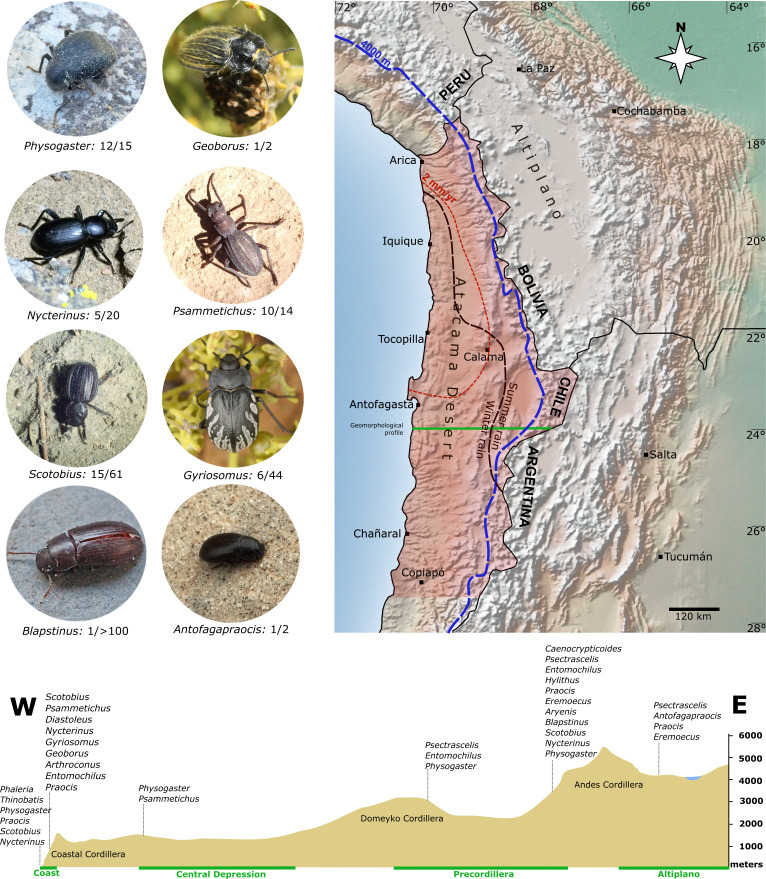
Tenebrionidae (Insecta: Coleoptera) are a conspicuous component of desert fauna worldwide. In these ecosystems, they are significantly responsible for nutrient cycling and show remarkable morphological and physiological adaptations. Nevertheless, Tenebrionidae colonizing individual deserts have repeatedly emerged from different lineages. The goal of our study was to gain insights into the phylogenetic relationships of the tenebrionid genera from the Atacama Desert and how these taxa are related to the globally distributed Tenebrionidae.
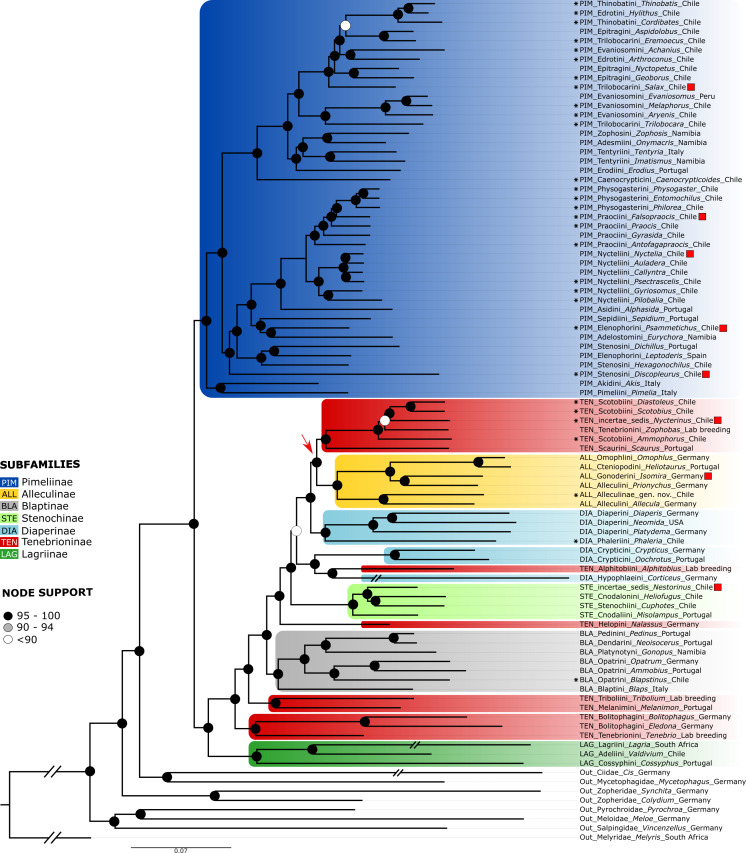
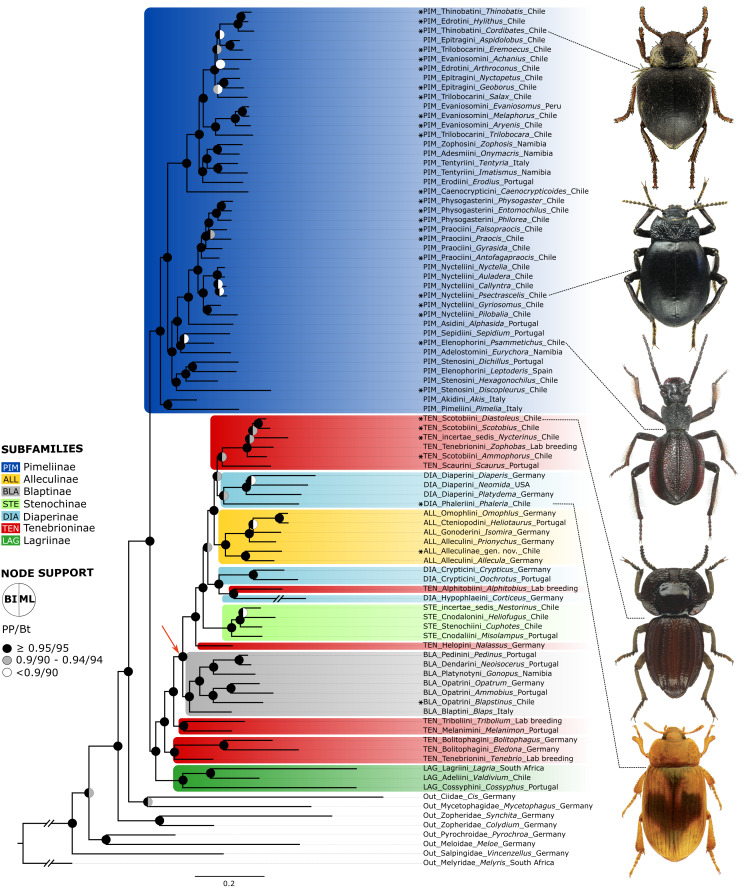
We used newly generated transcriptome data (47 tribes, 7 of 11 subfamilies) that allowed for a comprehensive phylogenomic analysis of the tenebrionid fauna of this hyperarid desert and fills a gap in our knowledge of the highly diversified Tenebrionidae. We examined two independent data sets known to be suitable for phylogenomic reconstructions. One is based on 35 neuropeptide precursors, the other on 1,742 orthologous genes shared among Coleoptera.
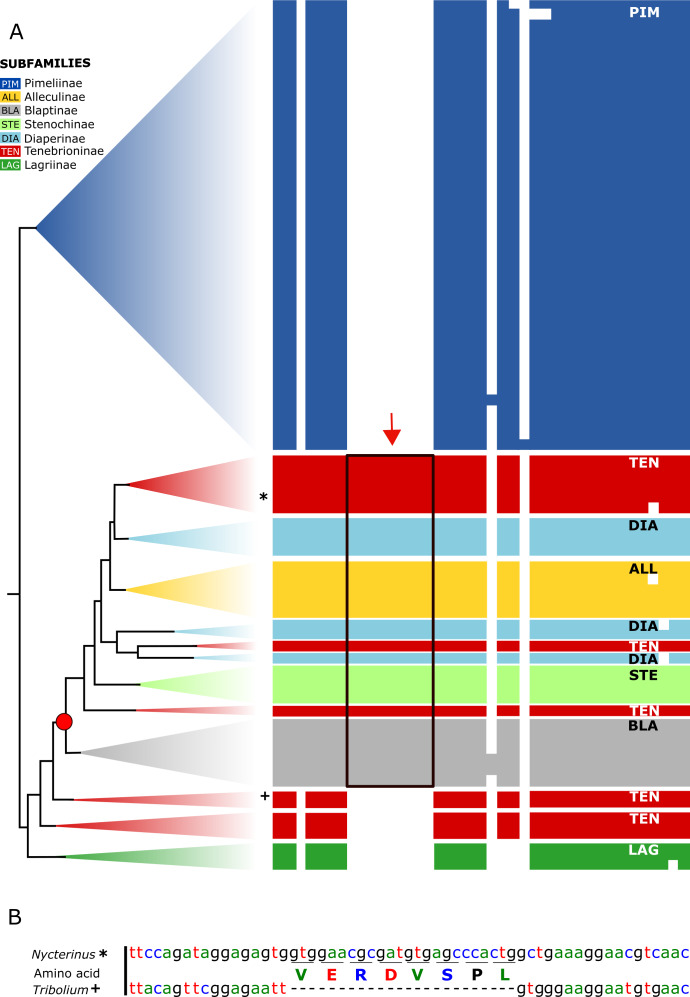
The majority of Atacama genera are placed into three groups, two of which belong to typical South American lineages within the Pimeliinae. While the data support the monophyly of the Physogasterini, Nycteliini and Scotobiini, this does not hold for the Atacama genera of Edrotini, Epitragini, Evaniosomini, Praociini, Stenosini, Thinobatini, and Trilobocarini. A suggested very close relationship of with the Mediterranean also could not be confirmed. We also provide hints regarding the phylogenetic relationships of the Caenocrypticini, which occur both in South America and southern Africa. Apart from the focus on the Tenebrionidae from the Atacama Desert, we found a striking synapomorphy grouping Alleculinae, Blaptinae, Diaperinae, Stenochinae, and several taxa of Tenebrioninae, but not and . This character, an insertion in the gene, defines a higher-level monophyletic group within the Tenebrionidae.
Transcriptome data allow a comprehensive phylogenomic analysis of the tenebrionid fauna of the Atacama Desert, which represents one of the seven major endemic tribal areas in the world for Tenebrionidae. Most Atacama genera could be placed in three lineages typical of South America; monophyly is not supported for several tribes based on molecular data, suggesting that a detailed systematic revision of several groups is necessary.
拟步甲科(昆虫纲:鞘翅目)是全球沙漠动物群中一个显著的组成部分。在这些生态系统中,它们在营养循环中起着重要作用,并表现出显著的形态和生理适应性。然而,在不同的沙漠中出现的拟步甲科昆虫,其起源于不同的谱系。我们的研究目的是深入了解阿塔卡马沙漠拟步甲科属的系统发育关系,以及这些类群与全球分布的拟步甲科的关系。
我们使用新生成的转录组数据(47 个部落,11 个亚科中的 7 个),对这个极度干旱沙漠的拟步甲科动物群进行了全面的系统基因组分析,填补了我们对高度多样化的拟步甲科知识的空白。我们检查了两个已知适合系统发育重建的独立数据集。一个基于 35 种神经肽前体,另一个基于鞘翅目共有 1742 个直系同源基因。
阿塔卡马的大多数属被分为三组,其中两组属于南美典型的 Pimeliinae 谱系。虽然数据支持 Physogasterini、Nycteliini 和 Scotobiini 的单系性,但这并不适用于 Atacama 的 Edrotini、Epitragini、Evaniosomini、Praociini、Stenosini、Thinobatini 和 Trilobocarini 属。与地中海的密切关系也不能得到证实。我们还提供了关于 Caenocrypticini 属的系统发育关系的提示,该属既存在于南美洲,也存在于南部非洲。除了关注阿塔卡马沙漠的拟步甲科外,我们还发现了一个惊人的同形特征,将 Alleculinae、Blaptinae、Diaperinae、stenochinae 和几个 Tenebrioninae 类群分组,但不包括 和 。这个特征,即在 基因中的一个插入,定义了一个更高层次的单系群在拟步甲科内。
转录组数据允许对阿塔卡马沙漠的拟步甲科动物群进行全面的系统基因组分析,这是世界上七个主要的拟步甲科特有部落地区之一。大多数阿塔卡马属可以被归入三个典型的南美谱系;基于分子数据,几个部落的单系性不被支持,这表明需要对几个群体进行详细的系统修订。