Laboratory of Wildlife Biology and Medicine, Department of Environmental Veterinary Science, Graduate School of Veterinary Medicine, Hokkaido University, Sapporo, Japan.
Department of Biology, University of Kentucky, Lexington, KY, USA.
Environ Monit Assess. 2024 Oct 23;196(11):1097. doi: 10.1007/s10661-024-13253-2.
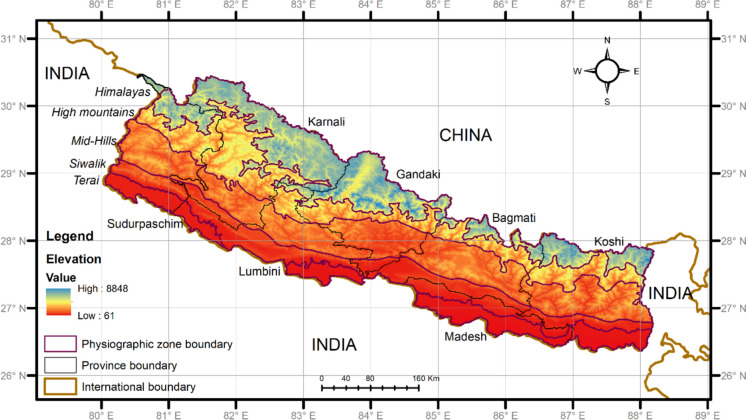
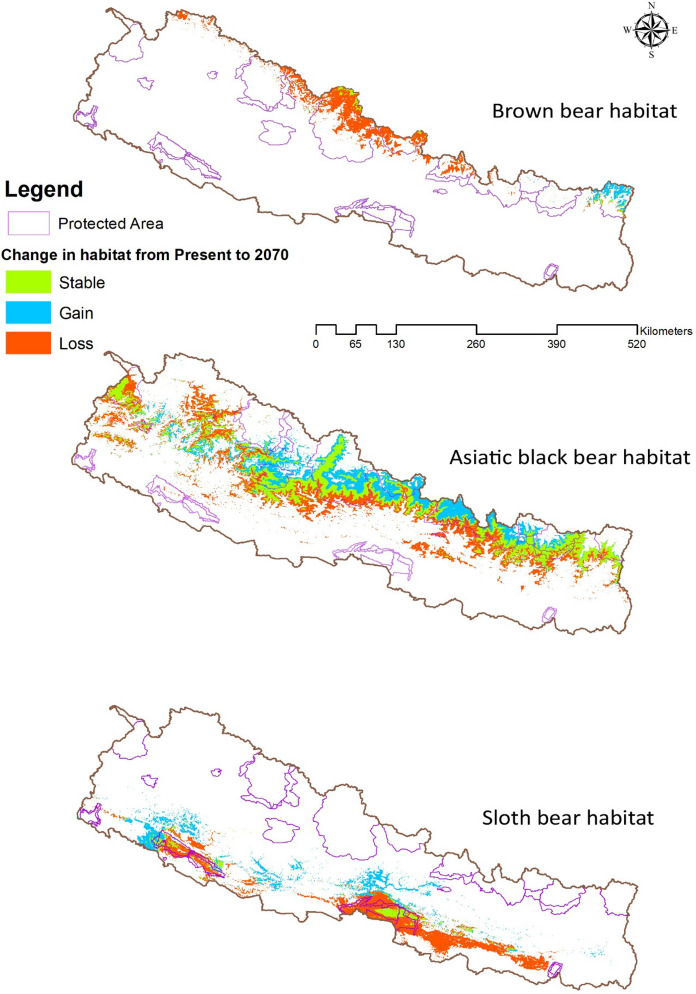
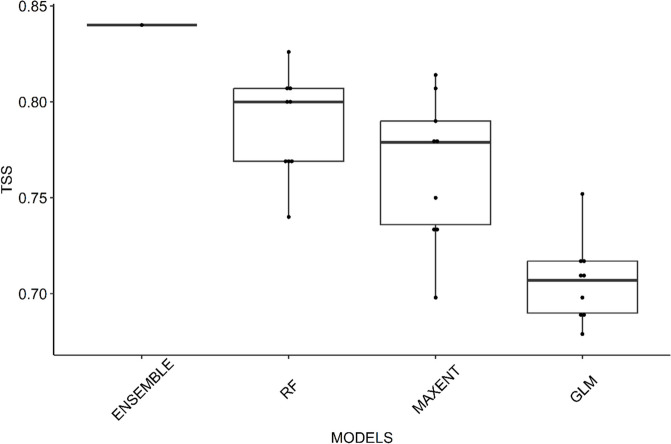
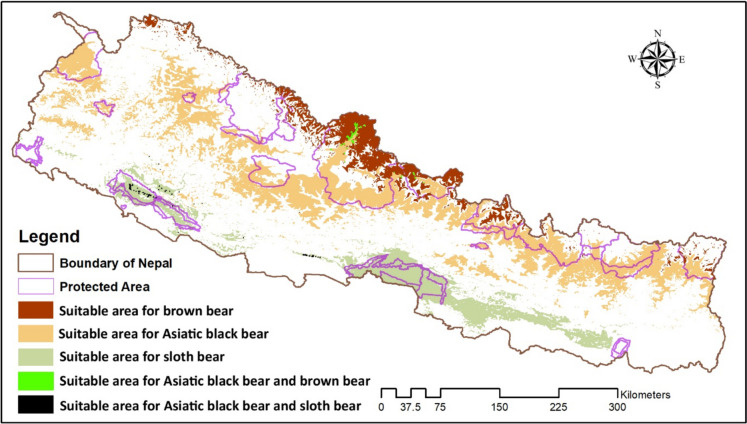
In Nepal, the distributions of three bear species vary: sloth bears (Melursus ursinus) in the lowlands, Asiatic black bears (Ursus thibetanus) in the mid-hills, and brown bears (Ursus arctos) in the high Himalayas. We utilized 179 occurrence points for sloth bears, 199 for Asiatic black bears, and 41 points for brown bears to construct a habitat model incorporating climate and topographic variables. Employing various species distribution modeling algorithms in BIOMOD2, the model predicts suitable habitats spanning 10,971.75 km for sloth bears; 29,470.75 km for Asiatic black bears; and 6152.97 km for brown bears. Within protected areas, the habitat for sloth bears is 4120.56 km, that for Asiatic black bears is 9688.67 km, and that for brown bears is 4538.67 km. Chitwan National Park emerged as the prime sloth bear habitat with a core area of 918.55 km and a buffer zone of 726.485 km. The Annapurna Conservation Area was deemed suitable for Asiatic black bears and brown bears, covering 2802.23 km and 2795.91 km, respectively. The models projected a significant reduction in the habitat of these bear species both inside and outside protected areas. As predicted under the Shared Socioeconomic Pathways (SSP)2-4.5 scenario, sloth bears may experience 54.9% (2050) and 44.7% (2070) losses, respectively, of habitat; Asiatic black bears, 11.2% (2050) and 16.8% (2070); and brown bears, 68.41% (2050) and 82.20% (2070) losses. The overlap between sloth bears and black bears spans 38.7 km, and that between brown bears and black bears is 26.6 km. Notably, all three bear species exhibited suitability correlations with the intermediate temperature of the driest quarter. Examining current and projected habitats provides essential information for guiding conservation strategies and ensuring the conservation of these bear species in the face of climate change.
在尼泊尔,三种熊的分布范围各不相同:树懒熊(Melursus ursinus)分布在低地,亚洲黑熊(Ursus thibetanus)分布在中丘陵地区,棕熊(Ursus arctos)分布在喜马拉雅山脉的高海拔地区。我们利用了 179 个树懒熊的发生点、199 个亚洲黑熊的发生点和 41 个棕熊的发生点,构建了一个包含气候和地形变量的栖息地模型。在 BIOMOD2 中,我们使用了各种物种分布模型算法,预测了树懒熊适宜栖息地面积为 10971.75 平方公里;亚洲黑熊适宜栖息地面积为 29470.75 平方公里;棕熊适宜栖息地面积为 6152.97 平方公里。在保护区内,树懒熊的栖息地面积为 4120.56 平方公里,亚洲黑熊的栖息地面积为 9688.67 平方公里,棕熊的栖息地面积为 4538.67 平方公里。奇特旺国家公园是树懒熊的主要栖息地,核心区面积为 918.55 平方公里,缓冲区面积为 726.485 平方公里。安娜普尔纳保护区被认为是亚洲黑熊和棕熊的适宜栖息地,分别覆盖了 2802.23 平方公里和 2795.91 平方公里。模型预测,这些熊类物种的栖息地无论是在保护区内还是保护区外都将显著减少。根据共享社会经济路径(SSP)2-4.5 情景预测,树懒熊的栖息地可能分别减少 54.9%(2050 年)和 44.7%(2070 年);亚洲黑熊的栖息地可能分别减少 11.2%(2050 年)和 16.8%(2070 年);棕熊的栖息地可能分别减少 68.41%(2050 年)和 82.20%(2070 年)。树懒熊和黑熊的重叠范围为 38.7 公里,棕熊和黑熊的重叠范围为 26.6 公里。值得注意的是,所有三种熊类物种的适宜性都与最干旱季度的中间温度相关。研究当前和预测的栖息地为指导保护策略提供了重要信息,确保了这些熊类物种在气候变化面前的生存。