Department of Anesthesia, Bharatpur Hospital, Bharatpur, Nepal.
Department of Anesthesiology & Critical Care Medicine, BP Koirala Institute of Health Sciences, Dharan, Nepal.
BMC Anesthesiol. 2024 Oct 23;24(1):383. doi: 10.1186/s12871-024-02766-5.
Shock index (SI) is calculated as heart rate divided by systolic blood pressure. In the obstetric population, SI of ≥ 0.9 is associated with maternal adverse outcomes. Our primary aim was to investigate the association between SI and post-spinal hypotension in non-elective cesarean section.
In this prospective, observational study, term parturient of ASA physical status II, and urgency categories 2 and 3, undergoing non-elective cesarean section with spinal anesthesia were enrolled. We performed univariable and multivariable logistic regression to explore the association between baseline SI (categorized as < 0.9 and ≥ 0.9) and hypotension after spinal anesthesia. The diagnostic ability of the baseline SI to predict post-spinal hypotension was assessed using ROC (receiver operating characteristics) curves.
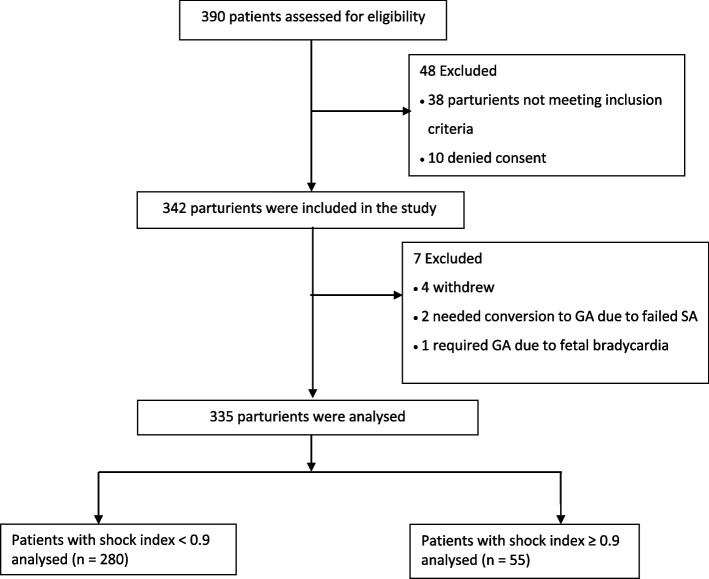
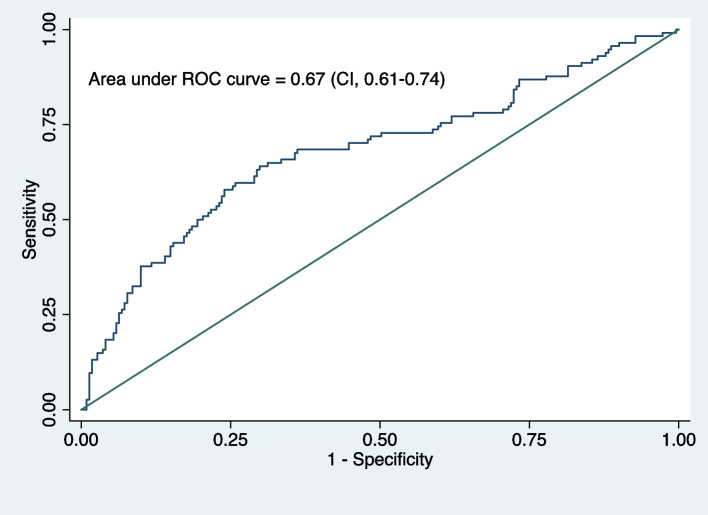
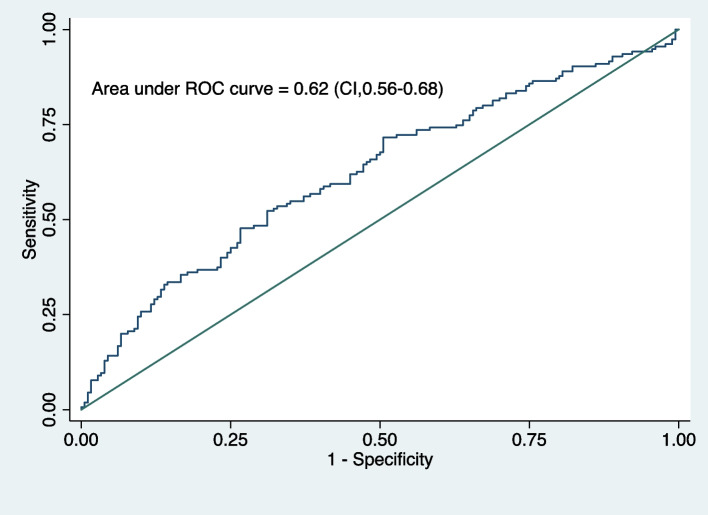
Three hundred forty-two parturient were recruited, and among them, 335 were analyzed. One hundred fifty-five (46.27%) parturients developed post-spinal hypotension, and 114 (34.03%) reported post-delivery hypotension. Preoperative SI (adjusted odds ratio [AOR], 2.77; 95% CI, 1.15-6.66; p = 0.023) and thoracic sensory block height > 4 (AOR, 2.33; 95%CI, 1.14-4.76; p = 0.020) were associated with post-spinal hypotension. Preoperative SI (AOR, 4.34; 95%CI, 1.72-10.94; p = 0.002) and anxiety (AOR,1.22; 95%CI, 1.06-1.40; p = 0.004) were associated with post-delivery hypotension. Area under the ROC curve for SI alone in predicting hypotension before and after delivery was 0.53 (95%CI 0.49-0.57) and 0.56 (95%CI 0.51-0.60) respectively. However, the model performance as reflected by ROC curve for the multivariable logistic regression analysis was 0.623 for post-spinal hypotension and 0.679 for post-delivery hypotension, respectively.
In parturients undergoing non-elective cesarean section, baseline SI ≥ 0.9 was associated with post-spinal and post-delivery hypotension. While the SI alone showed limited predictive power for post-spinal and post-delivery hypotension, integrating it with other risk factors improved the model's predictive ability.
Registration number: NCT04692870. Date of registration: 05/01/2021. Website: https://clinicaltrials.gov .
休克指数(SI)是心率除以收缩压的比值。在产科人群中,SI 值≥0.9 与产妇不良结局相关。我们的主要目的是研究 SI 与非择期剖宫产术后脊髓麻醉后低血压之间的关系。
在这项前瞻性、观察性研究中,纳入 ASA 身体状况 II 级和紧急程度 2 级和 3 级的足月产妇,行非择期剖宫产术并接受脊髓麻醉。我们进行了单变量和多变量逻辑回归分析,以探讨基线 SI(分类为<0.9 和≥0.9)与脊髓麻醉后低血压之间的关系。使用 ROC 曲线评估基线 SI 预测脊髓麻醉后低血压的诊断能力。
共纳入 342 名产妇,其中 335 名进行了分析。155 名(46.27%)产妇发生了脊髓麻醉后低血压,114 名(34.03%)产妇发生了产后低血压。术前 SI(调整后的优势比 [AOR],2.77;95%CI,1.15-6.66;p=0.023)和胸段感觉阻滞高度>4(AOR,2.33;95%CI,1.14-4.76;p=0.020)与脊髓麻醉后低血压相关。术前 SI(AOR,4.34;95%CI,1.72-10.94;p=0.002)和焦虑(AOR,1.22;95%CI,1.06-1.40;p=0.004)与产后低血压相关。SI 单独预测分娩前后低血压的 ROC 曲线下面积分别为 0.53(95%CI 0.49-0.57)和 0.56(95%CI 0.51-0.60)。然而,多变量逻辑回归分析的 ROC 曲线反映的模型性能分别为脊髓麻醉后低血压的 0.623 和产后低血压的 0.679。
在接受非择期剖宫产术的产妇中,基线 SI≥0.9 与脊髓麻醉后和产后低血压相关。虽然 SI 单独对脊髓麻醉后和产后低血压的预测能力有限,但将其与其他危险因素相结合可以提高模型的预测能力。
注册号:NCT04692870。注册日期:2021 年 5 月 1 日。网址:https://clinicaltrials.gov。