Retina Consultants of Texas, Houston, TX, USA.
Retina Consultants, Hartford, CT, USA.
BMC Res Notes. 2024 Oct 23;17(1):317. doi: 10.1186/s13104-024-06969-4.
To obtain physicians' "real-world" perspectives on early experiences with triamcinolone acetonide suprachoroidal injection (SCS-TA) for treatment of patients with uveitic macular edema (UME).
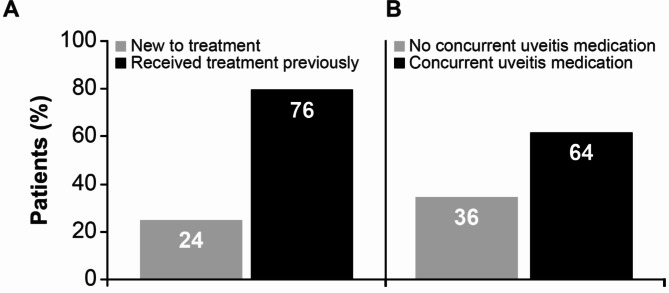
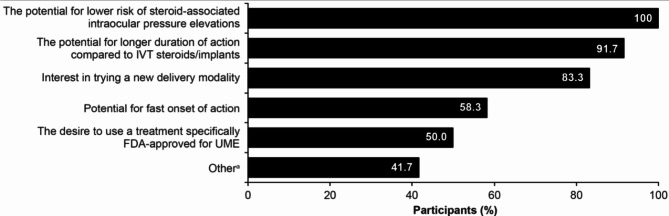
Twelve retina/uveitis specialists in the United States were surveyed about SCS-TA injection procedure and patient outcomes. Survey participants administered ≥ 291 SCS-TA injections to 243 patients with UME with various disease characteristics (etiologies, chronicity, and anatomical subtypes). Commonly reported reasons for SCS-TA adoption included potential for lowering the risk of steroid-associated intraocular pressure elevations versus intravitreal injections or implants (100%), potential for longer duration of action versus intravitreal steroid injections or implants (92%), and desire to use a new delivery modality (83%). Nearly all participants (92%) found injection procedure relatively easy post-training, with most (75%) procedurally comfortable after completing 2-5 injections. 58% of participants indicated that their patients gained 2-3 lines of vision by first follow-up visit, and 92% reported having patients who experienced 100-150 μm or greater reduction in central subfield thickness. Overall, 92% of participants were satisfied with SCS-TA treatment outcomes. Findings from this survey of early adopters of SCS-TA indicate that the suprachoroidal injection technique was easy to learn and resulted in favorable patient outcomes consistent with clinical trial data.
了解医师对于曲安奈德玻璃体内注射(IVTA)治疗葡萄膜炎性黄斑水肿(UME)的真实体验。
对美国的 12 位视网膜/葡萄膜炎专家进行了关于玻璃体内注射(IVTA)手术和患者结局的调查。调查参与者对 243 例不同疾病特征(病因、慢性程度和解剖亚型)的 UME 患者进行了≥291 次玻璃体内注射。采用玻璃体内注射的常见原因包括与玻璃体内注射或植入物相比,降低类固醇相关眼压升高风险(100%)、作用持续时间更长(92%)以及希望采用新的给药方式(83%)。几乎所有参与者(92%)在接受培训后发现注射程序相对简单,大多数参与者(75%)在完成 2-5 次注射后在程序上感到舒适。58%的参与者表示患者在首次随访时视力提高了 2-3 行,92%的参与者报告患者的中央凹下区厚度减少了 100-150μm 或更多。总体而言,92%的参与者对玻璃体内注射的治疗结果感到满意。对玻璃体内注射的早期使用者进行的这项调查结果表明,玻璃体内注射技术易于学习,且患者的结局与临床试验数据一致。