Fernandes Georgina, Chappell Elizabeth, Goetghebuer Tessa, Kahlert Christian R, Ansone Santa, Bernardi Stefania, Castelli Gattinara Guido, Chiappini Elena, Dollfus Catherine, Frange Pierre, Freyne Bridget, Galli Luisa, Giacomet Vania, Grisaru-Soen Galia, Königs Christoph, Lyall Hermione, Marczynska Magdalena, Mardarescu Mariana, Naver Lars, Niehues Tim, Noguera-Julian Antoni, Stol Kim, Volokha Alla, Welch Steven B, Thorne Claire, Bamford Alasdair
Population, Policy and Practice Research and Teaching Department, UCL Great Ormond Street Institute of Child Health, London, UK.
MRC Clinical Trials Unit at UCL, London, UK.
HIV Med. 2025 Feb;26(2):207-217. doi: 10.1111/hiv.13723. Epub 2024 Oct 23.
This survey was conducted to describe current European postnatal prophylaxis (PNP) and infant feeding policies with the aim of informing future harmonized guidelines.
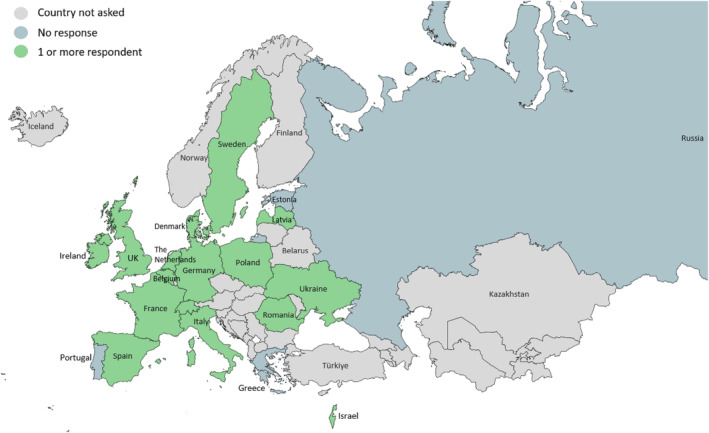
A total of 32 senior clinicians with relevant expertise, working in 20 countries within the European Region, were invited to complete a REDCap questionnaire between July and September 2023.
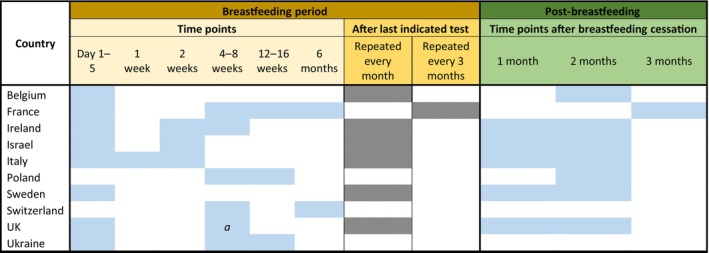
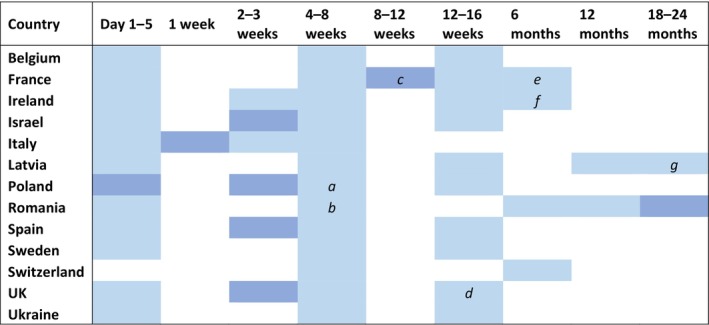
Twenty-three of the 32 invited paediatricians responded, representing 16/20 countries. There were multiple respondents from the same country for Italy (n = 5), the UK (n = 2), Germany (n = 2) and France (n = 2). All countries use risk stratification to guide PNP regimen selection. Nine out of 16 countries reported three risk categories, six out of 16 reported two, and one country reported differences in categorization. Criteria used to stratify risk varied between and within countries. For the lowest risk category, the PNP regimen reported ranged from no PNP to up to four weeks of one drug; the drug of choice reported was zidovudine, apart from one country which reported nevirapine. For the highest risk category, the most common regimen was zidovudine/lamivudine/nevirapine (20/23 respondents); regimen duration varied from two to six weeks with variation in recommended dosing. Guidelines support breastfeeding for infants born to people living with HIV in eight out of 16 countries; in the other eight, guidelines do not support/specify.
Guidelines and practice for PNP and infant feeding vary substantially across Europe and within some countries, reflecting the lack of robust evidence. Effort is needed to align policies and practice to reflect up-to-date knowledge to ensure the vertical transmission risk is minimized and unnecessary infant HIV testing and PNP avoided, while simultaneously supporting families to make informed decisions on infant feeding choice.
开展本次调查以描述当前欧洲的产后预防(PNP)及婴儿喂养政策,旨在为未来统一指南提供信息。
2023年7月至9月期间,邀请了欧洲区域20个国家的32名具有相关专业知识的资深临床医生完成一份REDCap问卷。
32名受邀儿科医生中有23人回复,代表16个/20个国家。意大利(n = 5)、英国(n = 2)、德国(n = 2)和法国(n = 2)有来自同一国家的多名受访者。所有国家均使用风险分层来指导PNP方案的选择。16个国家中有9个报告了三种风险类别,16个中有6个报告了两种,1个国家报告了分类差异。各国之间以及国内用于分层风险的标准各不相同。对于最低风险类别,报告的PNP方案从无PNP到一种药物使用长达四周不等;除一个报告使用奈韦拉平的国家外,报告的首选药物是齐多夫定。对于最高风险类别,最常见的方案是齐多夫定/拉米夫定/奈韦拉平(20/23名受访者);方案持续时间从两周到六周不等,推荐剂量也有所不同。16个国家中有8个国家的指南支持HIV感染者所生婴儿进行母乳喂养;在其他8个国家,指南不支持/未明确规定。
欧洲各国之间以及一些国家内部,PNP和婴儿喂养的指南与实践差异很大,这反映出缺乏有力证据。需要努力使政策和实践保持一致,以反映最新知识,确保将垂直传播风险降至最低,避免不必要的婴儿HIV检测和PNP,同时支持家庭就婴儿喂养选择做出明智决策。