Mun Seong Hee, Kwon Joon Yeong
Department of Aquatic Life Medical Sciences, Sunmoon University, Asan 31460, Korea.
Ecological Risk Research Department, Korea Institute of Ocean Science and Technology, Geoje 53201, Korea.
Dev Reprod. 2024 Sep;28(3):75-86. doi: 10.12717/DR.2024.28.3.75. Epub 2024 Sep 30.
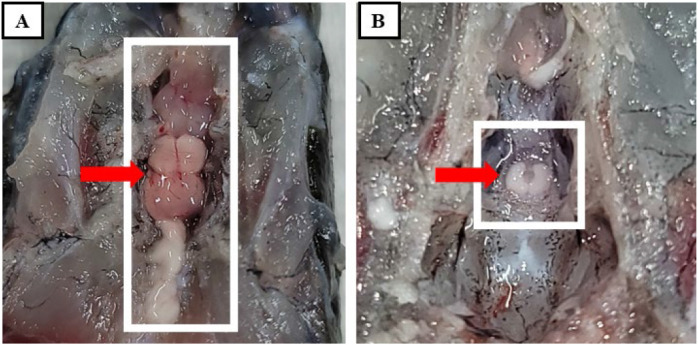
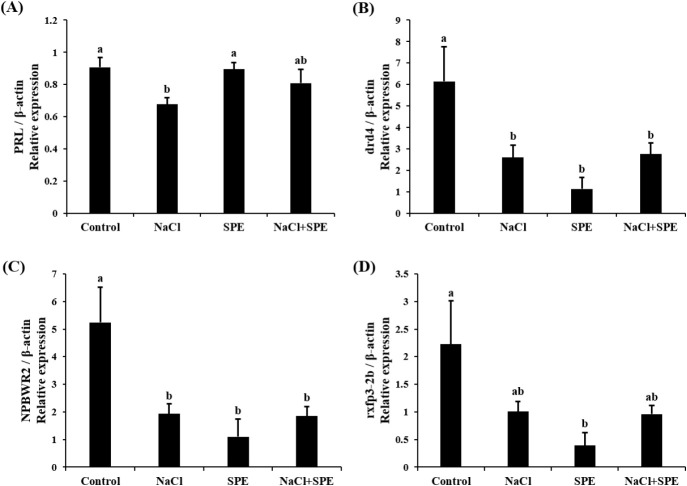
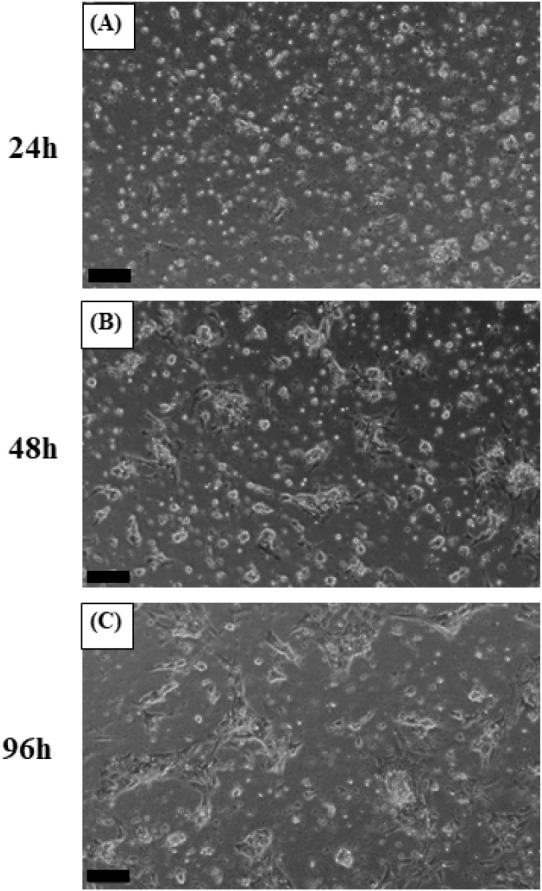
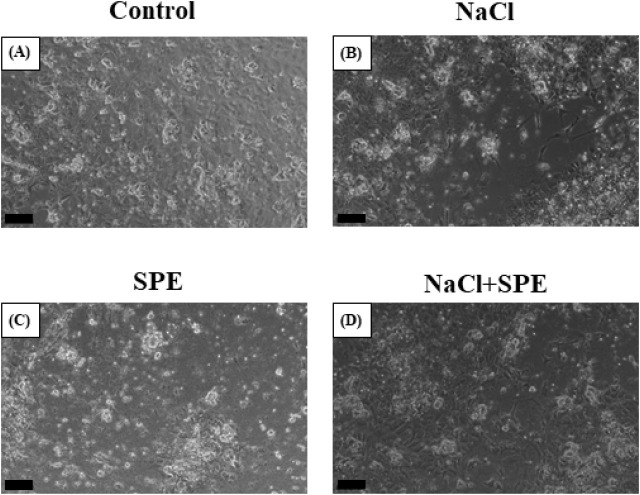
Artificial sexual maturation of eel () involves rearing in seawater and injecting salmon pituitary extract (SPE). The salinity of seawater and components of SPE influence hormonal activities of the eel pituitary, leading to gonad development. This study investigated the direct effects of salinity change and SPE treatment on the eel pituitary gland using primary cell cultures. Pituitary cells were cultured into four experimental groups: control culture (control), SPE-treated culture (SPE), NaCl-treated culture (NaCl) and NaCl+SPE treated culture (NaCl+SPE). We investigated the expression of genes presumably related to reproduction and/or salinity, including luteinizing hormone (), follicle stimulating hormone (), progesterone receptor-like (), prolactin (), dopamine receptor D4 (), neuropeptide B/W receptor 2 () and relaxin family peptide receptor 3-2b (). Gene expression analysis revealed significant upregulation of LHβ in SPE and NaCl+SPE groups compared to control and NaCl (<0.05). FSHβ expression did not show any significant changes. PRL showed a significant decrease in the NaCl group (<0.05). , and displayed the highest expression in the control group, with downregulation observed in all treatment groups (NaCl, SPE, and NaCl+SPE) (<0.05). This study demonstrated the direct effects of salinity changes and SPE treatment on the eel pituitary. Results from this study also suggest that salinity change is necessary but work together with SPE to induce reproductive process, and that , and genes are obviously associated with reproduction and salinity changes in eels.
鳗鱼的人工性成熟包括在海水中养殖并注射鲑鱼垂体提取物(SPE)。海水盐度和SPE成分会影响鳗鱼垂体的激素活性,从而导致性腺发育。本研究使用原代细胞培养研究了盐度变化和SPE处理对鳗鱼垂体的直接影响。垂体细胞被培养到四个实验组中:对照培养(control)、SPE处理培养(SPE)、NaCl处理培养(NaCl)和NaCl + SPE处理培养(NaCl + SPE)。我们研究了可能与繁殖和/或盐度相关的基因的表达,包括促黄体生成素(LHβ)、促卵泡激素(FSHβ)、孕酮受体样(PRLR)、催乳素(PRL)、多巴胺受体D4(DRD4)、神经肽B/W受体2(NPBWR2)和松弛素家族肽受体3-2b(RXFP3-2b)。基因表达分析显示,与对照和NaCl组相比,SPE组和NaCl + SPE组中的LHβ显著上调(P < 0.05)。FSHβ表达未显示任何显著变化。PRL在NaCl组中显著降低(P < 0.05)。NPBWR2、DRD4和RXFP3-2b在对照组中表达最高,在所有处理组(NaCl、SPE和NaCl + SPE)中均观察到下调(P < 0.05)。本研究证明了盐度变化和SPE处理对鳗鱼垂体的直接影响。本研究结果还表明,盐度变化是必要的,但需要与SPE共同作用以诱导生殖过程,并且NPBWR2、DRD4和RXFP3-2b基因明显与鳗鱼的繁殖和盐度变化相关。