Cheng Zhen, Hu Chunyu, Zhang Yalan, Zhou Jie, Shi Jiayang, Sun Li, Chen Zongtao
Health Management Centre, First Affiliated Hospital of Army Medical University, Chongqing, People's Republic of China.
Diabetes Metab Syndr Obes. 2024 Oct 19;17:3875-3890. doi: 10.2147/DMSO.S469859. eCollection 2024.
The aim of this study was to comprehensively compare the predictive effect of 10 body fat indexes on MAFLD in different sex, age and BMI subgroups.
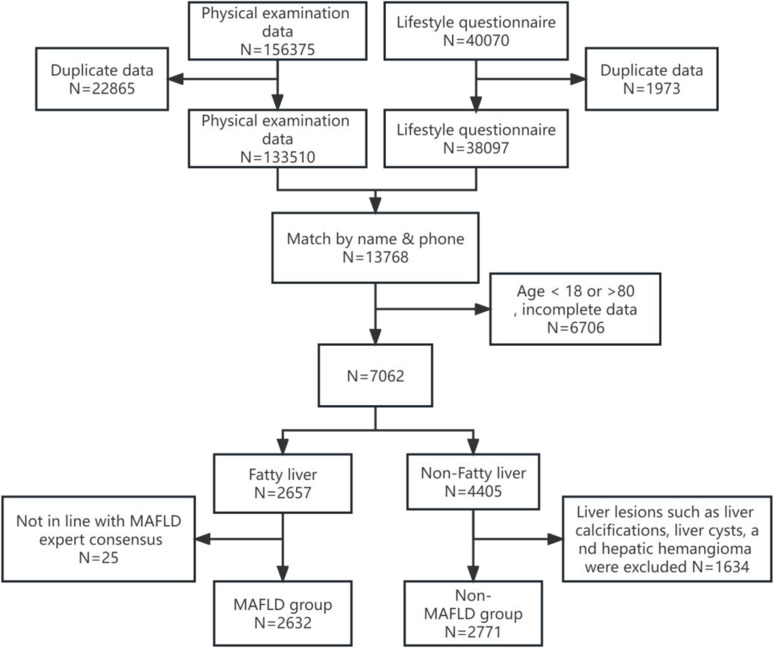
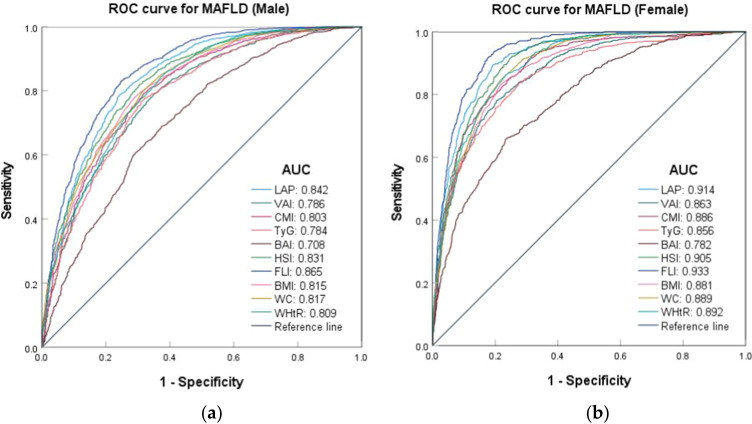
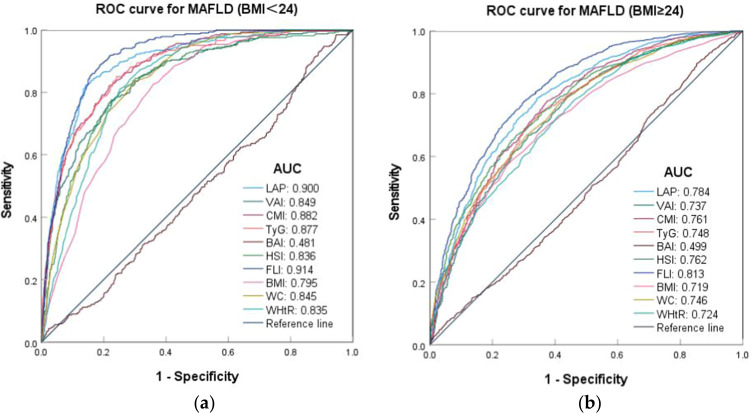
A total of 5403 physical examination data were included and divided into the MAFLD group (N=2632) and non-MAFLD group (N=2771). The differences and correlation of 10 promising indicators between the two groups were compared, including fatty liver index (FLI), hepatic steatosis index (HSI), lipid accumulation product (LAP), visceral fat index (VAI), cardiometabolic index (CMI), body adiposity index (BAI), and triglyceride-glucose index (TyG), waist circumference index (WC), body mass index (BMI), waist to height ratio (WHtR). Logistic regression was used to analyze the risk of MAFLD under different adjustment conditions. The operating characteristic curve of different genders, BMI levels and age subgroups was plotted.
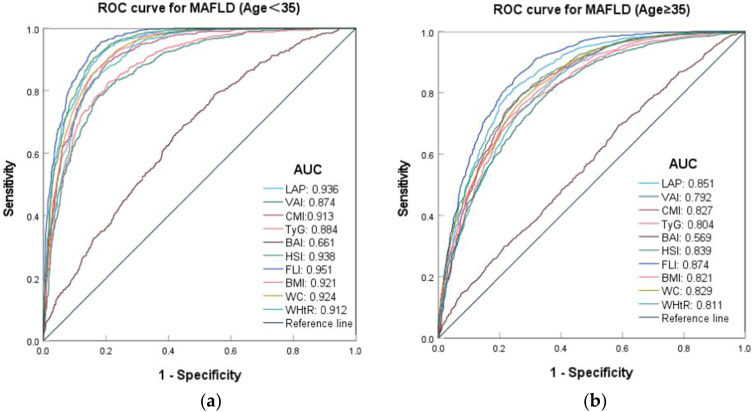
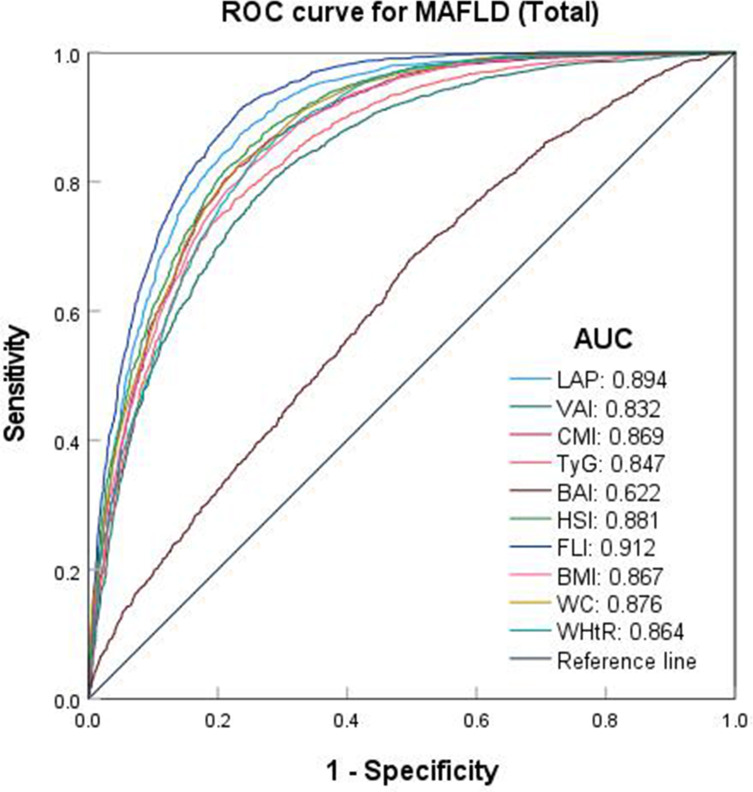
Male gender, smoking, alcohol drinking, and higher age are risk factors for MAFLD. In addition to BAI, the other 9 indicators had a high correlation with MAFLD, the area under the curve (AUC) value was >0.7, and the prediction effect was better in females, BMI<24 kg/m2, age <35 years subgroup, among which FLI (AUC: 0.912, 95% CI: 0.905-0.920), LAP (AUC: 0.894, 95% CI: 0.8866-0.903), and HSI (AUC: 0.881, 95% CI: 0.872-0.890) have better prediction effects.
Our study confirmed the accuracy of body fat-related indexes in predicting MAFLD in people of different sexes, ages, and BMI levels. Among them, FLI, LAP and HSI have high predictive value and can be utilized as simple and cost-effective tools for screening MAFLD in clinical settings.
本研究旨在全面比较10种体脂指数对不同性别、年龄和BMI亚组中MAFLD的预测效果。
共纳入5403份体检数据,分为MAFLD组(N = 2632)和非MAFLD组(N = 2771)。比较两组间10项有前景指标的差异及相关性,包括脂肪肝指数(FLI)、肝脂肪变性指数(HSI)、脂质蓄积产物(LAP)、内脏脂肪指数(VAI)、心脏代谢指数(CMI)、身体肥胖指数(BAI)、甘油三酯-葡萄糖指数(TyG)、腰围指数(WC)、体重指数(BMI)、腰高比(WHtR)。采用逻辑回归分析不同调整条件下MAFLD的风险。绘制不同性别、BMI水平和年龄亚组的操作特征曲线。
男性、吸烟、饮酒和较高年龄是MAFLD的危险因素。除BAI外,其他9项指标与MAFLD高度相关,曲线下面积(AUC)值>0.7,在女性、BMI<24 kg/m²、年龄<35岁亚组中预测效果更佳,其中FLI(AUC:0.912,95%CI:0.905 - 0.920)、LAP(AUC:0.894,95%CI:0.8866 - 0.903)和HSI(AUC:0.881,95%CI:0.872 - 0.890)预测效果较好。
我们的研究证实了体脂相关指标在预测不同性别、年龄和BMI水平人群MAFLD方面的准确性。其中,FLI、LAP和HSI具有较高的预测价值,可作为临床筛查MAFLD的简单且经济有效的工具。