Duggal Radhika, Osborne Kyra, Kominsky Alan, Tierney William S
Cleveland Clinic Lerner College of Medicine Case Western Reserve University Cleveland Ohio USA.
Department of Otolaryngology - Head and Neck Surgery Cleveland Clinic Foundation Cleveland Ohio USA.
OTO Open. 2024 Oct 23;8(4):e70024. doi: 10.1002/oto2.70024. eCollection 2024 Oct-Dec.
While students in the 2023 Otolaryngology-Head and Neck Surgery (Oto-HNS) residency match were allowed 7 preference signals, this number increased to 25 for the 2024 match with the goal of reducing the overall application volume. We sought to understand the impact of this change to application volume and interview patterns.
Cross-sectional survey.
Program directors of US Oto-HNS residency programs were invited to participate in an anonymous, electronic survey.
An anonymous REDCap questionnaire was sent via email to all current Oto-HNS program directors in January 2024. Data were analyzed using R Version 4.3.1.
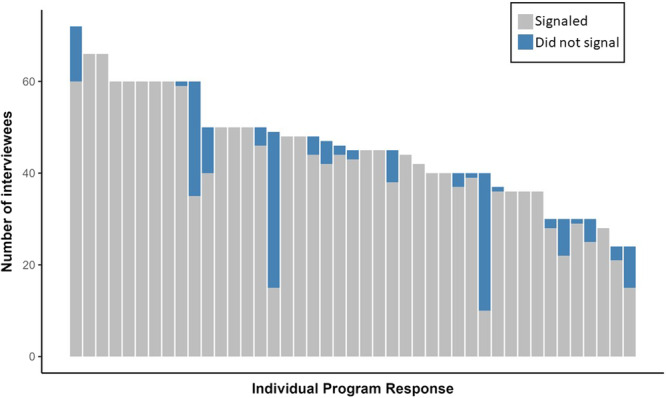
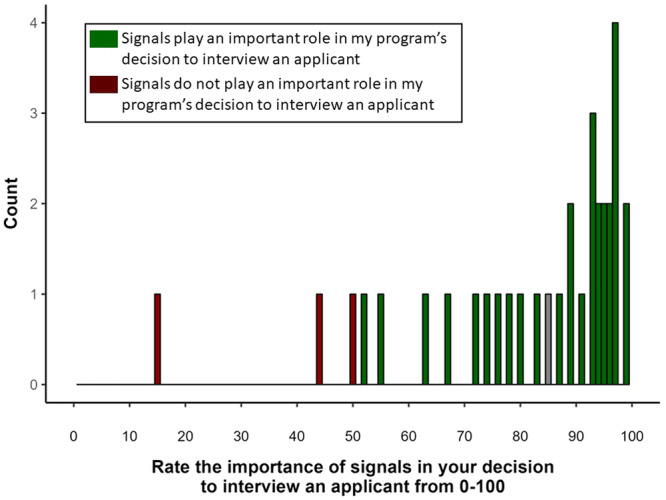
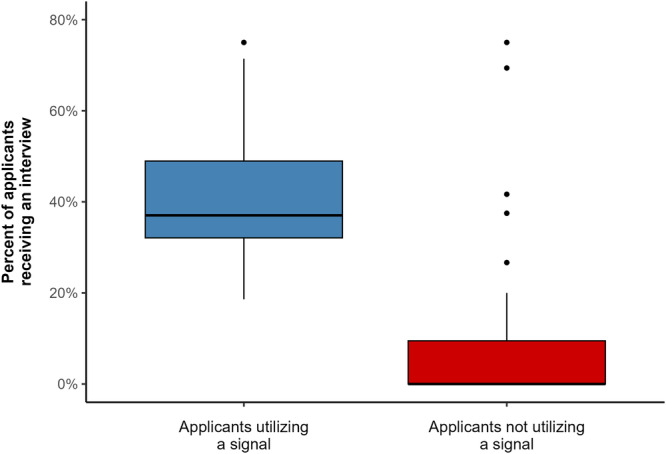
Forty-four program directors completed the survey. While programs received a median [interquartile range] of 400 [363, 445] applications last year, this year they reported receiving 295 [233, 339] applications of which a median of 110 applicants (40%) signaled the program. While the median percent of applicants who were interviewed by a program was 16%, the percent of interviews among applicants who had signaled the program was 37%. Of all interviews, nearly all (median 100% [91, 100]) were of applicants who had signaled the program. Finally, 40 (91%) of program directors reported that signaling played an important role in deciding to interview a candidate.
Preference signals play an important role in a residency program's decision to interview a candidate. Our findings suggest that the implementation of preference signals successfully decreased the average number of applications received by each program and that medical students applying to more programs than available signals may experience diminishing returns.
2023年耳鼻咽喉头颈外科(Oto - HNS)住院医师匹配中,学生被允许有7个优先信号,但在2024年匹配时,这一数字增加到了25个,目的是减少总体申请量。我们试图了解这一变化对申请量和面试模式的影响。
横断面调查。
邀请美国Oto - HNS住院医师培训项目的项目主任参加一项匿名电子调查。
2024年1月通过电子邮件向所有现任Oto - HNS项目主任发送一份匿名的REDCap问卷。使用R版本4.3.1进行数据分析。
44名项目主任完成了调查。去年各项目收到的申请中位数[四分位间距]为400份[363, 445],而今年他们报告收到295份[233, 339]申请,其中中位数为110名申请人(40%)选择了该项目。虽然一个项目面试的申请人中位数百分比为16%,但在选择了该项目的申请人中,面试百分比为37%。在所有面试中,几乎所有(中位数100% [91, 100])都是选择了该项目的申请人。最后,40名(91%)项目主任报告称,优先信号在决定面试候选人方面发挥了重要作用。
优先信号在住院医师培训项目决定面试候选人方面发挥着重要作用。我们的研究结果表明,优先信号的实施成功降低了每个项目收到的平均申请数量,并且申请项目数量超过可用信号数量的医学生可能会出现收益递减的情况。