Liu Zhen, Zeng Yang, Li Rui, Yan Ying, Yi Sicheng, Zhang Kui
Department of Traditional Chinese Medicine, Guizhou Provincial People's Hospital, Guiyang, China.
J Thorac Dis. 2024 Sep 30;16(9):6052-6063. doi: 10.21037/jtd-23-1836. Epub 2024 Sep 26.
Chronic obstructive pulmonary disease (COPD) is a frequently occurring disorder. The aim of this study is to explore the mechanism of traditional Chinese medicine Morin monomer in the treatment of COPD via regulating autophagy based on the long non-coding RNA (lncRNA) H19/microRNA (miR)-194-5p/Sirtuin (SIRT)1 signal axis.
The COPD rat model was constructed, and the lung tissues were collected. The pathological analysis was performed using hematoxylin-eosin (HE), Masson, and periodic acid-Schiff (PAS) staining. Autophagosomes were observed using transmission electron microscope. , , genes in the rat lung tissues were detected using reverse transcription-quantitative real-time polymerase chain reaction (RT-qPCR). The autophagy-related proteins including SIRT1, mammalian/mechanistic target of rapamycin (mTOR), phosphorylated (p)-mTOR, microtubule-associated protein light chain 3 (LC3), Beclin-1, autophagy-related (ATG)7, and p62 in each group were detected using Western blot.
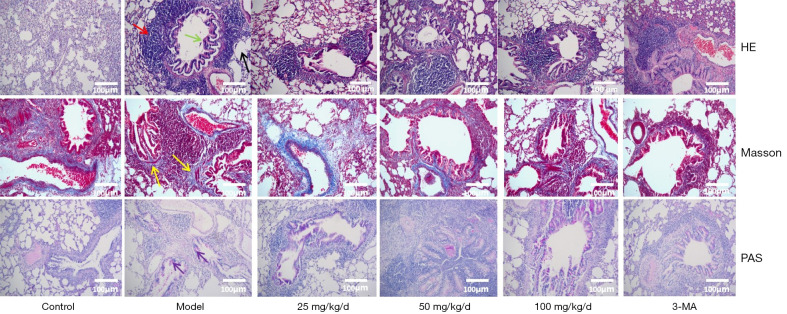
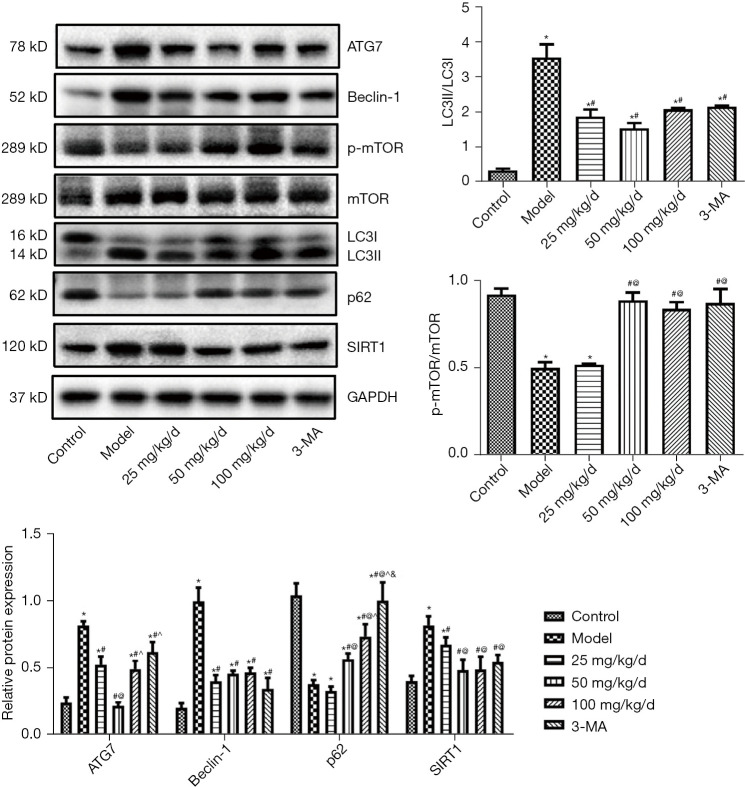
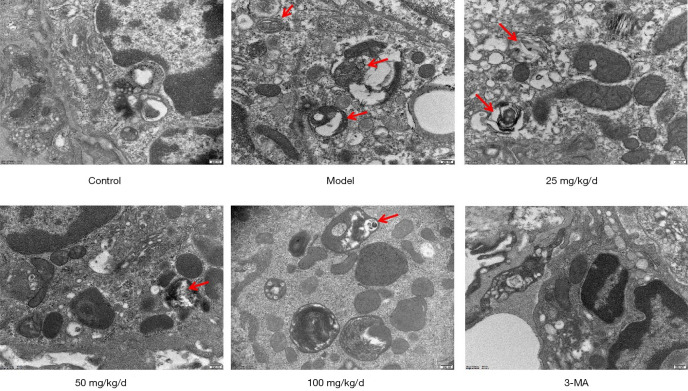
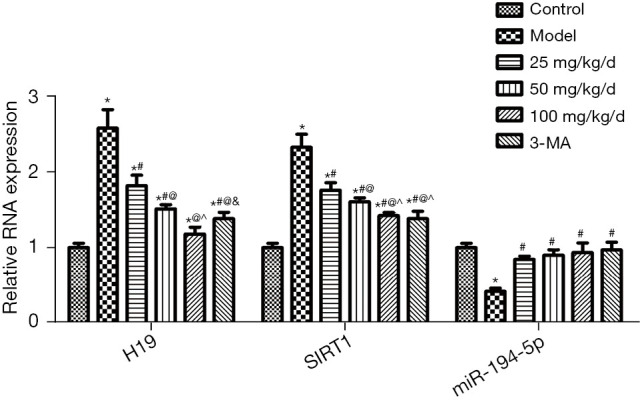
The rats in the control group had normal lung structure. Alveolar enlargement and destruction could be found in the rat lung tissues in the model group, accompanied with obvious infiltration of inflammatory cells, thickened bronchial walls, enlarged alveolar septum, collagen fibers deposition, and goblet cells proliferation. In comparison with the model group, Morin treatment relieved the lung injuries, which was optimized in the moderate- and high-dose groups. The number of autophagosomes in the lung tissues of the model rats was dramatically increased compared with the normal rats. However, the number of autophagosomes in each Morin treatment group was obviously less than that in the model group. and expression was significantly increased in the model group, and was significantly decreased (P<0.05). Morin and 3-methyladenine (3-MA) could obviously reduce the and expression, and increase the expression (P<0.05). Relative to control rats, ATG7, Beclin-1, LC3II/I and SIRT1 levels in the model group increased obviously, while the expression of p62, and p-mTOR/mTOR decreased (P<0.05). Morin treatment reduced the expression of ATG7, Beclin-1, SIRT1, LC3II/I significantly, and increased the p-mTOR/mTOR and p62 expression (P<0.05).
Morin decreased expression, resulting in upregulation of expression, downregulation of expression, and increased of p-mTOR/mTOR expression. Furthermore, cell autophagy was inhibited, contributing to the COPD treatment.
慢性阻塞性肺疾病(COPD)是一种常见疾病。本研究旨在基于长链非编码RNA(lncRNA)H19/微小RNA(miR)-194-5p/沉默调节蛋白(SIRT)1信号轴,探讨中药桑色素单体通过调节自噬治疗COPD的机制。
构建COPD大鼠模型并收集肺组织。采用苏木精-伊红(HE)、Masson和过碘酸-希夫(PAS)染色进行病理分析。使用透射电子显微镜观察自噬体。采用逆转录-定量实时聚合酶链反应(RT-qPCR)检测大鼠肺组织中lncRNA H19、miR-194-5p、SIRT1基因。采用蛋白质免疫印迹法检测各组中自噬相关蛋白,包括SIRT1、哺乳动物雷帕霉素靶蛋白(mTOR)、磷酸化(p)-mTOR、微管相关蛋白轻链3(LC3)、Beclin-1、自噬相关蛋白7(ATG7)和p62。
对照组大鼠肺结构正常。模型组大鼠肺组织可见肺泡扩大和破坏,伴有明显的炎症细胞浸润、支气管壁增厚、肺泡间隔增宽、胶原纤维沉积和杯状细胞增生。与模型组相比,桑色素治疗减轻了肺损伤,中、高剂量组效果更佳。与正常大鼠相比,模型大鼠肺组织中自噬体数量显著增加。然而,各桑色素治疗组的自噬体数量明显少于模型组。模型组lncRNA H19和miR-194-5p表达显著增加,SIRT1表达显著降低(P<0.05)。桑色素和3-甲基腺嘌呤(3-MA)可明显降低lncRNA H19和miR-194-5p表达,并增加SIRT1表达(P<0.05)。相对于对照大鼠,模型组ATG7、Beclin-1、LC3II/I和SIRT1水平明显升高,而p62和p-mTOR/mTOR表达降低(P<0.05)。桑色素治疗显著降低了ATG7、Beclin-1、SIRT1、LC3II/I的表达,并增加了p-mTOR/mTOR和p62表达(P<0.05)。
桑色素降低lncRNA H19表达,导致miR-194-5p表达上调、SIRT1表达下调以及p-mTOR/mTOR表达增加。此外,抑制了细胞自噬,有助于COPD的治疗。