Ricart Elena, Bastida Guillermo, Carpio Daniel, Ceballos Daniel, Ginard Daniel, Marín-Jimenéz Ignacio, Menchén Luis, Muñoz Fernando, González-Lama Yago
Inflammatory Bowel Disease Unit, Gastroenterology Department, Hospital Clinic Barcelona, IDIBAPS, CIBEREHD, Barcelona 08036, Spain.
Gastroenterology Department, La Fe University and Polytechnic Hospital, Valencia 46026, Spain.
Crohns Colitis 360. 2024 Oct 10;6(4):otae055. doi: 10.1093/crocol/otae055. eCollection 2024 Oct.
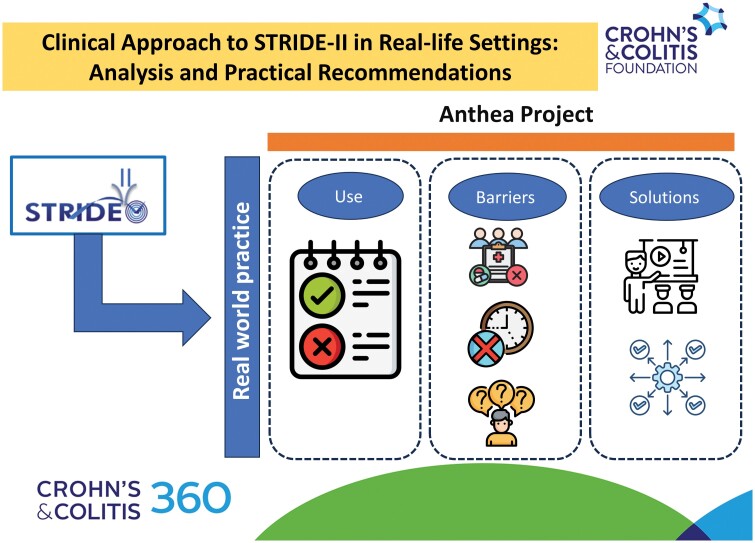
We aimed to (1) analyze the applicability of the updated Selecting Therapeutic Targets in Inflammatory Bowel Disease (STRIDE-II) recommendations in real-world clinical practice, (2) identify barriers to their implementation, and (3) propose practical measures to overcome these obstacles.
This qualitative study was based on a survey, a literature review, and expert opinions. Nine inflammatory bowel disease (IBD) experts identified 7 areas likely to be controversial or potential implementation barriers in daily clinical practice: endoscopy, histology, ultrasound, quality of life, biomarkers, symptom control, and patient-reported outcomes (PROs). Based on this, a survey was carried out among educational course participants. The experts discussed the literature review and survey results and proposed several statements and practical actions.
A total of 55 gastroenterologists answered the survey. The reported difficulty level in reaching STRIDE-II treatment goals in clinical practice was high. Only 22% of participants performed clinical remission assessments using clinical indexes and PROs. Seventy percent of responders did not use fecal calprotectin cutoffs and considered changes from the previous levels instead. Mucosal healing as a long-term therapeutic goal was considered necessary to be individualized in specific patient subgroups (eg, elderly/fragile patients, multiple treatment failures, and last-line therapies). Other barriers, like the lack of access to imaging techniques or insufficient knowledge and skills among healthcare professionals, were detected. The experts suggested adding less stringent treatment goals and measurements, patient stratification, local adaptations, educational activities, and research.
STRIDE-II recommendations face various implementation barriers needing careful evaluation in order to enhance their adoption in clinical practice, and ultimately improve outcomes in IBD patients.
我们旨在(1)分析更新后的炎症性肠病治疗靶点选择(STRIDE-II)建议在实际临床实践中的适用性,(2)确定其实施的障碍,以及(3)提出克服这些障碍的实际措施。
这项定性研究基于一项调查、文献综述和专家意见。九位炎症性肠病(IBD)专家确定了日常临床实践中可能存在争议或潜在实施障碍的7个领域:内镜检查、组织学、超声、生活质量、生物标志物、症状控制和患者报告结局(PROs)。基于此,对参加教育课程的人员进行了一项调查。专家们讨论了文献综述和调查结果,并提出了几条声明和实际行动建议。
共有55位胃肠病学家回答了该调查。据报告,在临床实践中实现STRIDE-II治疗目标的难度很大。只有22%的参与者使用临床指标和PROs进行临床缓解评估。70%的受访者未使用粪便钙卫蛋白临界值,而是考虑与之前水平的变化。黏膜愈合作为长期治疗目标,被认为有必要在特定患者亚组(如老年/体弱患者、多次治疗失败患者和一线治疗)中进行个体化。还发现了其他障碍,如无法获得成像技术或医疗保健专业人员知识和技能不足。专家们建议增加不太严格的治疗目标和测量方法、患者分层、因地制宜、开展教育活动和进行研究。
STRIDE-II建议面临各种实施障碍,需要仔细评估,以提高其在临床实践中的采用率,并最终改善IBD患者的治疗效果。