Berglas Nancy F, Schroeder Rosalyn, Kaller Shelly, Stewart Clara, Upadhyay Ushma D
Advancing New Standards in Reproductive Health (ANSIRH), Department of Obstetrics, Gynecology & Reproductive Sciences, University of California, San Francisco, Oakland, California.
Obstet Gynecol. 2025 Jan 1;145(1):e31-e36. doi: 10.1097/AOG.0000000000005772. Epub 2024 Oct 24.
To examine changes in availability of procedural abortion, especially in the second and third trimesters of pregnancy, since the U.S. Supreme Court ended federal protections for abortion in its Dobbs v. Jackson Women's Health Organization decision in 2022.
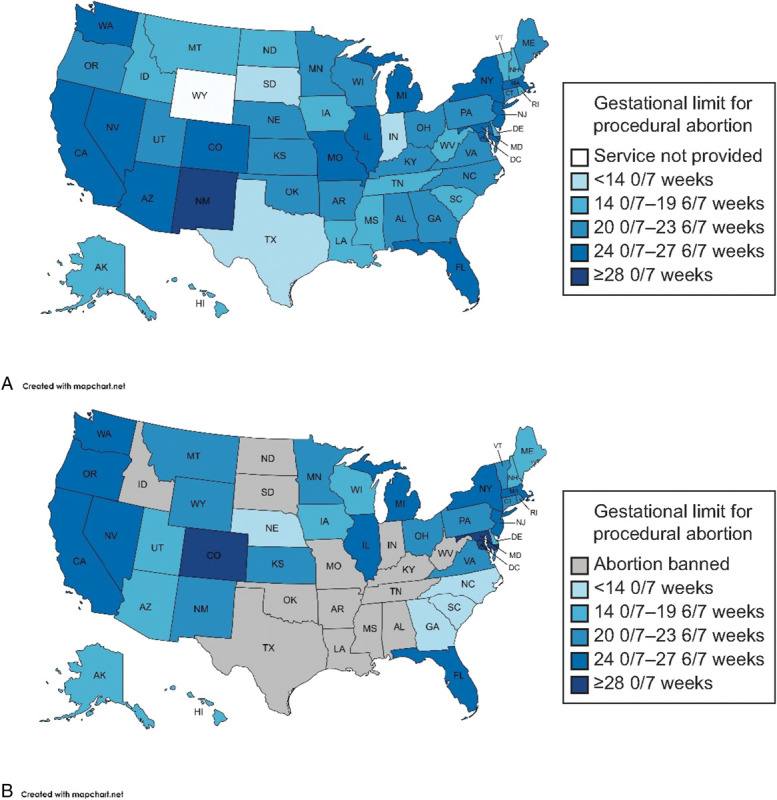
We used the Advancing New Standards in Reproductive Health Abortion Facility Database, a national database of all publicly advertising abortion facilities, to document trends in service availability from 2021 to 2023. We calculated summary statistics to describe facility gestational limits for procedural abortion for the United States and by state, subregion, and region, and we examined the number and proportion of facilities that offer procedural abortion in the second or third trimester of pregnancy.
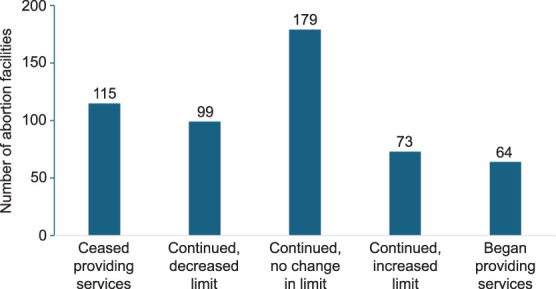
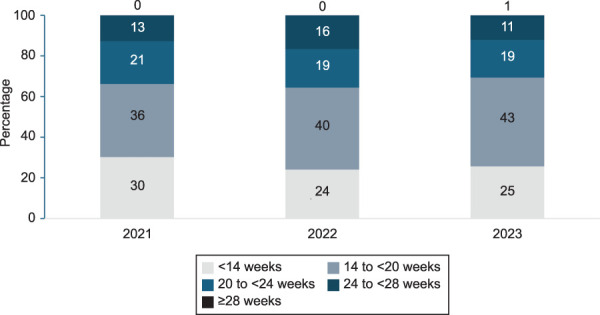
From 2021 to 2023, the total number of publicly advertising facilities providing procedural abortion decreased 11.0%, from 473 to 421. Overall, one-quarter of facilities (n=115) that had been providing procedural abortion in 2021 ceased providing services, and an additional 99 decreased their gestational limits. In contrast, 73 facilities increased their gestational limits, and 64 new facilities began providing or publicly advertising procedural abortion services. The number of facilities offering procedural abortion later in pregnancy decreased (327 to 309 providing 14 weeks of gestation or later, 60 to 50 providing 24 weeks of gestation or later), although the proportion of all facilities providing these services held steady. The greatest changes were in the South, where many facilities closed.
There have been substantial reductions in the number and distribution of facilities offering procedural abortion since the Dobbs decision, with critical decreases in the availability of later abortion services. Some facilities are positioning themselves to meet the needs of patients by opening new facilities, publicly advertising their services, or extending their gestational limits.
研究自美国最高法院在2022年的多布斯诉杰克逊妇女健康组织案判决中终止联邦对堕胎的保护以来,尤其是在妊娠中期和晚期进行手术堕胎的可及性变化。
我们使用了生殖健康堕胎设施数据库中的新标准推进数据库,这是一个全国性的所有公开宣传堕胎设施的数据库,以记录2021年至2023年服务可及性的趋势。我们计算了汇总统计数据,以描述美国以及按州、次区域和地区划分的手术堕胎设施的孕周限制,并研究了在妊娠中期或晚期提供手术堕胎的设施数量和比例。
从2021年到2023年,公开宣传提供手术堕胎的设施总数下降了11.0%,从473家降至421家。总体而言,2021年一直在提供手术堕胎的设施中有四分之一(n = 115)停止提供服务,另有99家降低了其孕周限制。相比之下,73家设施提高了其孕周限制,64家新设施开始提供或公开宣传手术堕胎服务。在妊娠后期提供手术堕胎的设施数量减少了(提供妊娠14周及以后堕胎服务的设施从327家降至309家,提供妊娠24周及以后堕胎服务的设施从60家降至50家),尽管提供这些服务的所有设施的比例保持稳定。变化最大的是南方,许多设施关闭。
自多布斯案判决以来,提供手术堕胎的设施数量和分布大幅减少,后期堕胎服务的可及性显著下降。一些设施通过开设新设施、公开宣传其服务或扩大其孕周限制来满足患者的需求。