Department of Social Welfare, Jeonbuk National University, 567 Baekje-Daero, Jeonju, 54896, Republic of Korea.
School of Social Welfare, The Catholic University of Korea, 43 Jibong-Ro, Bucheon-Si, Gyeonggi-Do, 14662, Republic of Korea.
BMC Geriatr. 2024 Oct 24;24(1):867. doi: 10.1186/s12877-024-05427-x.
The unprecedented pandemic situation of COVID-19 has had a negative impact on the mental health of many people, especially among the "old-old" older adults who are aged 75 or older. Therefore, the aim of this study is to investigate the changes in depression among "old-old" older adults before and after the onset of COVID-19, and the extent to which depression affects suicidal ideations.
The 12th to 16th Korea Welfare Panel Study(KoWePS) conducted from 2017 to 2021 was used for analysis. For this study, 771 older individuals with complete data to estimate the degree of change of depression were selected as the final analysis subjects.
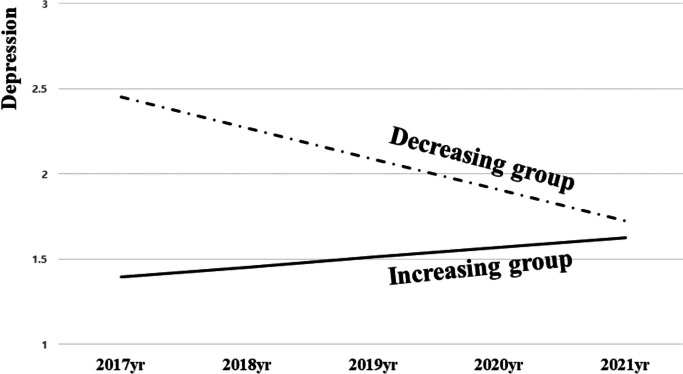
A Growth Mixture Modeling(GMM) analysis was conducted, resulting in the classification of two groups: an increasing group and a decreasing group. The study findings showed that "old-old" older individuals with high levels of depression, specifically those in the decreasing group, may be more susceptible to suicidal ideation. Despite this steep change slope, the decreasing group still exhibited a higher level of depression in 2021 compared to the increasing group. As per characteristics, the decreasing group, which showed a higher prevalence of suicidal ideation, had a higher proportion of women and individuals with lower levels of education, those living alone, and a lower household income compared to the increasing group.
It is important to note that although the study emphasized the need to prioritize intervention for the decreasing group with consistently high levels of depression, the majority of individuals belong to the increasing group, which exhibited a gradual increase in depression levels over time. Therefore, intervention plans should be developed concurrently for both groups. Also, it is crucial to implement proactive efforts targeting groups with understandings of these characteristics when establishing preventative measures for depression and suicidal ideation among "old-old" older adults.
COVID-19 疫情的空前爆发对许多人的心理健康产生了负面影响,尤其是 75 岁及以上的“老老人”。因此,本研究旨在调查 COVID-19 爆发前后“老老人”抑郁程度的变化,以及抑郁对自杀意念的影响程度。
本研究使用了 2017 年至 2021 年进行的第 12 至 16 次韩国福利面板研究(KoWePS)的数据进行分析。本研究选取了 771 名抑郁程度变化估计完整数据的老年人作为最终分析对象。
进行了增长混合模型(GMM)分析,将人群分为增加组和减少组。研究结果表明,抑郁程度较高的“老老人”,特别是减少组,可能更容易产生自杀意念。尽管变化斜率很大,但减少组在 2021 年的抑郁程度仍高于增加组。就特征而言,表现出更高自杀意念发生率的减少组,女性比例、受教育程度较低、独居者以及家庭收入较低的比例均高于增加组。
值得注意的是,尽管该研究强调需要优先干预持续高水平抑郁的减少组,但大多数人属于抑郁程度逐渐增加的增加组。因此,应该同时为这两个组制定干预计划。此外,在制定针对“老老人”抑郁和自杀意念的预防措施时,针对具有这些特征的群体采取主动措施至关重要。