Central Department of Biotechnology, Tribhuvan University, Kirtipur, Kathmandu, Nepal.
Center for Vaccine Innovation, La Jolla Institute for Immunology, La Jolla, CA, USA.
BMC Genomics. 2024 Oct 24;25(1):998. doi: 10.1186/s12864-024-10879-x.
The 4 serotypes of dengue virus (DENV1-4) can each cause potentially deadly dengue disease, and are spreading globally from tropical and subtropical areas to more temperate ones. Nepal provides a microcosm of this global phenomenon, having met each of these grim benchmarks. To better understand DENV transmission dynamics and spread into new areas, we chose to study dengue in Nepal and, in so doing, to build the onsite infrastructure needed to manage future, larger studies.
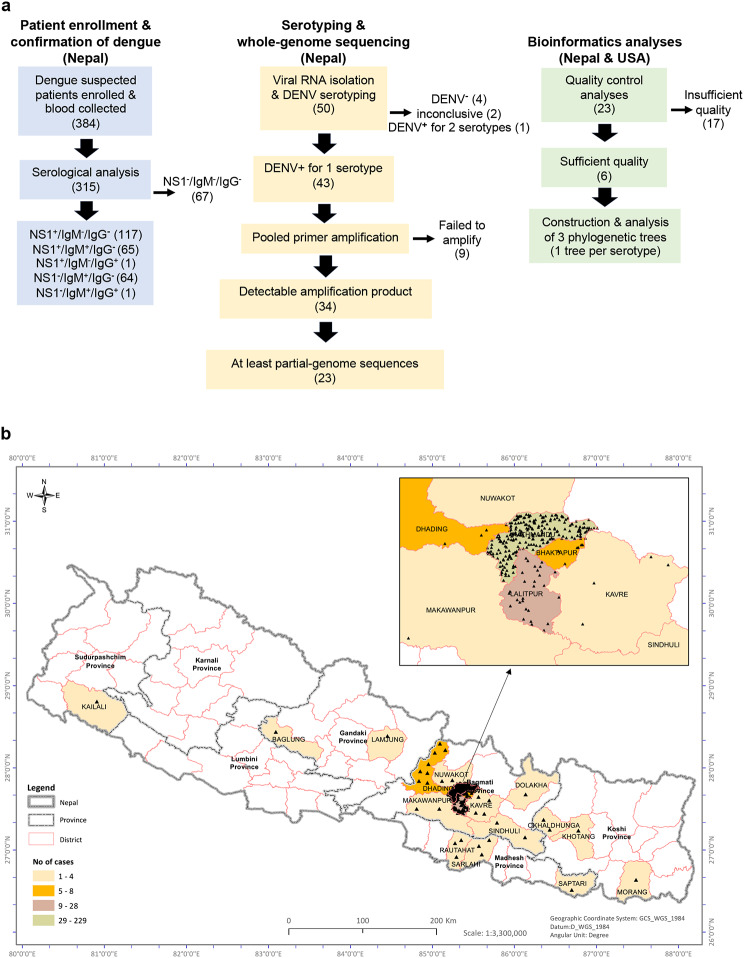
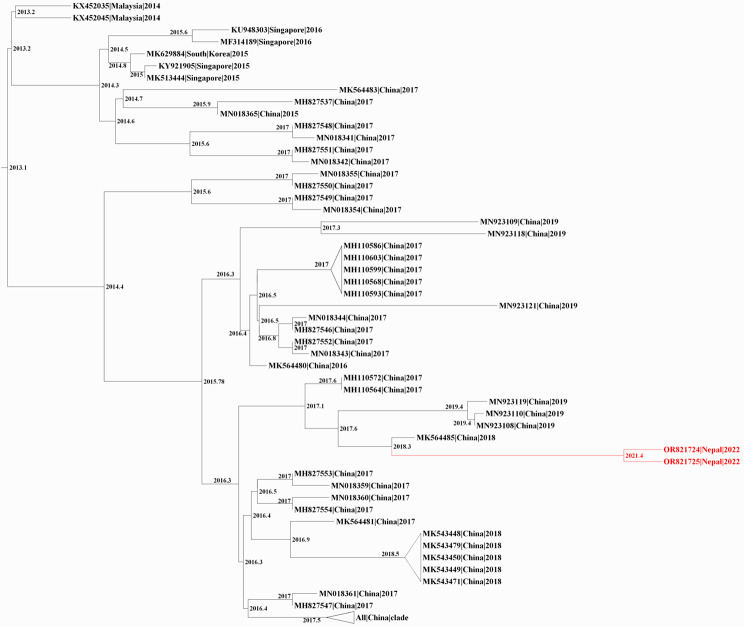
During the 2022 dengue season, we enrolled 384 patients presenting at a hospital in Kathmandu with dengue-like symptoms; 79% of the study participants had active or recent DENV infection (NS1 antigen and IgM). To identify circulating serotypes, we screened serum from 50 of the NS1 participants by RT-PCR and identified DENV1, 2, and 3 - with DENV1 and 3 codominant. We also performed whole-genome sequencing of DENV, for the first time in Nepal, using our new on-site capacity. Sequencing analysis demonstrated the DENV1 and 3 genomes clustered with sequences reported from India in 2019, and the DENV2 genome clustered with a sequence reported from China in 2018.
These findings highlight DENV's geographic expansion from neighboring countries, identify China and India as the likely origin of the 2022 DENV cases in Nepal, and demonstrate the feasibility of building onsite capacity for more rapid genomic surveillance of circulating DENV. These ongoing efforts promise to protect populations in Nepal and beyond by informing the development and deployment of DENV drugs and vaccines in real time.
登革热病毒有 4 种血清型(DENV1-4),每一种都可能导致致命的登革热疾病,而且正在从热带和亚热带地区向更温和的地区传播。尼泊尔就是这种全球现象的一个缩影,已经达到了所有这些严峻的标准。为了更好地了解登革热病毒的传播动态和向新地区的扩散,我们选择在尼泊尔研究登革热,并在此过程中建立现场基础设施,以管理未来更大规模的研究。
在 2022 年登革热季节期间,我们招募了 384 名在加德满都一家医院出现登革热样症状的患者;79%的研究参与者有现症或近期登革热病毒感染(NS1 抗原和 IgM)。为了确定循环血清型,我们通过 RT-PCR 对 50 名 NS1 参与者的血清进行了筛查,并发现了 DENV1、2 和 3,其中 DENV1 和 3 占主导地位。我们还使用我们的新现场能力首次在尼泊尔进行了登革热病毒全基因组测序。测序分析表明,DENV1 和 3 基因组与 2019 年印度报告的序列聚类,而 DENV2 基因组与 2018 年中国报告的序列聚类。
这些发现突出了登革热病毒从邻国的地理扩张,确定了中国和印度是 2022 年尼泊尔登革热病毒病例的可能来源,并证明了建立现场能力以更快速进行循环登革热病毒基因组监测的可行性。这些正在进行的努力有望通过实时为登革热病毒药物和疫苗的开发和部署提供信息,保护尼泊尔和其他地区的人群。