Zeng Shengyuan, Ekwall Karl
Department of Medicine Huddinge, Division of Biosciences and Nutrition, Karolinska Institute, NEO Building, SE-141-83 Huddinge, Sweden.
Epigenomes. 2024 Oct 22;8(4):39. doi: 10.3390/epigenomes8040039.
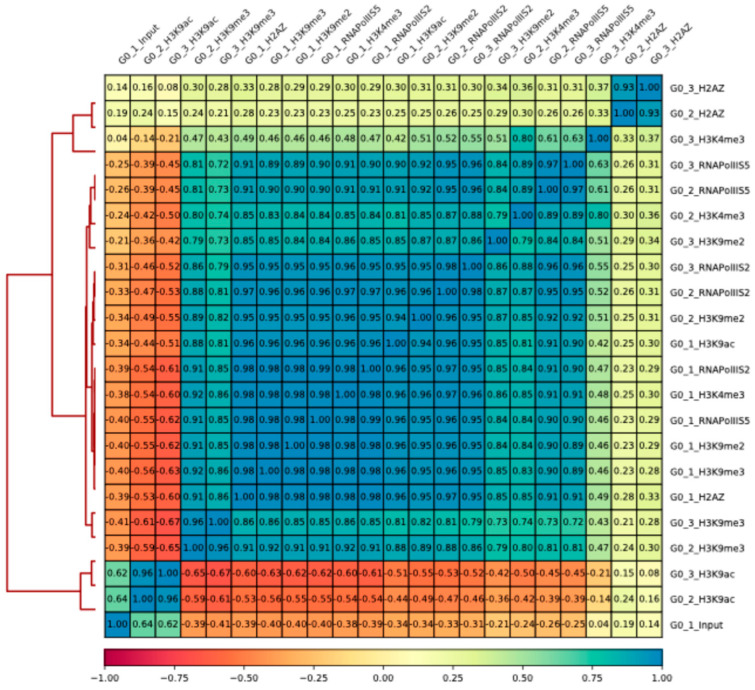
(1) Background: Quiescent cells are those that have stopped dividing and show strongly reduced levels of gene expression during dormancy. In response to appropriate signals, the cells can wake up and start growing again. Many histone modifications are regulated in quiescence, but their exact functions remain to be determined. (2) Methods: Here, we map the different histone modifications, H3K4me3, H3K9ac, H3K9me2, and H3K9me3, and the histone variant H2A.Z, comparing vegetative and quiescent fission yeast () cells. We also map histone H3 as a control and RNA polymerase II (phosphorylated at S2 and S5) to enable comparisons of their occupancies within genes. We use ChIP-seq methodology and several different bioinformatics tools. (3) Results: The histone modification mapping data show that H3K4me3 changes stand out as being the most significant. Changes in occupancy of histone variant H2A.Z were also significant, consistent with earlier studies. Regarding gene expression changes in quiescence, we found that changes in mRNA levels were associated with changes in occupancy of RNA polymerase II (S2 and S5). Analysis of quiescence genes showed that increased H3K4me3 levels and RNA polymerase II occupancy were super-significant in a small set of core quiescence genes that are continuously upregulated during dormancy. We demonstrate that several of these genes were require Set1C/COMPASS activity for their strong induction during quiescence. (4) Conclusions: Our results imply that regulation of gene expression in quiescent cells involves epigenome changes with a key role for H3K4me3 in regulation of RNA polymerase II activity, and that different gene activation mechanisms control early and core quiescence genes. Thus, our data give further insights into important epigenome changes in quiescence using fission yeast as an experimental model.
(1) 背景:静止细胞是那些已经停止分裂且在休眠期间基因表达水平大幅降低的细胞。响应适当信号时,这些细胞能够苏醒并再次开始生长。许多组蛋白修饰在静止状态下受到调控,但其确切功能仍有待确定。(2) 方法:在此,我们绘制了不同的组蛋白修饰,即H3K4me3、H3K9ac、H3K9me2和H3K9me3,以及组蛋白变体H2A.Z,比较了营养生长和静止的裂殖酵母()细胞。我们还绘制了组蛋白H3作为对照以及RNA聚合酶II(在S2和S5处磷酸化),以便比较它们在基因内的占据情况。我们使用染色质免疫沉淀测序(ChIP-seq)方法和几种不同的生物信息学工具。(3) 结果:组蛋白修饰图谱数据表明,H3K4me3的变化最为显著。组蛋白变体H2A.Z占据情况的变化也很显著,这与早期研究一致。关于静止状态下的基因表达变化,我们发现mRNA水平的变化与RNA聚合酶II(S2和S5)占据情况的变化相关。对静止基因的分析表明,在一小部分在休眠期间持续上调的核心静止基因中,H3K4me3水平和RNA聚合酶II占据情况的增加具有超显著性。我们证明,这些基因中的几个在静止期间的强烈诱导需要Set1C/COMPASS活性。(4) 结论:我们的结果表明,静止细胞中基因表达的调控涉及表观基因组变化,其中H3K4me3在调控RNA聚合酶II活性中起关键作用,并且不同的基因激活机制控制早期和核心静止基因。因此,我们的数据利用裂殖酵母作为实验模型,进一步深入了解了静止状态下重要的表观基因组变化。