Saito Shotaro, Tsukamoto Hayato, Karaki Marino, Kunimatsu Narumi, Ogoh Shigehiko
Department of Biomedical Engineering, Toyo University, Saitama, Japan.
Faculty of Sport Sciences, Waseda University, Saitama, Japan.
Exp Physiol. 2025 Jan;110(1):68-78. doi: 10.1113/EP092178. Epub 2024 Oct 25.
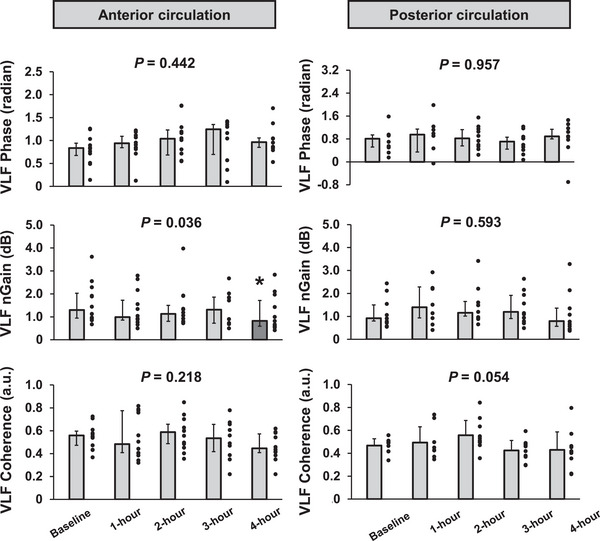
Individuals who experience prolonged sitting daily are reported to be at risk of developing cerebrovascular disease, which is associated, in part, with attenuation in cerebral blood flow regulation. However, the effect of prolonged sitting on dynamic cerebral autoregulation (dCA), a crucial mechanism of cerebral blood flow regulation, remains unclear. Additionally, cerebrovascular disease occurs heterogeneously within cerebral arteries. The purpose of the present study was to examine the hypothesis that prolonged sitting attenuates dCA in the cerebral circulation heterogeneously. Twelve young, healthy participants were instructed to maintain a seated position for 4 h without moving their lower limbs. Mean arterial pressure and mean blood velocities of the middle cerebral artery (MCA V) and the posterior cerebral artery (PCA V) were measured continuously throughout the experiment. The dCA was assessed using transfer function analysis (TFA) with mean arterial pressure and either MCA V or PCA V. In the MCA, very low-frequency TFA-normalized gain decreased significantly during 4 h of prolonged sitting (P = 0.029), indicating an improvement rather than attenuation in dCA, despite a significant reduction in MCA V after 4 h of continuous sitting (P = 0.039). In the PCA, PCA V remained stable throughout the 4 h sitting period (P = 0.923), and all TFA parameters remained unchanged throughout the 4 h of sitting. Contrary to our hypothesis, these results suggest that the dCA in both the MCA and the PCA was well stabilized in healthy young individuals during acute prolonged sitting.
据报道,每天长时间坐着的人有患脑血管疾病的风险,这在一定程度上与脑血流调节减弱有关。然而,长时间坐着对动态脑自动调节(dCA)(脑血流调节的关键机制)的影响仍不清楚。此外,脑血管疾病在脑动脉内的发生具有异质性。本研究的目的是检验以下假设:长时间坐着会使脑循环中的dCA异质性减弱。12名年轻健康的参与者被要求保持坐姿4小时,下肢不动。在整个实验过程中持续测量平均动脉压以及大脑中动脉(MCA V)和大脑后动脉(PCA V)的平均血流速度。使用传递函数分析(TFA),以平均动脉压和MCA V或PCA V来评估dCA。在大脑中动脉,长时间坐着4小时期间,极低频TFA标准化增益显著降低(P = 0.029),这表明dCA有所改善而非减弱,尽管连续坐4小时后MCA V显著降低(P = 0.039)。在大脑后动脉,在整个4小时的坐姿期间PCA V保持稳定(P = 0.923),并且在整个4小时的坐姿期间所有TFA参数均保持不变。与我们的假设相反,这些结果表明,在健康的年轻个体中,急性长时间坐着期间大脑中动脉和大脑后动脉的dCA均得到了良好的稳定。