Lambiase Christian, Bellini Massimo, Whitehead William E, Popa Stefan Lucian, Morganti Riccardo, Chiarioni Giuseppe
Gastrointestinal Unit, Department of Translational Research and New Technologies in Medicine and Surgery, University of Pisa, Pisa, Italy.
NIHR Nottingham BRC, Nottingham University Hospitals NHS Trust and the University of Nottingham, Nottingham, UK.
Neurogastroenterol Motil. 2025 Jan;37(1):e14948. doi: 10.1111/nmo.14948. Epub 2024 Oct 25.
Functional defecation disorders (FDD) are a common etiology of refractory chronic constipation (CC). FDD diagnosis (dyssynergic defecation [DD] and inadequate defecatory propulsion [IDP]), requires diagnostic tests including anorectal manometry (ARM) and balloon expulsion test (BET). Biofeedback (BF) is the treatment of choice for DD. The aims of our study were to evaluate: the outcome of BF in a group of constipated patients with defecatory disorders of any etiology; the efficacy of two simple diagnostic tools in predicting BF outcome in the short-term.
One hundred and thirty-one refractory CC patients failing the BET underwent BF therapy. Before BF, all patients underwent the following: ARM. Straining questionnaire. The answers were: "belly muscles"; "anal muscles"; "both"; "Don't know/No answer." Digital rectal examination augmented by abdominal palpation on straining (augmented-DRE). The BF therapist was blinded to ARM, straining questionnaire, and augmented-DRE results.
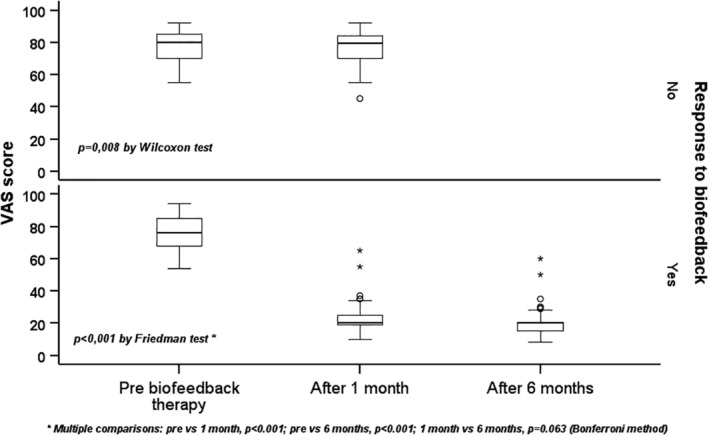
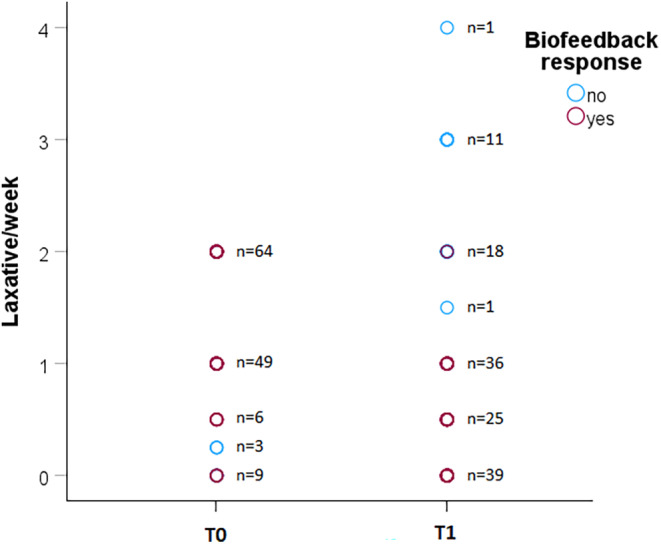
Eighty-one patients responded to BF. Gender, age, and IBS-C showed no significant impact on BF response. Both DD and IDP responded equally to BF, while the rate of response in patients with isolated structural pelvic floor abnormalities was lower (p < 0.001). The answer "anal muscles" to straining questionnaire showed a strong association with BF response (p < 0.001). A lack in abdominal contraction and in anal relaxation on augmented-DRE were strongly associated with BF response (p < 0.01). Absence of manual maneuvers to facilitate defecation was associated with BF response (p < 0.001).
CONCLUSIONS & INFERENCES: BF is the therapy of choice for refractory constipation due to FDD of any etiology, inducing both clinical and anorectal physiology improvement in the short term. Comorbid IBS-C did not affect outcome while symptomatic isolated pelvic floor abnormalities appeared refractory to behavior treatment. The straining questionnaire and augmented-DRE outcomes showed a strong correlation with BF response and can be implemented in clinical practice to improve the management of constipated patients by prompting early referral to BF.
功能性排便障碍(FDD)是难治性慢性便秘(CC)的常见病因。FDD的诊断(排便协同失调[DD]和排便推进不足[IDP])需要进行包括肛门直肠测压(ARM)和球囊排出试验(BET)在内的诊断测试。生物反馈(BF)是DD的首选治疗方法。我们研究的目的是评估:一组患有任何病因排便障碍的便秘患者的BF治疗结果;两种简单诊断工具在预测短期BF治疗结果方面的有效性。
131例BET试验失败的难治性CC患者接受BF治疗。在BF治疗前,所有患者均接受以下检查:ARM、用力排便问卷。答案包括:“腹部肌肉”;“肛门肌肉”;“两者都有”;“不知道/无答案”。在用力排便时通过腹部触诊增强的直肠指检(增强直肠指检)。BF治疗师对ARM、用力排便问卷和增强直肠指检结果不知情。
81例患者对BF治疗有反应。性别、年龄和IBS-C对BF治疗反应无显著影响。DD和IDP对BF治疗的反应相同,而孤立性结构性盆底异常患者的反应率较低(p<0.001)。用力排便问卷中“肛门肌肉”的答案与BF治疗反应密切相关(p<0.001)。增强直肠指检时腹部收缩和肛门松弛的缺乏与BF治疗反应密切相关(p<0.01)。缺乏促进排便的手法操作与BF治疗反应相关(p<0.001)。
BF是任何病因的FDD所致难治性便秘的首选治疗方法,可在短期内改善临床症状和肛门直肠生理功能。合并IBS-C不影响治疗结果,而有症状的孤立性盆底异常对行为治疗似乎无效。用力排便问卷和增强直肠指检结果与BF治疗反应密切相关,可在临床实践中应用,通过促使早期转诊至BF治疗来改善便秘患者的管理。