Department of Pathology and Laboratory Medicine, University of North Carolina, Chapel Hill, NC 27599, USA.
McAllister Heart Institute, University of North Carolina, Chapel Hill, NC 27599, USA.
Cells. 2024 Oct 11;13(20):1683. doi: 10.3390/cells13201683.
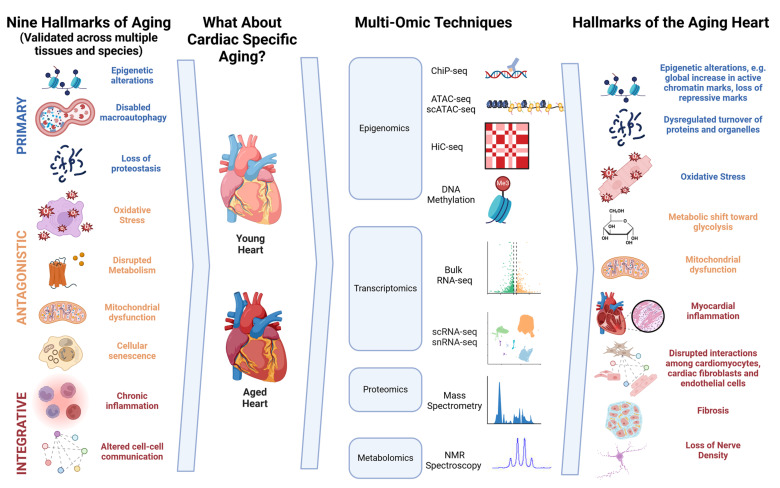
Cardiovascular diseases are a leading cause of mortality worldwide, and the risks of both developing a disease and receiving a poor prognosis increase with age. With increasing life expectancy, understanding the mechanisms underlying heart aging has become critical. Traditional techniques have supported research into finding the physiological changes and hallmarks of cardiovascular aging, including oxidative stress, disabled macroautophagy, loss of proteostasis, and epigenetic alterations, among others. The advent of high-throughput multi-omics techniques offers new perspectives on the molecular mechanisms and cellular processes in the heart, guiding the development of therapeutic targets. This review explores the contributions and characteristics of these high-throughput techniques to unraveling heart aging. We discuss how different high-throughput omics approaches, both alone and in combination, produce robust and exciting new findings and outline future directions and prospects in studying heart aging in this new era.
心血管疾病是全球范围内导致死亡的主要原因之一,患病风险和预后不良的风险随着年龄的增长而增加。随着预期寿命的延长,了解心脏衰老的机制变得至关重要。传统技术支持了寻找心血管衰老的生理变化和特征的研究,包括氧化应激、受损的巨自噬、蛋白质稳态丧失和表观遗传改变等。高通量多组学技术的出现为心脏的分子机制和细胞过程提供了新的视角,指导治疗靶点的开发。本综述探讨了这些高通量技术对揭示心脏衰老的贡献和特点。我们讨论了不同的高通量组学方法(单独使用或组合使用)如何产生强大而令人兴奋的新发现,并概述了在这个新时代研究心脏衰老的未来方向和前景。