Fernández-Gibello Alejandro, Camuñas Nieves Gabriel, Jara Pacheco Ruth Liceth, Fajardo Pérez Mario, Galluccio Felice
Clínica Vitruvio, 28003 Madrid, Spain.
Podiatry Department, La Salle Centro Universitario, 28023 Madrid, Spain.
Healthcare (Basel). 2024 Oct 17;12(20):2071. doi: 10.3390/healthcare12202071.
BACKGROUND/OBJECTIVES: The tibial nerve, commonly misnamed the "posterior tibial nerve", branches into four key nerves: the medial plantar, lateral plantar, inferior calcaneal (Baxter's nerve), and medial calcaneal branches. These nerves are integral to both the sensory and motor functions of the foot. Approximately 15% of adults with foot issues experience heel pain, frequently stemming from neural origins, such as tarsal tunnel syndrome (TTS). TTS diagnosis remains challenging due to a high false negative rate in neurophysiological studies. This study aims to improve the understanding and diagnosis of distal tarsal tunnel pathology to enable more effective treatments, including platelet-rich plasma, hydrodissections, radiofrequencies, and prolotherapy.
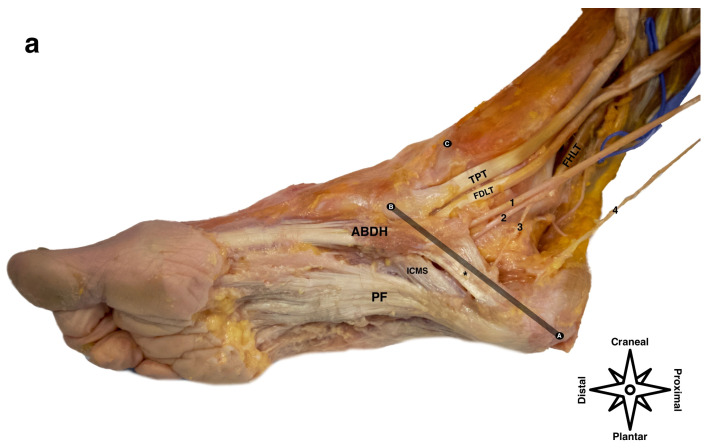
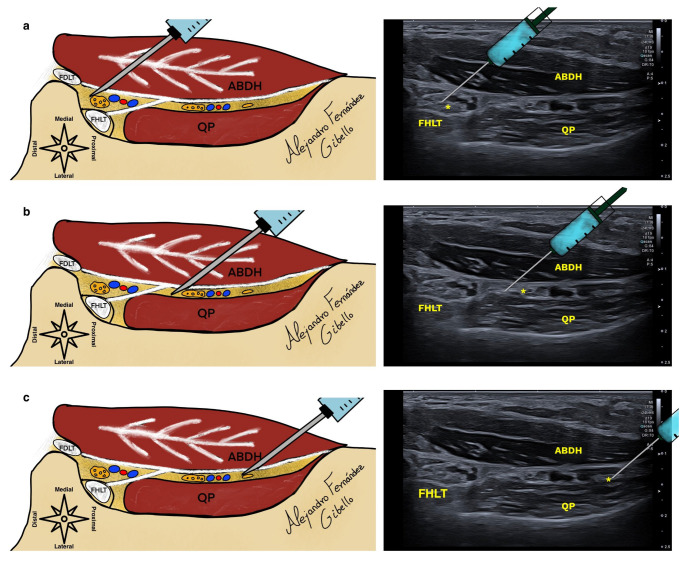
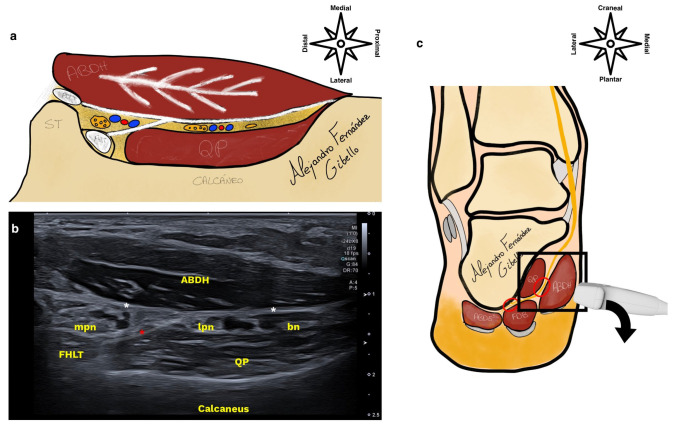
Ultrasound-guided techniques were employed to examine the distal tarsal tunnel using the Heimkes triangle for optimal probe placement.
The results indicate that the tunnel consists of two chambers separated by the interfascicular septum, housing the medial, lateral plantar, and inferior calcaneal nerves. Successful interventions depend on precise visualization and patient positioning. This study emphasizes the importance of avoiding the calcaneus periosteum to reduce discomfort.
Standardizing nerve involvement classification in TTS is difficult without robust neurophysiological studies. The accurate targeting of nerve branches is essential for effective treatment.
背景/目的:胫神经,通常被误称为“胫后神经”,分为四条关键神经:足底内侧神经、足底外侧神经、跟下神经(巴克斯特神经)和跟内侧神经分支。这些神经对于足部的感觉和运动功能均不可或缺。约15%有足部问题的成年人会经历足跟痛,通常源于神经源性病因,如跗管综合征(TTS)。由于神经生理学研究中的假阴性率较高,TTS的诊断仍然具有挑战性。本研究旨在提高对跗管远端病理的认识和诊断,以实现更有效的治疗,包括富血小板血浆治疗、水分离术、射频治疗和注射治疗。
采用超声引导技术,利用海姆克斯三角来优化探头放置,对跗管远端进行检查。
结果表明,该管由两个腔室组成,由束间隔膜分隔,容纳足底内侧神经、足底外侧神经和跟下神经。成功的干预取决于精确的可视化和患者体位。本研究强调避免跟骨骨膜以减轻不适的重要性。
没有强有力的神经生理学研究,很难对TTS中的神经受累情况进行标准化分类。准确靶向神经分支对于有效治疗至关重要。