Benecke Jonas-Alexander, Calderón Eduardo, Reischl Gerald, Brendlin Andreas, Tsaur Igor, la Fougère Christian, Vogel Jonas
Nuclear Medicine and Clinical Molecular Imaging, Department of Radiology, University Hospital of Tuebingen, Otfried-Mueller-Strasse 14, 72076 Tuebingen, Germany.
Cluster of Excellence iFIT (EXC 2180) "Image Guided and Functionally Instructed Tumor Therapies", University of Tuebingen, 72076 Tuebingen, Germany.
Diagnostics (Basel). 2024 Oct 18;14(20):2327. doi: 10.3390/diagnostics14202327.
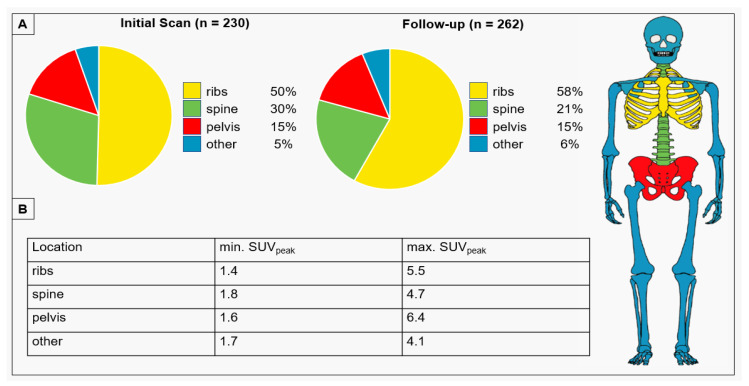
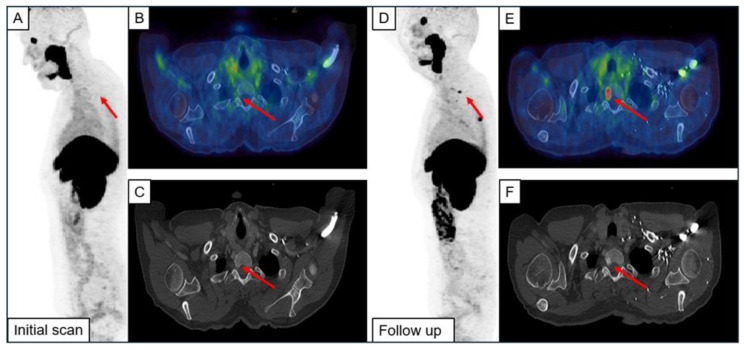
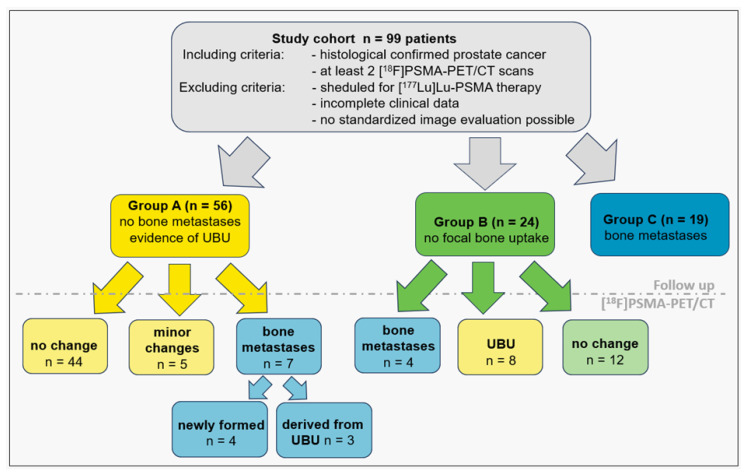
Focal unspecific bone uptake (UBU) is common in [F]PSMA-1007 PET/CT, yet its clinical significance remains unclear, causing uncertainty in treatment decisions. We retrospectively analyzed 99 prostate cancer patients (age 69 ± 7) who underwent [F]PSMA-1007 PET/CT scans (3 MBq/kg; uptake time 70 ± 14 min) for staging and follow-up (after 13.0 ± 7.2 months). Semiquantitative assessment using the miPSMA score, analogous to the PROMISE criteria, evaluated the prevalence of UBU and bone metastases. In the initial PET/CT scan, 56 patients had 230 lesions classified as UBU. A total of 19 patients were found to have bone metastases and UBU, while 24 patients had no focal bone uptake. UBU distribution was as follows: ribs (50%), spine (30%), pelvis (15%), and other sites (5%). There were no significant differences in age, Gleason score, injected tracer dose, uptake time, SUV of UBU, or SUV in the spleen and parotid gland between patients with and without UBU. Follow-up showed stable miPSMA-score and CT appearance in 44/56 patients with UBU (79%), minor changes in 5/56 patients (8%), and new bone metastases in 7/56 patients (12%). Patient-specific analysis indicated at least one bone metastasis initially classified as UBU in 3/56 patients (5%) and new bone metastases in 4/56 patients (7%). In total, 4 of the 24 patients (17%) without initial focal uptake developed osseous metastases at follow-up. No significant differences were found between patients with or without UBU. Only a small portion of UBU (2%) evolved into metastases, a lower rate than the development of new osseous metastases, which appears to be independent of UBU.
局灶性非特异性骨摄取(UBU)在[F]PSMA - 1007 PET/CT中很常见,但其临床意义仍不明确,这导致治疗决策存在不确定性。我们回顾性分析了99例前列腺癌患者(年龄69±7岁),这些患者接受了[F]PSMA - 1007 PET/CT扫描(3 MBq/kg;摄取时间70±14分钟)用于分期和随访(13.0±7.2个月后)。使用类似于PROMISE标准的miPSMA评分进行半定量评估,以评估UBU和骨转移的发生率。在初始PET/CT扫描中,56例患者有230个病变被分类为UBU。总共19例患者被发现有骨转移和UBU,而24例患者没有局灶性骨摄取。UBU分布如下:肋骨(50%)、脊柱(30%)、骨盆(15%)和其他部位(5%)。有UBU和无UBU的患者在年龄、 Gleason评分、注射示踪剂剂量、摄取时间、UBU的SUV以及脾脏和腮腺的SUV方面均无显著差异。随访显示,56例有UBU的患者中,44例(79%)的miPSMA评分和CT表现稳定,5例(8%)有轻微变化,7例(12%)出现新的骨转移。患者特异性分析表明,56例患者中有3例(5%)最初被分类为UBU的病变至少有一处骨转移,4例(7%)出现新的骨转移。在总共24例最初无局灶性摄取的患者中,4例(17%)在随访时发生了骨转移。有或无UBU的患者之间未发现显著差异。只有一小部分UBU(2%)发展为转移,其发生率低于新骨转移的发生率,新骨转移的发生似乎与UBU无关。