
基于勒让德多项式拟合的排列熵为疲劳对表面肌电图(sEMG)信号复杂性的影响提供了新见解。
Legendre Polynomial Fitting-Based Permutation Entropy Offers New Insights into the Influence of Fatigue on Surface Electromyography (sEMG) Signal Complexity.
作者信息
Jabloun Meryem, Buttelli Olivier, Ravier Philippe
机构信息
Laboratoire Pluridisciplinaire de Recherche en Ingénierie des Systèmes, Mécanique, Énergétique (PRISME), University of Orleans, 45100 Orleans, France.
出版信息
Entropy (Basel). 2024 Sep 30;26(10):831. doi: 10.3390/e26100831.
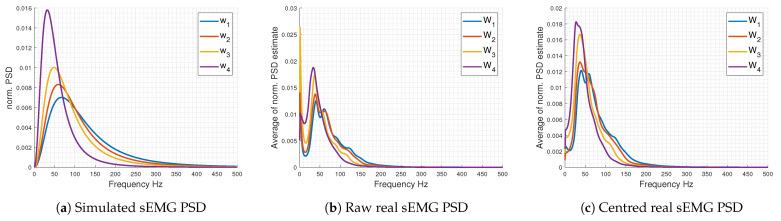
In a recently published work, we introduced local Legendre polynomial fitting-based permutation entropy (LPPE) as a new complexity measure for quantifying disorder or randomness in time series. LPPE benefits from the ordinal pattern (OP) concept and incorporates a natural, aliasing-free multiscaling effect by design. The current work extends our previous study by investigating LPPE's capability to assess fatigue levels using both synthetic and real surface electromyography (sEMG) signals. Real sEMG signals were recorded during biceps brachii fatiguing exercise maintained at 70% of maximal voluntary contraction (MVC) until exhaustion and were divided into four consecutive temporal segments reflecting sequential stages of exhaustion. As fatigue levels rise, LPPE values can increase or decrease significantly depending on the selection of embedding dimensions. Our analysis reveals two key insights. First, using LPPE with limited embedding dimensions shows consistency with the literature. Specifically, fatigue induces a decrease in sEMG complexity measures. This observation is supported by a comparison with the existing multiscale permutation entropy (MPE) variant, that is, the refined composite downsampling (rcDPE). Second, given a fixed OP length, higher embedding dimensions increase LPPE's sensitivity to low-frequency components, which are notably present under fatigue conditions. Consequently, specific higher embedding dimensions appear to enhance the discrimination of fatigue levels. Thus, LPPE, as the only MPE variant that allows a practical exploration of higher embedding dimensions, offers a new perspective on fatigue's impact on sEMG complexity, complementing existing MPE approaches.
在最近发表的一项工作中,我们引入了基于局部勒让德多项式拟合的排列熵(LPPE),作为一种用于量化时间序列中的无序或随机性的新复杂性度量。LPPE受益于序数模式(OP)概念,并通过设计纳入了一种自然的、无混叠的多尺度效应。当前的工作通过研究LPPE使用合成和真实表面肌电图(sEMG)信号评估疲劳水平的能力,扩展了我们之前的研究。在肱二头肌疲劳运动期间记录真实的sEMG信号,运动强度维持在最大自主收缩(MVC)的70%,直到疲劳耗尽,并将其分为四个连续的时间段,反映疲劳耗尽的连续阶段。随着疲劳水平的上升,根据嵌入维度的选择,LPPE值可能会显著增加或减少。我们的分析揭示了两个关键见解。首先,使用有限嵌入维度的LPPE与文献一致。具体而言,疲劳会导致sEMG复杂性度量的降低。与现有的多尺度排列熵(MPE)变体,即细化复合下采样(rcDPE)的比较支持了这一观察结果。其次,在给定固定的OP长度的情况下,更高的嵌入维度会增加LPPE对低频成分的敏感性,而低频成分在疲劳条件下尤为明显。因此,特定的更高嵌入维度似乎增强了对疲劳水平的辨别能力。因此,LPPE作为唯一允许实际探索更高嵌入维度的MPE变体,为疲劳对sEMG复杂性的影响提供了新的视角,补充了现有的MPE方法。




 Zotero 插件