Yang Xixi, Liechti Martina D, Kanber Baris, Sudre Carole H, Castellazzi Gloria, Zhang Jiaying, Yiannakas Marios C, Gonzales Gwen, Prados Ferran, Toosy Ahmed T, Gandini Wheeler-Kingshott Claudia A M, Panicker Jalesh N
Department of Neurology, Xuan Wu Hospital of Capital Medical University, Beijing 100053, China.
Department of Brain Repair and Rehabilitation, Faculty of Brain Sciences, Queen Square Institute of Neurology, University College London, London WC1E 6BT, UK.
Brain Sci. 2024 Sep 27;14(10):975. doi: 10.3390/brainsci14100975.
Lower urinary tract (LUT) symptoms are reported in more than 80% of patients with multiple sclerosis (MS), most commonly an overactive bladder (OAB). The relationship between brain white matter (WM) changes in MS and OAB symptoms is poorly understood.
We aim to evaluate (i) microstructural WM differences across MS patients (pwMS) with OAB symptoms, patients without LUT symptoms, and healthy subjects using diffusion tensor imaging (DTI), and (ii) associations between clinical OAB symptom scores and DTI indices.
Twenty-nine female pwMS [mean age (SD) 43.3 years (9.4)], including seventeen with OAB [mean age (SD) 46.1 years (8.6)] and nine without LUT symptoms [mean age (SD) 37.5 years (8.9)], and fourteen healthy controls (HCs) [mean age (SD) 48.5 years (20)] were scanned in a 3T MRI with a DTI protocol. Additionally, clinical scans were performed for WM lesion segmentation. Group differences in fractional anisotropy (FA) were evaluated using tract-based spatial statistics. The Urinary Symptom Profile questionnaire assessed OAB severity.
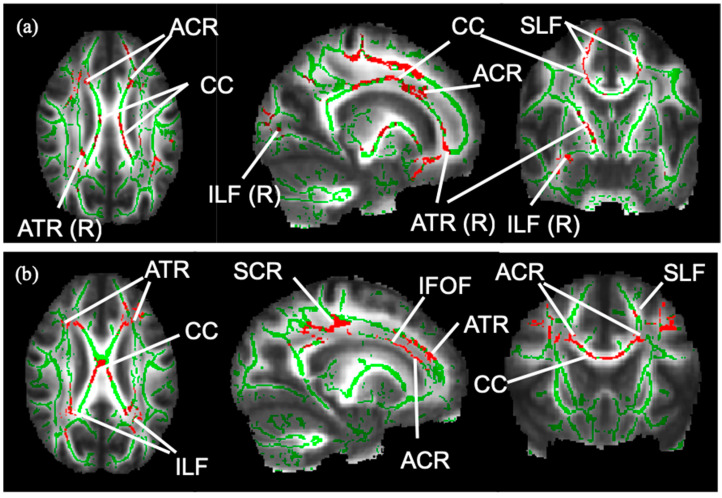
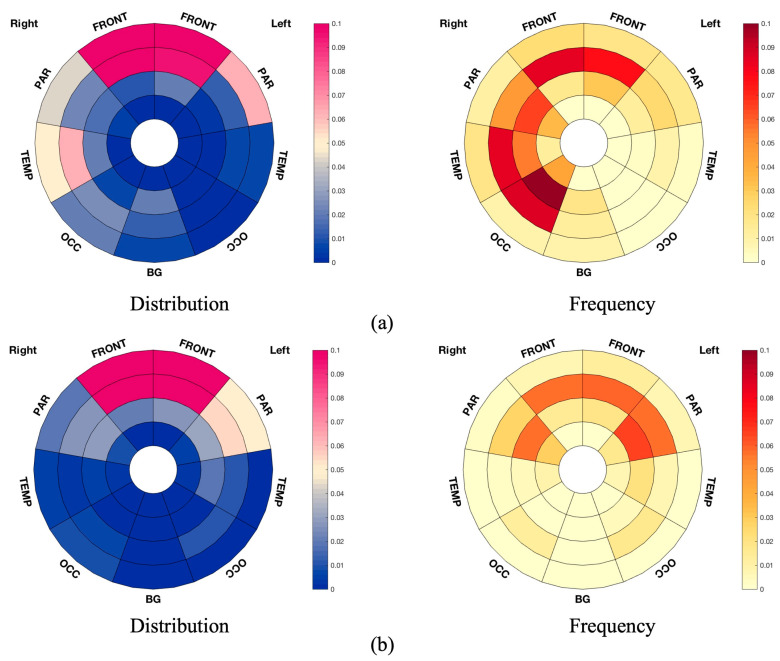
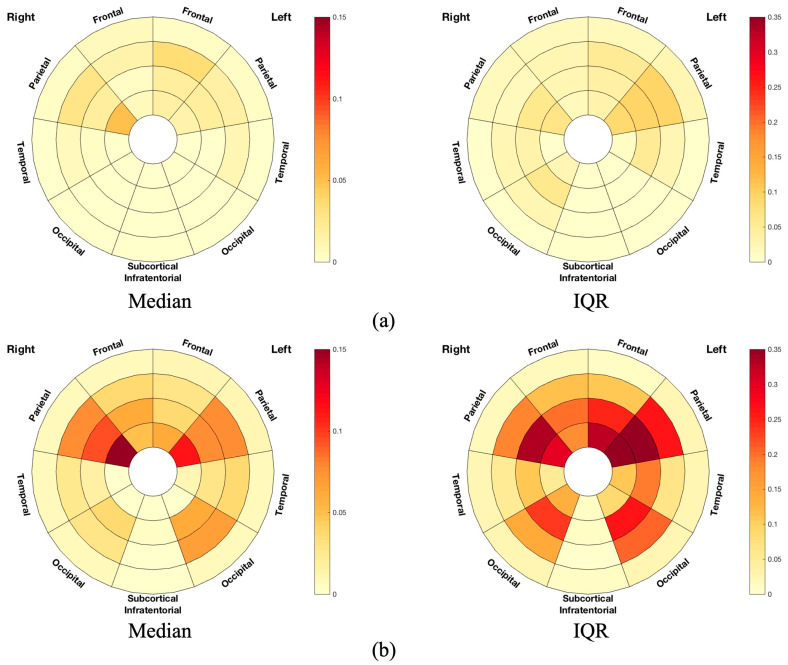
A statistically significant reduction in FA ( = 0.004) was identified in microstructural WM in pwMS, compared with HCs. An inverse correlation was found between FA in frontal and parietal WM lobes and OAB scores ( = 0.021) in pwMS. Areas of lower FA, although this did not reach statistical significance, were found in both frontal lobes and the rest of the non-dominant hemisphere in pwMS with OAB compared with pwMS without LUT symptoms ( = 0.072).
This study identified that lesions affecting different WM tracts in MS can result in OAB symptoms and demonstrated the role of the WM in the neural control of LUT functions. By using DTI, the association between OAB symptom severity and WM changes were identified, adding knowledge to the current LUT working model. As MS is predominantly a WM disease, these findings suggest that regional WM involvement, including of the anterior corona radiata, anterior thalamic radiation, superior longitudinal fasciculus, and superior frontal-occipital fasciculus and a non-dominant prevalence in WM, can result in OAB symptoms. OAB symptoms in MS correlate with anisotropy changes in different white matter tracts as demonstrated by DTI. Structural impairment in WM tracts plays an important role in LUT symptoms in MS.
超过80%的多发性硬化症(MS)患者报告有下尿路(LUT)症状,最常见的是膀胱过度活动症(OAB)。MS患者脑白质(WM)变化与OAB症状之间的关系尚不清楚。
我们旨在评估(i)使用扩散张量成像(DTI)对有OAB症状的MS患者(pwMS)、无LUT症状的患者和健康受试者的微观结构WM差异,以及(ii)临床OAB症状评分与DTI指数之间的关联。
29名女性pwMS[平均年龄(标准差)43.3岁(9.4)],包括17名有OAB的患者[平均年龄(标准差)46.1岁(8.6)]和9名无LUT症状的患者[平均年龄(标准差)37.5岁(8.9)],以及14名健康对照者(HCs)[平均年龄(标准差)48.5岁(20)]接受了3T MRI的DTI扫描。此外,还进行了临床扫描以进行WM病变分割。使用基于体素的空间统计学评估分数各向异性(FA)的组间差异。尿症状概况问卷评估OAB严重程度。
与HCs相比,pwMS的微观结构WM中FA有统计学显著降低(=0.004)。在pwMS中,额叶和顶叶WM叶的FA与OAB评分之间存在负相关(=0.021)。与无LUT症状的pwMS相比,有OAB的pwMS在额叶和非优势半球其余部分的FA较低,尽管未达到统计学显著性(=0.072)。
本研究发现,影响MS中不同WM束的病变可导致OAB症状,并证明了WM在LUT功能神经控制中的作用。通过使用DTI,确定了OAB症状严重程度与WM变化之间的关联,为当前的LUT工作模型增添了知识。由于MS主要是一种WM疾病,这些发现表明,包括放射冠前部、丘脑前辐射、上纵束和额枕上束在内的区域WM受累以及WM中的非优势患病率可导致OAB症状。如DTI所示,MS中的OAB症状与不同白质束中的各向异性变化相关。WM束的结构损伤在MS的LUT症状中起重要作用。