Asaf Achiron, Evan Stone, Anat Achiron
Multiple Sclerosis Center, Sheba Medical Center, Tel-Hashomer, Ramat-Gan, Israel.
Neuroimage Clin. 2015 Apr 30;8:261-6. doi: 10.1016/j.nicl.2015.04.020. eCollection 2015.
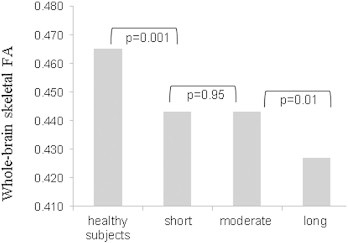
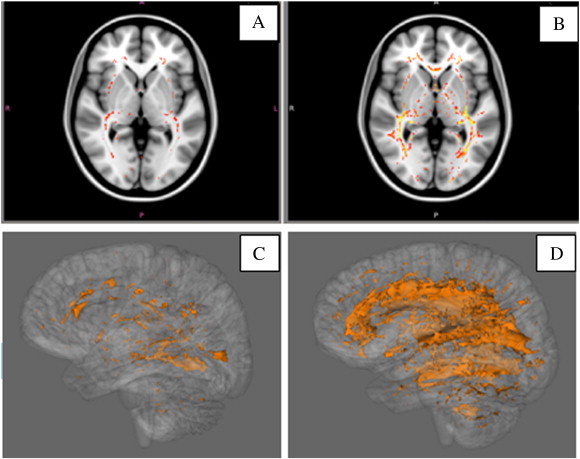
DTI studies in multiple sclerosis (MS) reveal white matter (WM) injury that occurs with disease progression. In the present study we aimed to elucidate the relationship of microstructural WM damage in patients with varying periods of disease duration. DTI scans were acquired from 90 MS patients and 25 healthy controls. Patients were grouped to short (<1 year), moderate (1 up to 6 years) and long (6-10 years) disease duration periods. Statistical analyses of the fractional anisotropy (FA) data were performed using tract-based spatial statistics (TBSS). Whole-brain skeletal FA measurements showed a significant decrease between healthy controls and the short MS disease duration group, as well as between moderate disease duration and long disease duration groups, but failed to show a significant difference between short and moderate disease duration groups. Voxelwise analysis revealed clusters of diffuse FA reductions in 40 WM tracts when comparing healthy controls and MS short disease duration group, with the point of maximal significant difference located in the left inferior longitudinal fasciculus. Comparing short with long disease duration groups, progressive FA reduction was demonstrated across 30 WM tracts, with the point of maximal significant difference migrating to the body of the corpus callosum. A non-linear pattern of WM microstructure disruption occurs in RRMS. Alterations are seen early in the disease course within 1 year from onset, reach a plateau within the next 5 years, and only later additional WM changes are detected. An important period of a possible therapeutic window therefore exists within the early disease stage.
扩散张量成像(DTI)研究显示,多发性硬化症(MS)患者的白质(WM)损伤会随着疾病进展而出现。在本研究中,我们旨在阐明不同病程患者的WM微观结构损伤之间的关系。对90例MS患者和25名健康对照者进行了DTI扫描。将患者分为病程短(<1年)、病程中等(1至6年)和病程长(6至10年)三组。使用基于束的空间统计学(TBSS)对各向异性分数(FA)数据进行统计分析。全脑骨骼FA测量结果显示,健康对照组与MS病程短的组之间,以及病程中等组和病程长的组之间,FA均显著降低,但病程短的组和病程中等的组之间未显示出显著差异。体素分析显示,在比较健康对照组和MS病程短的组时,40条WM束中存在弥漫性FA降低的簇,最大显著差异点位于左侧下纵束。比较病程短和病程长的组时,30条WM束中均显示出FA进行性降低,最大显著差异点迁移至胼胝体体部。复发缓解型多发性硬化症(RRMS)中存在WM微观结构破坏的非线性模式。发病后1年内的疾病早期即可观察到改变,在接下来的5年内达到平台期,之后才检测到额外的WM变化。因此,在疾病早期阶段存在一个可能的治疗窗的重要时期。