Mochizuki Luis, Pennone Juliana, Bigongiari Aline, Cosme Renata Garrido, Massa Marcelo, Ré Alessandro Hervaldo Nicolai, Alcântaro Ricardo Pereira, Amadio Alberto Carlos
School of Arts, Science and Humanities, University of São Paulo, São Paulo 03828-000, Brazil.
Department of Orthopeadics and Traumatology, Hospital das Clínicas, Faculty of Medicine, University of São Paulo, São Paulo 05402-000, Brazil.
Brain Sci. 2024 Oct 3;14(10):1004. doi: 10.3390/brainsci14101004.
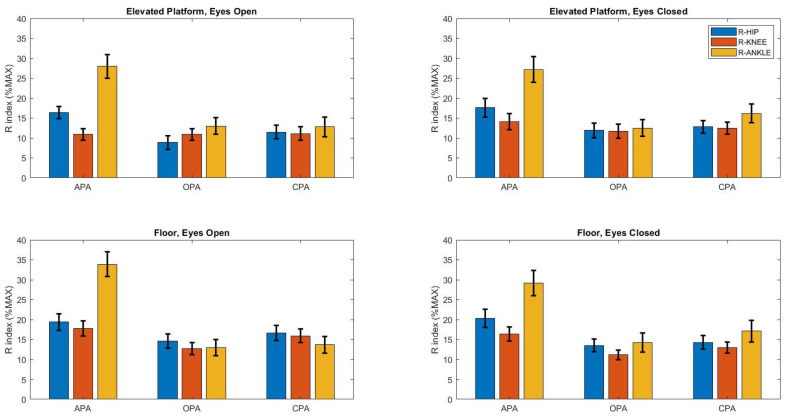
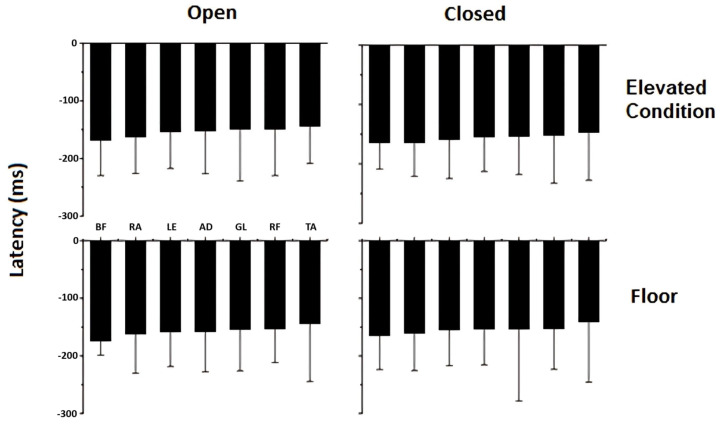
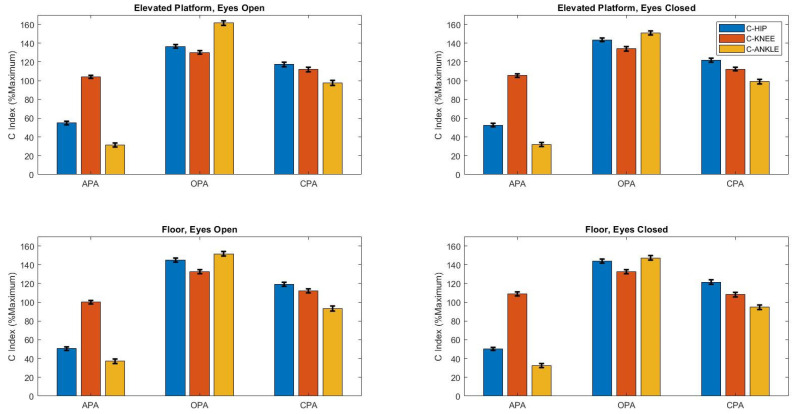
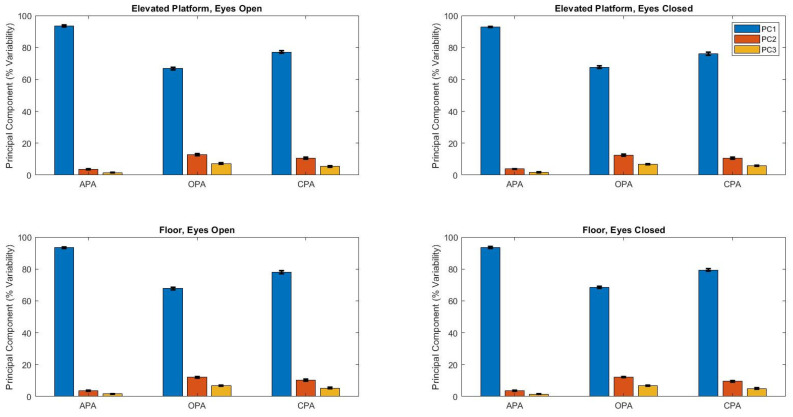
: This study investigated the behavior of postural adjustments throughout the entire action: from the preparatory phase (anticipatory postural adjustment, APA), the focal movement phase (online postural adjustments, OPA), to the compensatory phase (compensatory postural adjustment, CPA) while raising the arms in a standing position, both with eyes opened and closed. The goal was to analyze the effects of reduced sensorial information and different heights on postural muscle activity during these three phases. : Eight young women performed rapid shoulder flexion while standing on the ground and on a 1-m elevated platform. The EMG activity of the trunk and lower limb muscles was recorded during all three phases. : Although average muscle activity was similar on the ground and the elevated platform, the pattern of postural muscle activation varied across the motor action. During OPA, all postural muscle activity was the highest, while it was the lowest during APA. On the elevated platform postural muscles have increased their activation during APA. In the most stable condition (standing on the ground with eyes opened), muscle activity showed a negative correlation between APA and OPA, but there was no correlation between OPA and CPA. : Our results suggest postural control adapts to sensory, motor, and cognitive conditions. Therefore, the increased demand for postural control due to the height of the support base demands greater flexibility in postural synergies and alters muscle activity.
从准备阶段(预期姿势调整,APA)、焦点运动阶段(在线姿势调整,OPA)到补偿阶段(补偿性姿势调整,CPA),包括睁眼和闭眼两种情况。目的是分析在这三个阶段中感觉信息减少和不同高度对姿势肌肉活动的影响。八名年轻女性在地面和1米高的平台上进行快速肩部屈曲动作。在所有三个阶段记录躯干和下肢肌肉的肌电图活动。虽然地面和高台上的平均肌肉活动相似,但姿势肌肉激活模式在整个运动动作中有所不同。在OPA期间,所有姿势肌肉活动最高,而在APA期间最低。在高台上,姿势肌肉在APA期间增加了激活。在最稳定的条件下(睁眼站在地面上),肌肉活动在APA和OPA之间呈负相关,但OPA和CPA之间没有相关性。我们的结果表明,姿势控制适应感觉、运动和认知条件。因此,由于支撑基础高度导致的姿势控制需求增加,需要姿势协同作用具有更大的灵活性并改变肌肉活动。