Rizzacasa Barbara, Nicolì Vanessa, Tancredi Chantal, Conte Chiara, Salehi Leila B, Carriero Miriam Lucia, Longo Giuliana, Cirigliano Vincenzo, Lopez Luis Izquierdo, Palao Bibiana, Portarena Ilaria, Buonomo Oreste Claudio, Novelli Giuseppe, Biancolella Michela
Department of Biomedicine and Prevention, University of Rome "Tor Vergata", 00133 Rome, Italy.
Medical Genetics Unit, Tor Vergata University Hospital, 00133 Rome, Italy.
J Pers Med. 2024 Sep 27;14(10):1034. doi: 10.3390/jpm14101034.
The identification of women at high risk of breast cancer (BC) is crucial for personalized screening strategies. Pathogenic and likely pathogenic variants (PVs/LPVs) in susceptibility risk genes explain part of the individual risk. Moreover, a polygenic background, summarized as a polygenic risk score (PRS), contributes to the risk of BC and may modify the individual risk in carrier and non-carrier members of BC families.
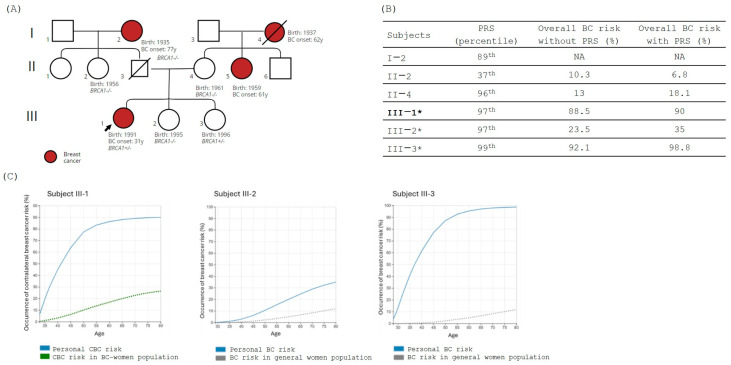
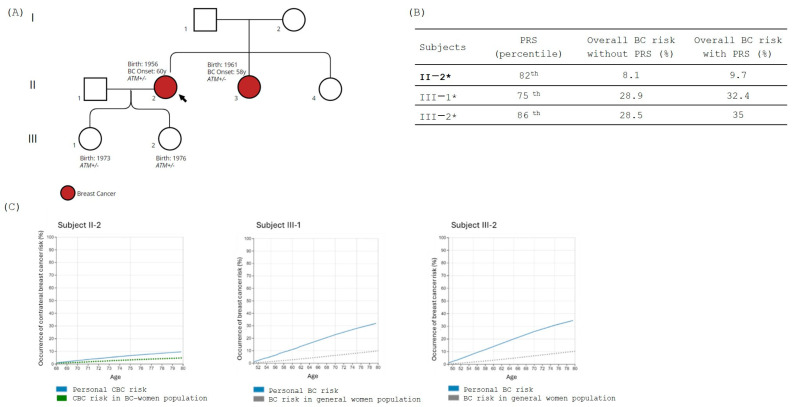
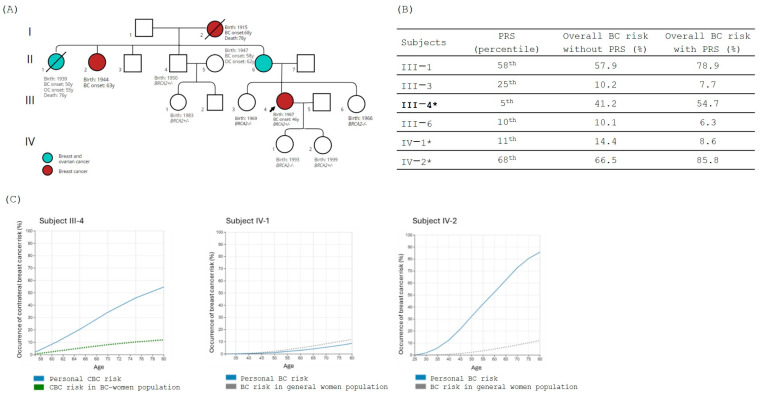
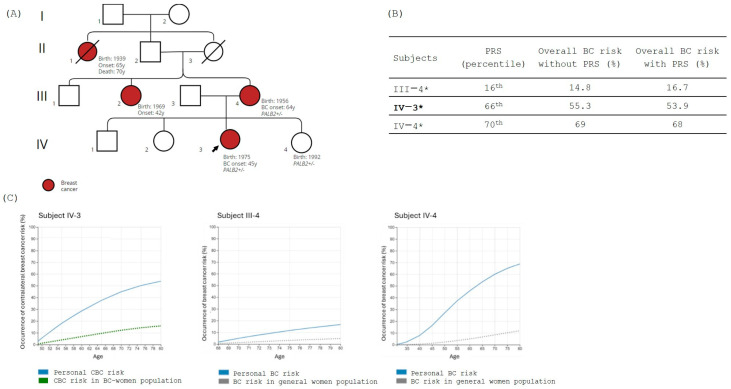
We performed a retrospective pilot study evaluating PRS in women from a subset of high- ( and and moderate-risk ( and ) BC families. We included PVs/LPVs carriers and non-carriers and evaluated a PRS based on 577,113 BC-associated variants. Using BOADICEA, we calculated the adjusted lifetime BC risk.
Our data showed that in carriers, PVs have a major role in stratifying the lifetime risk, while PRS improves risk estimation in non-carriers of these families. A different scenario may be observed in and families where PRS combined with PV/LPV carrier status gives a more informative lifetime risk.
This study showed that in BC families, the PRS might help to quantify the weight of the genetic familial background, improving the individual risk stratification and contributing to personalized clinical management for carrier and non-carrier women.
识别乳腺癌(BC)高危女性对于个性化筛查策略至关重要。易感风险基因中的致病性和可能致病性变异(PVs/LPVs)解释了部分个体风险。此外,总结为多基因风险评分(PRS)的多基因背景也会影响BC风险,并可能改变BC家族中携带者和非携带者成员的个体风险。
我们进行了一项回顾性试点研究,评估来自高风险( 、 )和中度风险( 、 )BC家族子集的女性的PRS。我们纳入了PVs/LPVs携带者和非携带者,并基于577,113个与BC相关的变异评估了PRS。使用BOADICEA,我们计算了调整后的终身BC风险。
我们的数据表明,在 携带者中,PVs在分层终身风险方面起主要作用,而PRS可改善这些家族中非携带者的风险估计。在 家族和 家族中可能观察到不同的情况,其中PRS与PV/LPV携带者状态相结合可提供更丰富的终身风险信息。
本研究表明,在BC家族中,PRS可能有助于量化遗传家族背景的权重,改善个体风险分层,并有助于对携带者和非携带者女性进行个性化临床管理。