Baybay Zyne, Montecillo Andrew, Pantua Airish, Mananggit Milagros, Romo Generoso Rene, San Pedro Esmeraldo, Pantua Homer, Leyson Christina Lora
BioAssets Corporation, Santo Tomas 4234, Batangas, Philippines.
Institute of Biological Sciences, University of the Philippines Los Baños, Los Baños 4031, Laguna, Philippines.
Pathogens. 2024 Sep 28;13(10):844. doi: 10.3390/pathogens13100844.
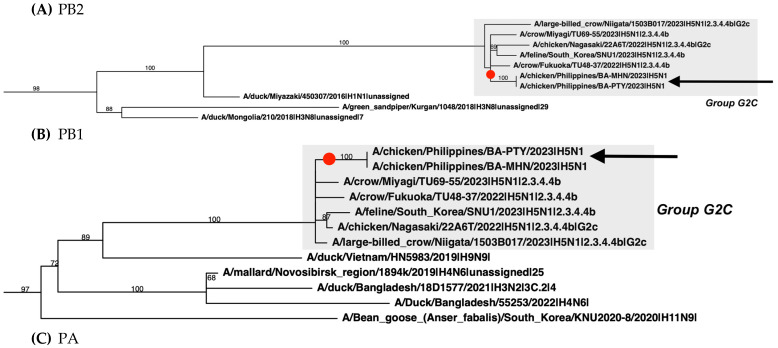
H5 subtype high-pathogenicity avian influenza (HPAI) viruses continue to devastate the poultry industry and threaten food security and public health. The first outbreak of H5 HPAI in the Philippines was reported in 2017. Since then, H5 HPAI outbreaks have been reported in 2020, 2022, and 2023. Here, we report the first publicly available complete whole-genome sequence of an H5N1 high-pathogenicity avian influenza virus from a case in Central Luzon. Samples were collected from a flock of layer chickens exhibiting signs of lethargy, droopy wings, and ecchymotic hemorrhages in trachea with excessive mucus exudates. A high mortality rate of 96-100% was observed within the week. Days prior to the high mortality event, migratory birds were observed around the chicken farm. Lungs, spleen, cloacal swabs, and oropharyngeal-tracheal swabs were taken from two chickens from this flock. These samples were positive in quantitative RT-PCR assays for influenza matrix and H5 hemagglutinin (HA) genes. To further characterize the virus, the same samples were subjected to whole-virus-genome amplification and sequencing using the Oxford Nanopore method with mean coverages of 19,190 and 2984, respectively. A phylogenetic analysis of the HA genes revealed that the H5N1 HPAI virus from Central Luzon belongs to the Goose/Guangdong lineage clade 2.3.4.4b viruses. Other segments also have high sequence identity and the same genetic lineages as other clade 2.3.4.4b viruses from Asia. Collectively, these data indicate that wild migratory birds are the likely source of H5N1 viruses from the 2022 outbreaks in the Philippines. Thus, biosecurity practices and surveillance for HPAI viruses in both domestic and wild birds should be increased to prevent and mitigate HPAI outbreaks.
H5亚型高致病性禽流感(HPAI)病毒继续重创家禽业,并威胁粮食安全和公众健康。菲律宾2017年报告了首例H5 HPAI疫情。自那时起,2020年、2022年和2023年都有H5 HPAI疫情报告。在此,我们报告了来自甲拉巴松一例病例的H5N1高致病性禽流感病毒首个公开的完整全基因组序列。样本取自一群出现嗜睡、翅膀下垂症状的蛋鸡,其气管有瘀斑性出血并伴有过多黏液渗出物。一周内观察到的死亡率高达96% - 100%。在高死亡率事件发生前几天,在养鸡场周围观察到有候鸟。从这群鸡中的两只鸡采集了肺、脾脏、泄殖腔拭子和口咽 - 气管拭子。这些样本在流感基质和H5血凝素(HA)基因的定量RT - PCR检测中呈阳性。为进一步鉴定该病毒,使用牛津纳米孔方法对相同样本进行全病毒基因组扩增和测序,平均覆盖度分别为19,190和2984。对HA基因的系统发育分析表明,来自甲拉巴松的H5N1 HPAI病毒属于鹅/广东谱系2.3.4.4b分支病毒。其他片段也与来自亚洲的其他2.3.4.4b分支病毒具有高度序列同一性和相同的遗传谱系。总体而言,这些数据表明野生候鸟可能是菲律宾2022年疫情中H5N1病毒的来源。因此,应加强家禽和野生鸟类中HPAI病毒的生物安全措施及监测,以预防和减轻HPAI疫情。