Tomasina Ramiro, González Fabiana C, Cabrera Andrés, Basmadjián Yester, Robello Carlos
Laboratorio de Interacciones Hospedero Patógeno, Institut Pasteur de Montevideo, Montevideo 11400, Uruguay.
Unidad Académica de Parasitología y Micología, Facultad de Medicina, Universidad de la República, Montevideo 11550, Uruguay.
Pathogens. 2024 Oct 2;13(10):866. doi: 10.3390/pathogens13100866.
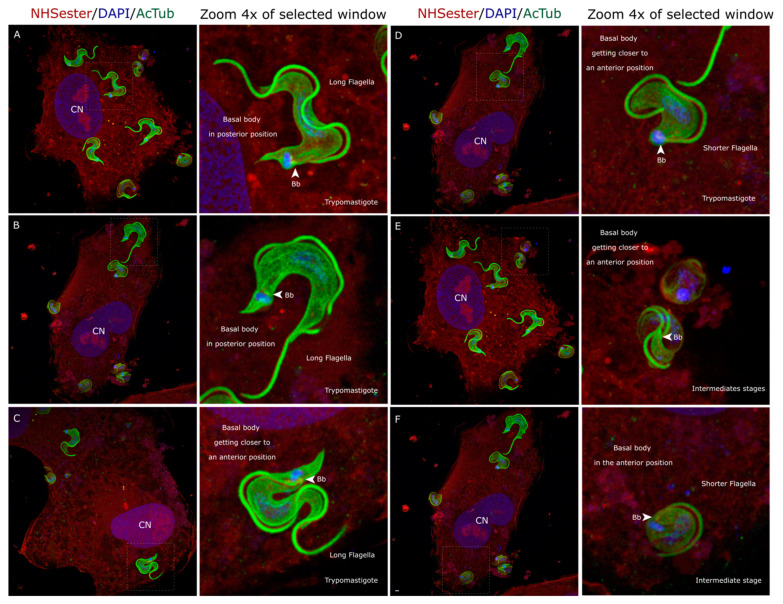
The protozoan parasite is the causative agent of Chagas disease, also called American trypanosomiasis. This neglected tropical disease affects millions of individuals across the Americas. To complete its life cycle, parasitizes both vertebrate hosts and its vector, commonly known as the 'kissing bug'. The parasite's survival and proliferation strategies are driven by the diverse environments it encounters. Despite being described by Carlos Chagas in 1909, significant knowledge gaps persist regarding the parasite's various life forms and adaptive capabilities in response to environmental cues. In this study, we employed Ultrastructure Expansion Microscopy to explore the intricate journey of within the host cell. Upon entry into the host cell, trypomastigotes undergo folding, resulting in intermediate forms characterized by a rounded cell body, anterior positioning of basal bodies, and a shortened flagellum. The repositioning of basal bodies and the kinetoplast and the shortening of the flagella mark the culmination of intracellular amastigogenesis. Furthermore, we analyzed intracellular trypomastigogenesis, identifying discrete intermediate forms, including leaf-shaped stages and epimastigote-like forms, which suggests a complex differentiation process. Notably, we did not observe any dividing intracellular epimastigotes, indicating that these may be non-replicative forms within the host cell. Our detailed examination of amastigote cell division revealed semi-closed nuclear mitosis, with mitotic spindle formation independent of basal bodies. This study provides new insights into the morphological and cytoskeletal changes during the intracellular stages of , providing a model for understanding the dynamics of intracellular amastigogenesis and trypomastigogenesis.
这种原生动物寄生虫是恰加斯病(也称为美洲锥虫病)的病原体。这种被忽视的热带疾病影响着美洲数百万人口。为了完成其生命周期,该寄生虫寄生于脊椎动物宿主及其传播媒介(通常称为“接吻虫”)。寄生虫的生存和增殖策略受其所处不同环境的驱动。尽管卡洛斯·恰加斯在1909年就对其进行了描述,但关于该寄生虫的各种生命形式以及对环境线索的适应能力仍存在重大知识空白。在本研究中,我们采用超微结构扩展显微镜来探索该寄生虫在宿主细胞内的复杂历程。进入宿主细胞后,锥鞭毛体发生折叠,形成中间形态,其特征为细胞体呈圆形、基体位于前部且鞭毛缩短。基体和动基体的重新定位以及鞭毛的缩短标志着细胞内无鞭毛体生成的完成。此外,我们分析了细胞内锥鞭毛体生成过程,识别出离散的中间形态,包括叶状阶段和类上鞭毛体形态,这表明存在一个复杂的分化过程。值得注意的是,我们未观察到任何正在分裂的细胞内上鞭毛体,这表明这些可能是宿主细胞内的非复制形式。我们对无鞭毛体细胞分裂的详细检查揭示了半封闭的核有丝分裂,有丝分裂纺锤体的形成独立于基体。本研究为该寄生虫细胞内阶段的形态和细胞骨架变化提供了新见解,为理解细胞内无鞭毛体生成和锥鞭毛体生成的动态过程提供了一个模型。