Çakır Edis Ebru, Çilli Aykut, Kızılırmak Deniz, Şakar Coşkun Ayşın, Sayıner Abdullah, Çiçek Sedat, Gülmez İnci, Çoban Ağca Meltem, Çağlayan Benan, Özçelik Neslihan, Köktürk Nurdan, Ocaklı Birsen, Uçan Eyüp Sabri
Department of Pulmoner Medicine, Trakya University Faculty of Medicine, Edirne, Türkiye.
Department of Pulmoner Medicine, Akdeniz University Faculty of Medicine, Antalya, Türkiye.
Thorac Res Pract. 2024 Sep 2;25(5):184-187. doi: 10.5152/ThoracResPract.2024.23054.
Coronavirus disease 2019 (COVID-19) has affected the whole world and caused the death of more than 6 million people. The disease has been observed to have a more severe course in patients with chronic lung diseases. There are limited data regarding COVID-19 in patients with bronchiectasis. The aim of this article is to investigate the course of COVID-19 and factors affecting the clinical outcome in patients with bronchiectasis.
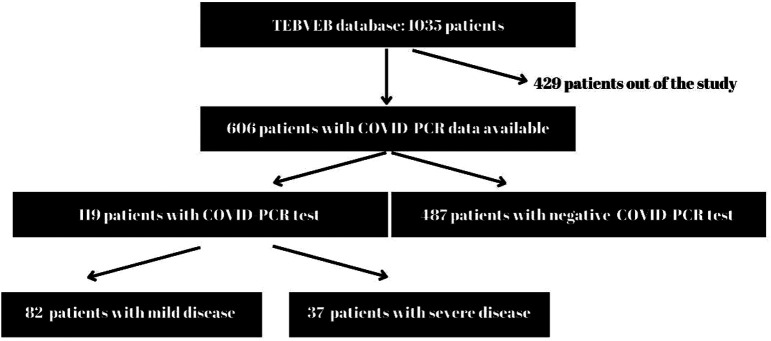
This study was conducted using the Turkish Adult Bronchiectasis Database (TEBVEB) to which 25 centers in Türkiye contributed between March 2019 and January 2022. The database consisted of 1035 patients, and COVID-19-related data were recorded for 606 patients.
One hundred nineteen (19.6%) of the bronchiectasis patients (64 female, mean age 57.3 ± 13.9) had COVID-19. Patients with bronchiectasis who developed COVID-19 more frequently had other comorbidities (P = .034). They also more frequently had cystic bronchiectasis (P = .009) and their Bronchiectasis Severity Index was significantly higher (P = .019). Eighty-two (68.9%) of the patients who had COVID-19 were followed up in the outpatient clinic, 27 (22.7%) in the inpatient ward and 10 (8.4%) patients in the intensive care unit. There tended to be a higher percentage of males among patients admitted to the hospital (P = .073); similarly, the mean age of the patients admitted to the hospital was also higher (60.8 vs 55.8 years for the outpatients), but these differences did not reach statistical significance (P = .071).
In conclusion, this study showed that severe bronchiectasis, presence of cystic bronchiectasis and worse Bronchiectasis Severity Index are associated with the development of COVID-19, but not with the severity of infection.
2019冠状病毒病(COVID-19)已影响全球,导致600多万人死亡。据观察,该疾病在慢性肺病患者中病程更为严重。关于支气管扩张症患者感染COVID-19的数据有限。本文旨在研究支气管扩张症患者的COVID-19病程及影响临床结局的因素。
本研究使用土耳其成人支气管扩张症数据库(TEBVEB)进行,2019年3月至2022年1月期间土耳其的25个中心为该数据库提供了数据。该数据库包含1035例患者,其中606例患者记录了与COVID-19相关的数据。
119例(19.6%)支气管扩张症患者(64例女性,平均年龄57.3±13.9岁)感染了COVID-19。感染COVID-19的支气管扩张症患者更常伴有其他合并症(P = 0.034)。他们也更常患有囊性支气管扩张症(P = 0.009),且支气管扩张严重指数显著更高(P = 0.019)。82例(68.9%)感染COVID-19的患者在门诊接受随访,27例(22.7%)在住院病房,10例(8.4%)在重症监护病房。入院患者中男性比例往往更高(P = 0.073);同样,入院患者的平均年龄也更高(门诊患者为55.8岁,入院患者为60.8岁),但这些差异未达到统计学意义(P = 0.071)。
总之,本研究表明,严重支气管扩张症、囊性支气管扩张症的存在以及较差的支气管扩张严重指数与COVID-19的发生有关,但与感染的严重程度无关。