Miner Kimberley, Baskaran Latha, Gay Bradley, Sousa Daniel, Miller Charles
NASA Jet Propulsion Laboratory, California Institute of Technology, Pasadena, USA.
Department of Geography, California State University at San Diego, San Diego, USA.
Sci Rep. 2024 Oct 25;14(1):25403. doi: 10.1038/s41598-024-76292-2.
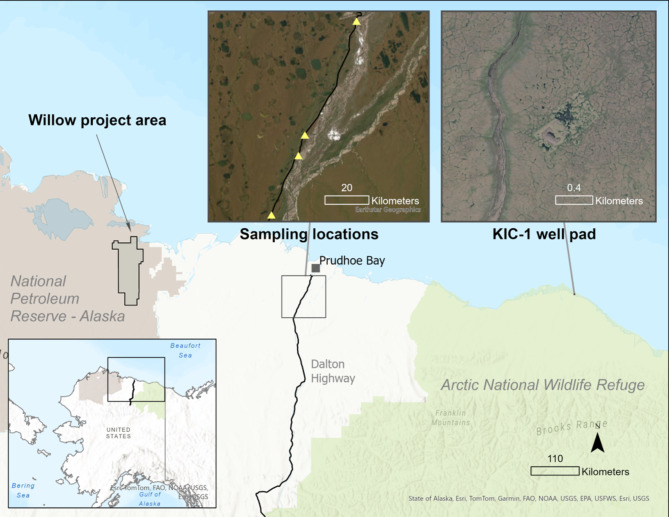
Approximately 8100 km of Alaska are leased to the oil and gas industry for exploration and extraction. According to industry estimates, subsurface expansion from these leases could cover up to 130.2 km per pad. As industrial oil extraction activities increase across the thawing Alaskan permafrost, impacts on the permafrost environment will include rapid thaw, increased hydrological flux, and the release of climate warming greenhouse gases. Here, we use remote sensing and field observations to provide a first-order comparison of the direct impacts to the permafrost tundra from oil well pads, and the long-term consequences of a legacy oil pads on the warming North Slope of Alaska. We find that oil well pads on the permafrost accelerate permafrost degradation and persist despite remediation.
阿拉斯加约8100公里的土地被租赁给石油和天然气行业用于勘探和开采。据行业估计,这些租约下的地下扩展范围每个钻井平台可达130.2公里。随着阿拉斯加永冻土融化地区工业石油开采活动的增加,对永冻土环境的影响将包括快速解冻、水文通量增加以及气候变暖温室气体的释放。在此,我们利用遥感和实地观测,对油井平台对永冻苔原的直接影响以及遗留油井平台对阿拉斯加变暖北坡的长期后果进行了一级比较。我们发现,永冻土上的油井平台加速了永冻土的退化,且即使经过修复仍持续存在。