Immunology of Infectious Diseases Research Center, Research Institute of Basic Medical Sciences, Rafsanjan University of Medical Sciences, Rafsanjan, Iran.
Department of Immunology, School of Medicine, Rafsanjan University of Medical Sciences, Rafsanjan, Iran.
BMC Immunol. 2024 Oct 26;25(1):72. doi: 10.1186/s12865-024-00662-8.
Despite the development of various antiviral drugs, most of them are not effective in the treatment of coronavirus disease 2019 (COVID-19) as a hyperinflammatory disorder. Chemokine (C-C motif) ligand 2 (CCL2) is one of the critical CC chemokines involved in the pathogenesis and severity of severe acute respiratory syndrome coronavirus-2 (SARS-CoV-2) infection. This study aimed to investigate the expression of CCL2 and CC chemokine receptor 2 (CCR2) in COVID-19 patients.
Peripheral blood samples were collected from 60 confirmed COVID-19 patients and 60 age-matched healthy subjects. The ages of the subjects were categorized as follows: up to 20 years, 20 to 40 years, 40 to 60 years, and more than 60 years. CCL2 serum levels were measured using the enzyme-linked immunosorbent assay (ELISA). CCR2 gene expression in peripheral blood mononuclear cells (PBMCs) was measured employing real-time polymerase chain reaction (PCR).
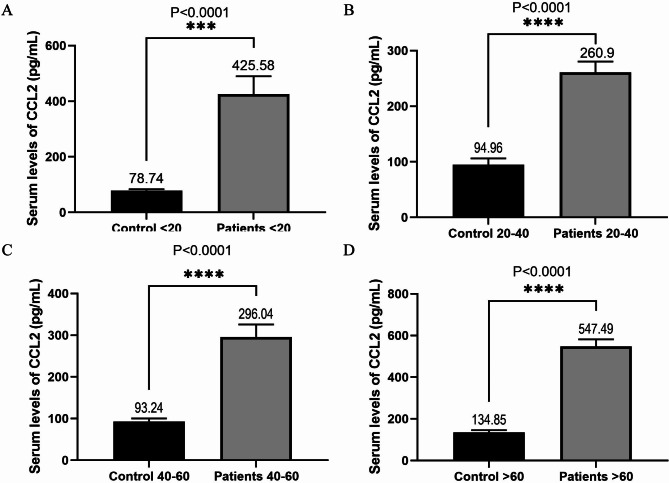
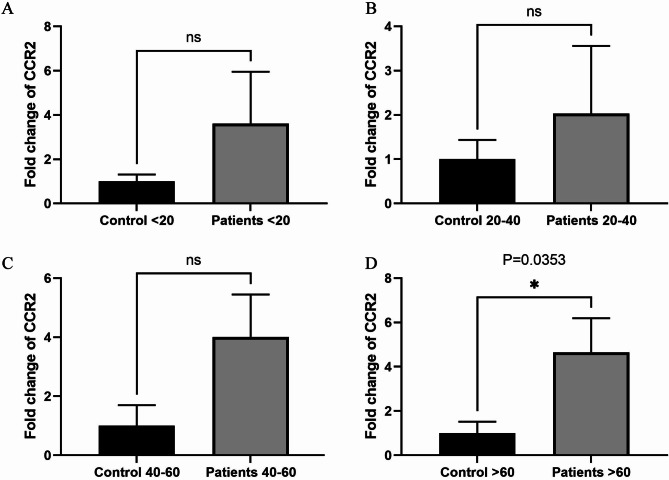
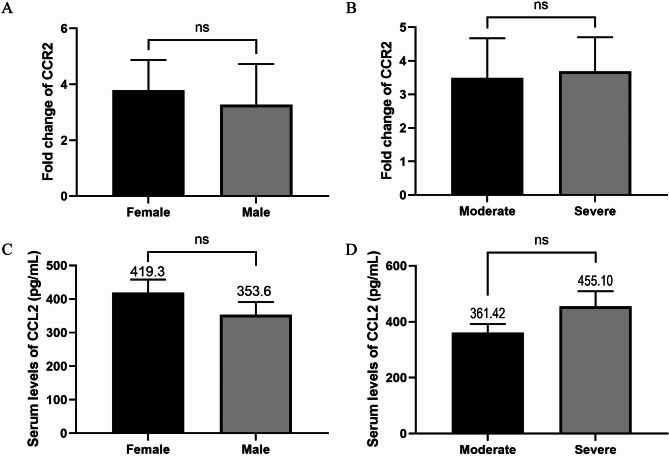
In all age groups, CCL2 serum levels were significantly elevated in patients compared to healthy controls (P < 0.0001). CCL2 levels were higher in severe patients than in moderate patients. Moreover, CCR2 expression by PBMCs was higher in patients compared to control subjects. However, a significant difference between patients and controls over 60 years of age was identified (P = 0.0353). There was no significant difference in CCR2 expression between moderate and severe COVID-19 patients.
Taken together, the findings demonstrate that CCL2 and CCR2 are upregulated in COVID-19 patients at protein and mRNA levels, respectively. Therefore, the CCL2/CCR2 axis may be a potential therapeutic target in order to improve patient outcomes.
尽管开发了各种抗病毒药物,但由于 2019 年冠状病毒病(COVID-19)是一种过度炎症性疾病,大多数药物在治疗 COVID-19 方面效果不佳。趋化因子(C-C 基序)配体 2(CCL2)是参与严重急性呼吸综合征冠状病毒 2(SARS-CoV-2)感染发病机制和严重程度的关键 CC 趋化因子之一。本研究旨在探讨 COVID-19 患者中 CCL2 和 CC 趋化因子受体 2(CCR2)的表达。
收集 60 例确诊 COVID-19 患者和 60 名年龄匹配的健康对照者的外周血样本。根据年龄将受试者分为以下几类:≤20 岁、20-40 岁、40-60 岁和>60 岁。采用酶联免疫吸附试验(ELISA)测定 CCL2 血清水平。采用实时聚合酶链反应(PCR)测定外周血单个核细胞(PBMCs)中 CCR2 基因表达。
在所有年龄组中,患者的 CCL2 血清水平均明显高于健康对照组(P<0.0001)。重症患者的 CCL2 水平高于轻症患者。此外,与对照组相比,患者的 PBMCs 中 CCR2 表达更高。然而,在年龄>60 岁的患者与对照组之间发现了显著差异(P=0.0353)。中度和重度 COVID-19 患者之间的 CCR2 表达无显著差异。
综上所述,研究结果表明,COVID-19 患者的 CCL2 和 CCR2 在蛋白和 mRNA 水平上均上调。因此,CCL2/CCR2 轴可能是改善患者预后的潜在治疗靶点。