Chen Xiaomei, Zhang Xuge, Xiang Xiang, Fang Xiang, Feng Shenghong
Department of Cardiology, Dazhou Second People's Hospital, No. 1, Longquan Road, Dazhou, 635000, Sichuan, China.
Department of Otorhinolaryngology Head and Neck Surgery, Dazhou Second People's Hospital, Dazhou, 635000, Sichuan, China.
Diabetol Metab Syndr. 2024 Oct 26;16(1):251. doi: 10.1186/s13098-024-01497-4.
Glucagon-like peptide-1 receptor agonists (GLP-1 RAs) have been shown to provide cardiovascular benefits in patients with type 2 diabetes mellitus (T2DM). However, their cardiovascular protective efficacy in high-risk T2DM patients, particularly those with a history of cardiovascular events or severe chronic kidney disease, remains uncertain.
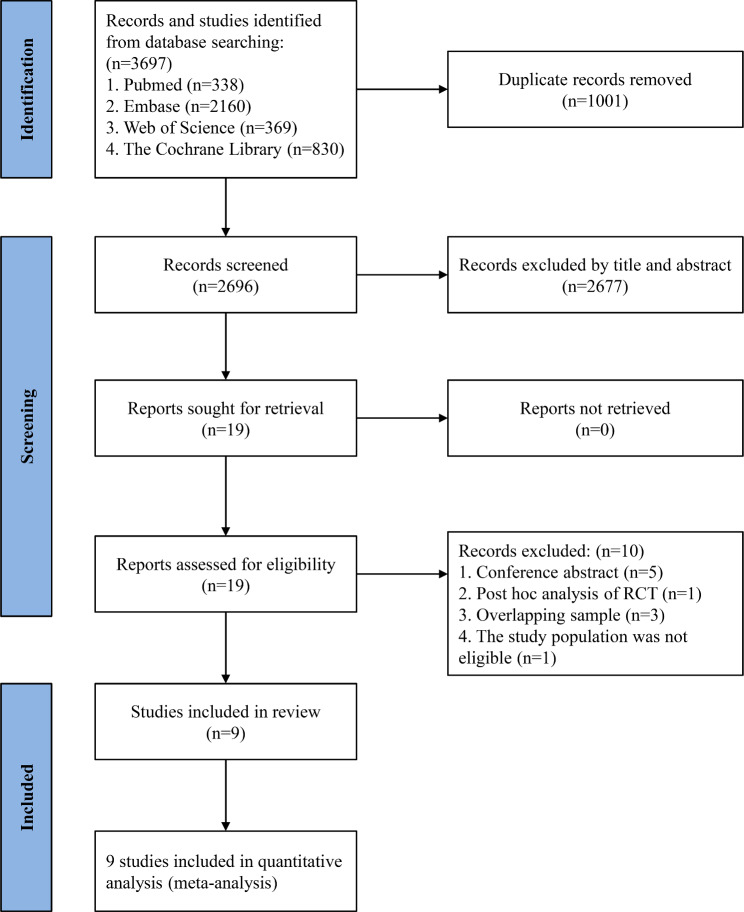
A comprehensive search was conducted in PubMed, Embase, Web of Science, and The Cochrane Library to identify randomized controlled trials (RCTs) that evaluated the effects of GLP-1 RAs on cardiovascular outcomes in high-risk patients with T2DM. A random-effects model was used to calculate pooled hazard ratios (HRs) for cardiovascular outcomes. Subgroup analyses and GRADE assessment were also performed.
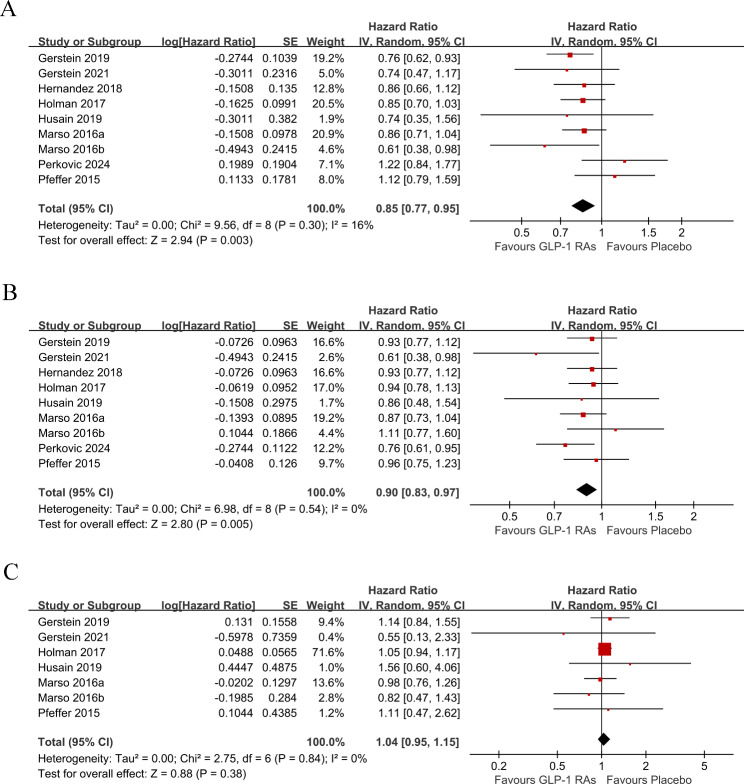
Nine RCTs involving 63,613 patients were included. GLP-1 RAs significantly reduced the risk of the primary composite outcome (HR: 0.86, 95% CI: 0.80-0.92), cardiovascular death (HR: 0.85, 95% CI: 0.78-0.93), all-cause death (HR: 0.87, 95% CI: 0.82-0.93), myocardial infarction (HR: 0.90, 95% CI: 0.82-0.98), stroke (HR: 0.85, 95% CI: 0.77-0.95), and heart failure (HF) hospitalization (HR: 0.90, 95% CI: 0.83-0.97). No significant difference in unstable angina (UA) hospitalization was observed (HR: 1.04, 95% CI: 0.95-1.15). Subgroup analyses indicated greater benefits with combination therapy, particularly in patients with chronic kidney disease. The quality of evidence was rated as "High" for six outcomes and "Moderate" for UA hospitalization.
GLP-1 RAs significantly reduce cardiovascular risk in high-risk T2DM patients, especially with combination therapy and in those with chronic kidney disease. However, further research is needed to confirm their long-term effects.
胰高血糖素样肽-1受体激动剂(GLP-1 RAs)已被证明可为2型糖尿病(T2DM)患者带来心血管益处。然而,它们在高危T2DM患者,尤其是有心血管事件史或严重慢性肾脏病患者中的心血管保护疗效仍不确定。
在PubMed、Embase、Web of Science和Cochrane图书馆进行全面检索,以识别评估GLP-1 RAs对高危T2DM患者心血管结局影响的随机对照试验(RCTs)。采用随机效应模型计算心血管结局的合并风险比(HRs)。还进行了亚组分析和GRADE评估。
纳入了9项涉及63613例患者的RCTs。GLP-1 RAs显著降低了主要复合结局的风险(HR:0.86,95%CI:0.80-0.92)、心血管死亡(HR:0.85,95%CI:0.78-0.93)、全因死亡(HR:0.87,95%CI:0.82-0.93)、心肌梗死(HR:0.90,95%CI:0.82-0.98)、中风(HR:0.85,95%CI:0.77-0.95)和心力衰竭(HF)住院(HR:0.90,95%CI:0.83-0.97)。未观察到不稳定型心绞痛(UA)住院有显著差异(HR:1.04,95%CI:0.95-1.15)。亚组分析表明联合治疗的益处更大,尤其是在慢性肾脏病患者中。六项结局的证据质量被评为“高”,UA住院的证据质量被评为“中”。
GLP-1 RAs显著降低高危T2DM患者的心血管风险,尤其是联合治疗时以及慢性肾脏病患者。然而,需要进一步研究来证实其长期效果。