Broege Aaron, Rossetti Stefano, Sen Adrish, Menon Arul S, MacNeil Ian, Molden Jhomary, Laing Lance
Celcuity, Inc., 16305 36th Ave N, Suite 100, Minneapolis, MN 55446, USA.
Department of Molecular and Cell Biology, University of California, Berkeley, CA 94720, USA.
Cancers (Basel). 2024 Oct 17;16(20):3520. doi: 10.3390/cancers16203520.
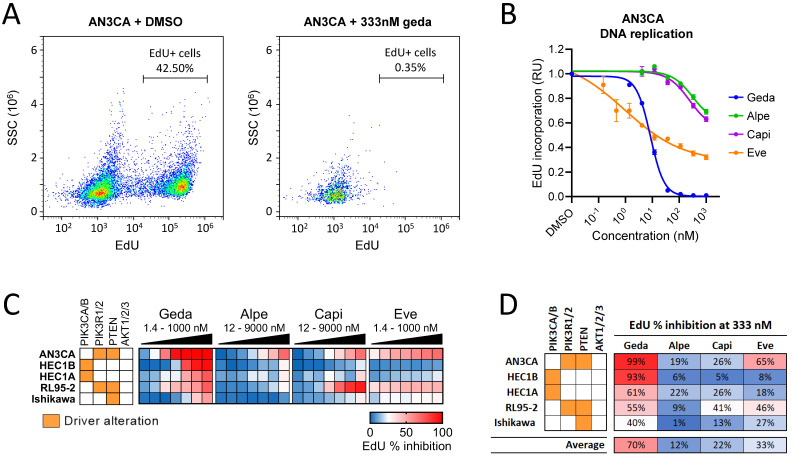
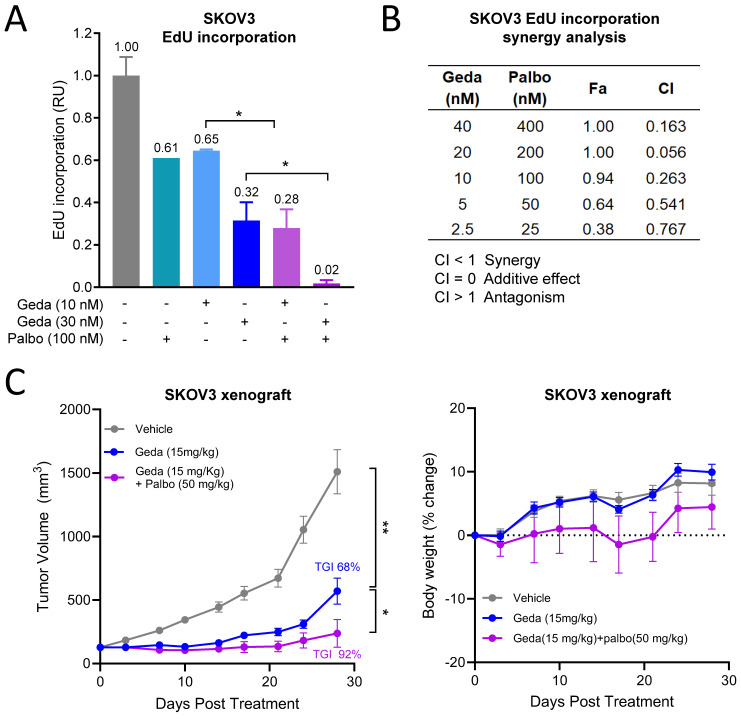
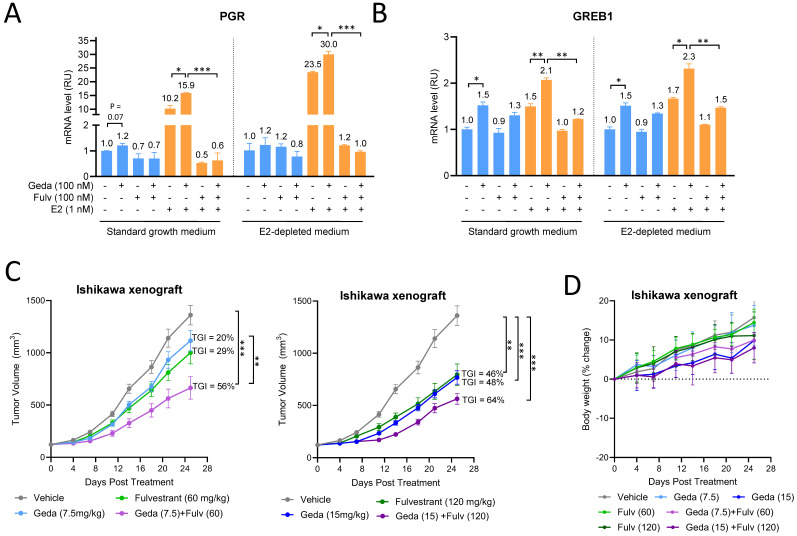
: The PI3K/AKT/mTOR (PAM) pathway is frequently activated in gynecological cancers. Many PAM inhibitors selectively target single PAM pathway nodes, which can lead to reduced efficacy and increased drug resistance. To address these limitations, multiple PAM pathway nodes may need to be inhibited. Gedatolisib, a well-tolerated panPI3K/mTOR inhibitor targeting all Class I PI3K isoforms, mTORC1 and mTORC2, could represent an effective treatment option for patients with gynecologic cancers. : Gedatolisib and other PAM inhibitors (e.g., alpelisib, capivasertib, and everolimus) were tested in endometrial, ovarian, and cervical cancer cell lines by using cell viability, cell proliferation, and flow cytometry assays. Xenograft studies evaluated gedatolisib in combination with a CDK4/6 inhibitor (palbociclib) or an anti-estrogen (fulvestrant). A pseudo-temporal transcriptomic trajectory of endometrial cancer clinical progression was computationally modeled employing data from 554 patients to correlate non-clinical studies with a potential patient group. : Gedatolisib induced a substantial decrease in PAM pathway activity in association with the inhibition of cell cycle progression and the decreased cell viability in vitro. Compared to single-node PAM inhibitors, gedatolisib exhibited greater growth-inhibitory effects in almost all cell lines, regardless of the PAM pathway mutations. Gedatolisib combined with either fulvestrant or palbociclib inhibited tumor growth in endometrial and ovarian cancer xenograft models. : Gedatolisib in combination with other therapies has shown an acceptable safety profile and promising preliminary efficacy in clinical studies with various solid tumor types. The non-clinical data presented here support the development of gedatolisib combined with CDK4/6 inhibitors and/or hormonal therapy for gynecologic cancer treatment.
PI3K/AKT/mTOR(PAM)信号通路在妇科癌症中经常被激活。许多PAM抑制剂选择性地靶向单个PAM信号通路节点,这可能导致疗效降低和耐药性增加。为了解决这些局限性,可能需要抑制多个PAM信号通路节点。Gedatolisib是一种耐受性良好的泛PI3K/mTOR抑制剂,靶向所有I类PI3K亚型、mTORC1和mTORC2,可能是妇科癌症患者的一种有效治疗选择。:通过细胞活力、细胞增殖和流式细胞术检测,在子宫内膜癌、卵巢癌和子宫颈癌细胞系中测试了Gedatolisib和其他PAM抑制剂(如阿培利司、卡匹西利和依维莫司)。异种移植研究评估了Gedatolisib与CDK4/6抑制剂(哌柏西利)或抗雌激素药物(氟维司群)联合使用的效果。利用554例患者的数据,通过计算模拟了子宫内膜癌临床进展的假时间转录组轨迹,以将非临床研究与潜在患者群体相关联。:Gedatolisib在体外诱导PAM信号通路活性大幅下降,同时抑制细胞周期进程并降低细胞活力。与单节点PAM抑制剂相比,无论PAM信号通路是否发生突变,Gedatolisib在几乎所有细胞系中均表现出更强的生长抑制作用。Gedatolisib与氟维司群或哌柏西利联合使用可抑制子宫内膜癌和卵巢癌异种移植模型中的肿瘤生长。:在各种实体瘤类型的临床研究中,Gedatolisib与其他疗法联合使用显示出可接受的安全性和有前景的初步疗效。本文提供的非临床数据支持开发Gedatolisib与CDK4/6抑制剂和/或激素疗法联合用于妇科癌症治疗。