Bravo Ana Catarina, Morão Bárbara, Luz André, Dourado Rúben, Oliveira Beatriz, Guedes Ana, Moreira-Barbosa Catarina, Fidalgo Catarina, Mascarenhas-Lemos Luís, Costa-Santos Maria Pia, Maio Rui, Paulino Jorge, Viana Baptista Pedro, Fernandes Alexandra R, Cravo Marília
Hospital Beatriz Ângelo, 2674-514 Loures, Portugal.
Associate Laboratory i4HB-Institute for Health and Bioeconomy, NOVA School of Science and Technology, NOVA University Lisbon, 2829-516 Caparica, Portugal.
Cancers (Basel). 2024 Oct 21;16(20):3544. doi: 10.3390/cancers16203544.
BACKGROUND/OBJECTIVES: Pancreatic ductal adenocarcinoma (PDAC) incidence is rising, and prognosis remains poor due to late diagnosis and limited effective therapies. Currently, patients are treated based on TNM staging, without molecular tumor characterization. This study aimed to validate a technique that combines the amplification refractory mutation system (ARMS) with high-resolution melting analysis (HRMA) for detecting mutations in codon 12 of KRAS in tumor and plasma, and to assess its prognostic value.
Prospective study including patients with newly diagnosed PDAC with tumor and plasma samples collected before treatment. Mutations in codon 12 of KRAS (G12D, G12V, G12C, and G12R) were detected using ARMS-HRMA and compared to Sanger sequencing (SS). Univariate and multivariate analyses were used to evaluate the prognostic significance of these mutations.
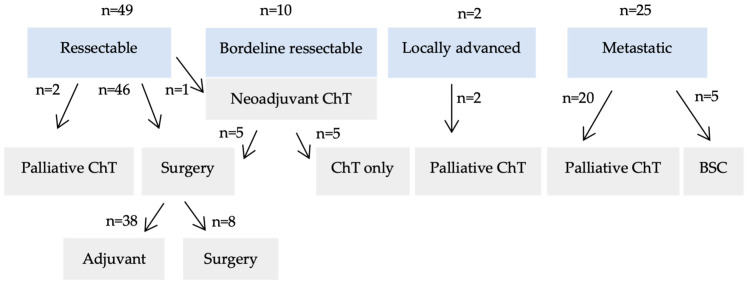
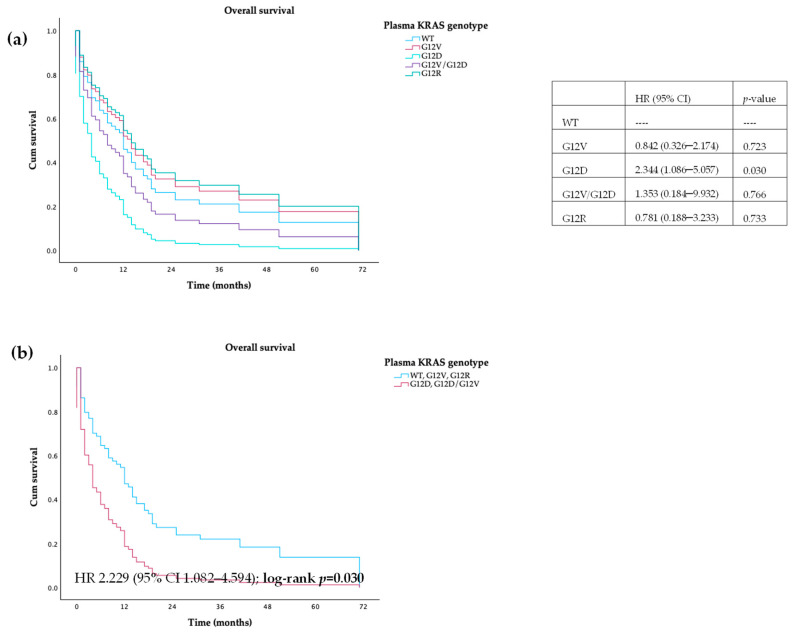
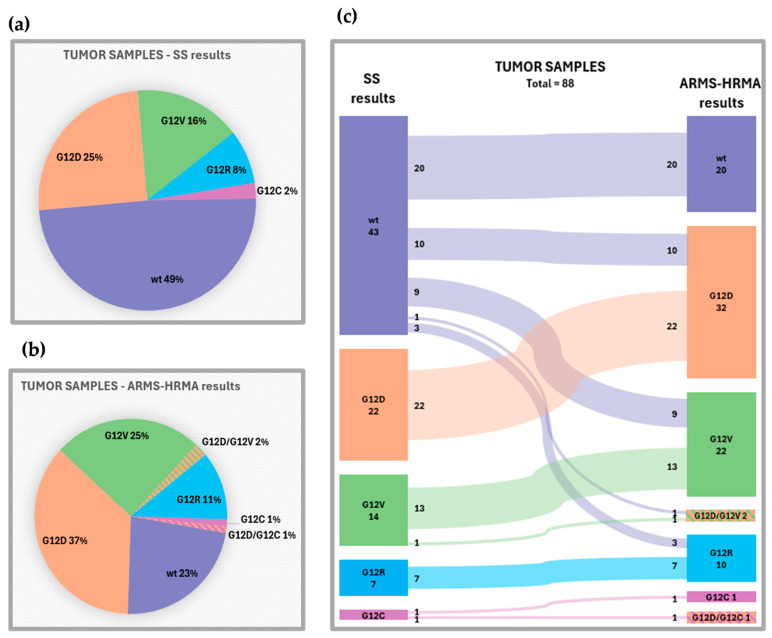
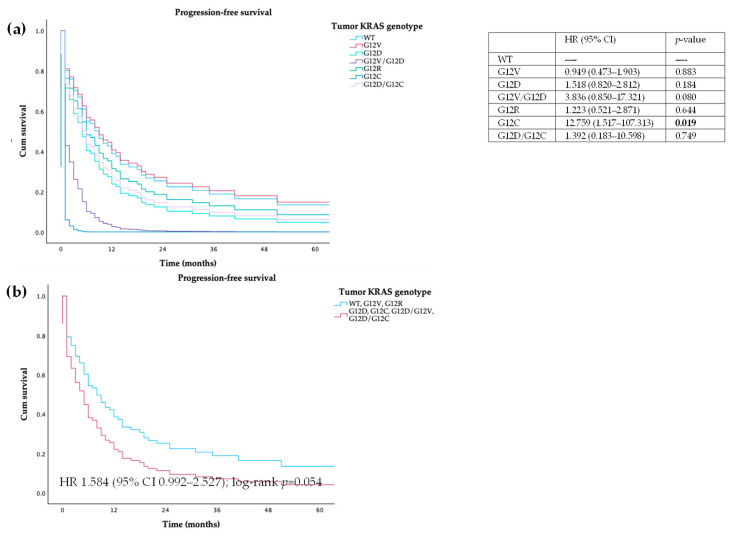
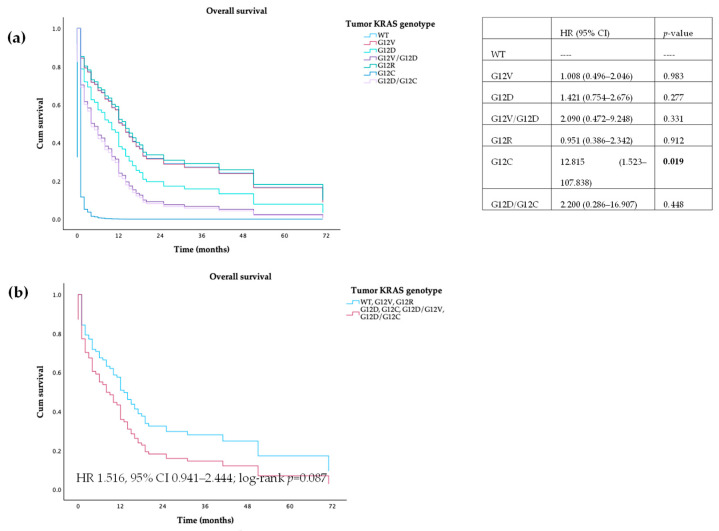
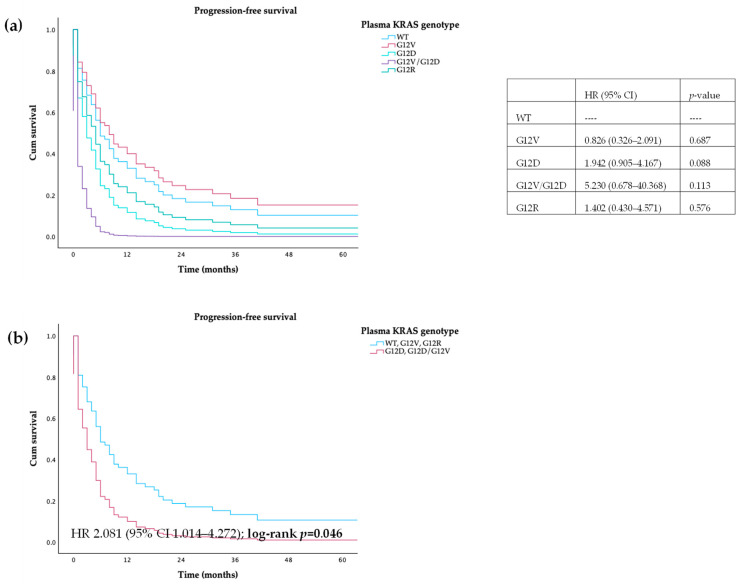
A total of 88 patients, 93% with ECOG-PS 0-1, 57% with resectable disease. ARMS-HRMA technique showed a higher sensitivity than SS, both in tumor and plasma (77% vs. 51%; 25 vs. 0%, respectively). The most frequent mutation was G12D (n = 32, 36%), followed by G12V (n = 22, 25%). On multivariate analysis, patients with G12D and/or G12C mutations, either in tumor or plasma, had lower PFS (HR 1.792, 95% CI 1.061-3.028, = 0.029; HR 2.081, 95% CI 1.014-4.272, = 0.046, respectively) and lower OS (HR 1.757, 95% CI 1.013-3.049, = 0.045; HR 2.229, 95% CI 1.082-4.594, = 0.030, respectively).
ARMS-HRMA is a rapid and cost-effective method for detecting mutations in PDAC patients, offering the potential for stratifying prognosis and guiding treatment decisions. The presence of G12D and G12C mutations in both tumor and plasma is associated with a poorer prognosis.
背景/目的:胰腺导管腺癌(PDAC)的发病率正在上升,由于诊断较晚且有效治疗方法有限,其预后仍然很差。目前,患者是根据TNM分期进行治疗的,没有对肿瘤进行分子特征分析。本研究旨在验证一种将扩增阻滞突变系统(ARMS)与高分辨率熔解分析(HRMA)相结合的技术,用于检测肿瘤和血浆中KRAS基因第12密码子的突变,并评估其预后价值。
前瞻性研究,纳入新诊断的PDAC患者,在治疗前收集肿瘤和血浆样本。使用ARMS-HRMA检测KRAS基因第12密码子(G12D、G12V、G12C和G12R)的突变,并与桑格测序(SS)进行比较。采用单因素和多因素分析评估这些突变的预后意义。
共88例患者,93%的患者东部肿瘤协作组体能状态(ECOG-PS)为0-1,57%的患者疾病可切除。ARMS-HRMA技术在肿瘤和血浆中的敏感性均高于SS(分别为77%对51%;25%对0%)。最常见的突变是G12D(n = 32,36%),其次是G12V(n = 22,25%)。多因素分析显示,肿瘤或血浆中存在G12D和/或G12C突变的患者,无进展生存期(PFS)较低(风险比[HR] 1.792,95%置信区间[CI] 1.061-3.028,P = 0.029;HR 2.081,95% CI 1.014-4.272,P = 0.046),总生存期(OS)也较低(HR 1.757,95% CI 1.013-3.049,P = 0.045;HR 2.229,95% CI 1.082-4.594,P = 0.030)。
ARMS-HRMA是一种快速且经济高效的检测PDAC患者突变的方法,具有对预后进行分层和指导治疗决策的潜力。肿瘤和血浆中均存在G12D和G12C突变与较差的预后相关。