Faculty of Biology, Lomonosov Moscow State University, Moscow 119234, Russia.
Institute of Computer Science and Mathematical Modeling, Sechenov First Moscow State Medical University (Sechenov University), Moscow 119991, Russia.
Int J Mol Sci. 2024 Oct 15;25(20):11083. doi: 10.3390/ijms252011083.
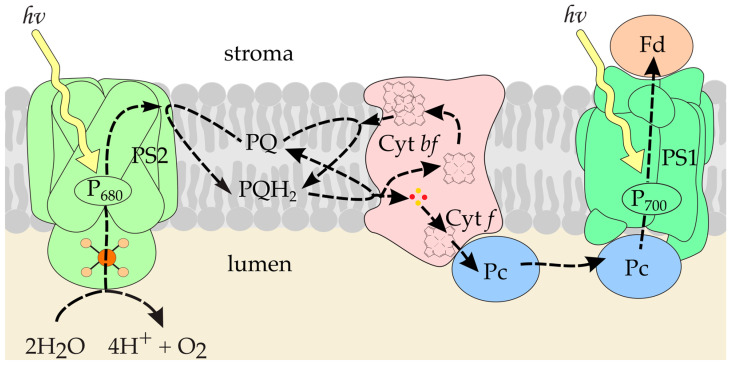
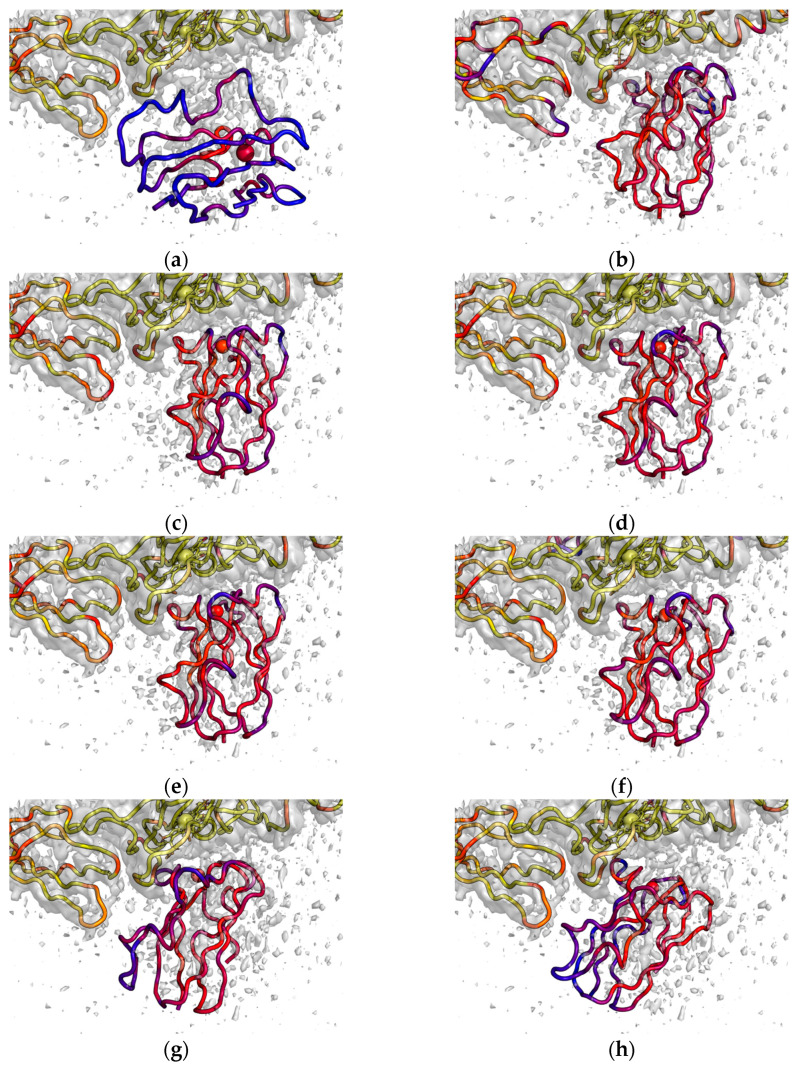
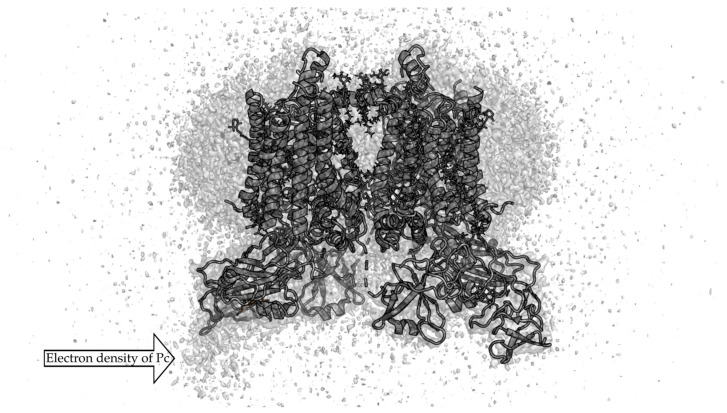
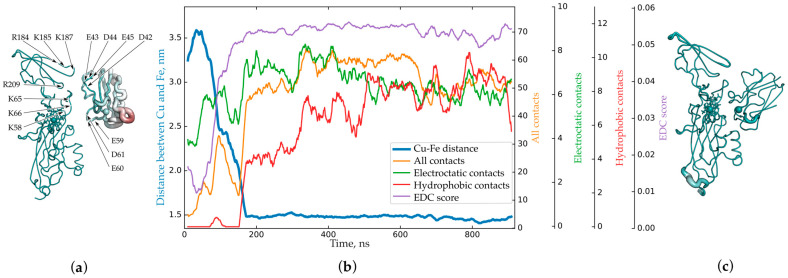
Plastocyanin is a small mobile protein that facilitates electron transfer through the formation of short-lived protein-protein complexes with cytochrome and photosystem 1. Due to the transient nature of plastocyanin-cytochrome complex, the lack of a long-lived tight complex makes it impossible to determine its structure by X-ray diffraction analysis. Up to today, a number of slightly different structures of such complexes have been obtained by experimental and computer methods. Now, artificial intelligence gives us the possibility to predict the structures of intermolecular complexes. In this study, we compare encounter and final complexes obtained by Brownian and molecular dynamics methods, as well as the structures predicted by AlphaFold 3, with NMR and cryo-EM data. Surprisingly, the best match for the plastocyanin electron density obtained by cryo-EM was demonstrated by an AlphaFold 3 structure. The orientation of plastocyanin in this structure almost completely coincides with its orientation obtained by molecular dynamics calculation, and, at the same time, it is different from the orientation of plastocyanin predicted on the basis of NMR data. This is even more unexpected given that only NMR structures for the plastocyanin-cytochrome complex are available in the PDB database, which was used to train AlphaFold 3.
质体蓝素是一种小型可移动蛋白,通过与细胞色素 c 和光系统 I 形成短暂的蛋白-蛋白复合物来促进电子传递。由于质体蓝素-细胞色素 c 复合物的瞬态性质,缺乏长寿命的紧密复合物使得通过 X 射线衍射分析来确定其结构成为不可能。迄今为止,已经通过实验和计算机方法获得了此类复合物的一些略有不同的结构。现在,人工智能使我们有可能预测分子间复合物的结构。在这项研究中,我们将布朗运动和分子动力学方法获得的相遇和最终复合物,以及由 AlphaFold 3 预测的结构,与 NMR 和 cryo-EM 数据进行了比较。令人惊讶的是,cryo-EM 获得的质体蓝素电子密度与 AlphaFold 3 结构的最佳匹配。该结构中质体蓝素的取向几乎与其通过分子动力学计算获得的取向完全一致,同时,它与基于 NMR 数据预测的质体蓝素取向不同。鉴于只有 NMR 结构可用于 PDB 数据库中质体蓝素-细胞色素 c 复合物,而 AlphaFold 3 是基于该数据库进行训练的,这一点更加出人意料。