Panetti Beatrice, Bucci Ilaria, Di Ludovico Armando, Pellegrino Giulia Michela, Di Filippo Paola, Di Pillo Sabrina, Chiarelli Francesco, Attanasi Marina, Sferrazza Papa Giuseppe Francesco
Pediatric Allergy and Pulmonology Unit, Department of Pediatrics, University of Chieti, 66100 Chieti, Italy.
Department of Neurorehabilitation Sciences, Casa di Cura Igea, 20144 Milan, Italy.
Children (Basel). 2024 Oct 12;11(10):1232. doi: 10.3390/children11101232.
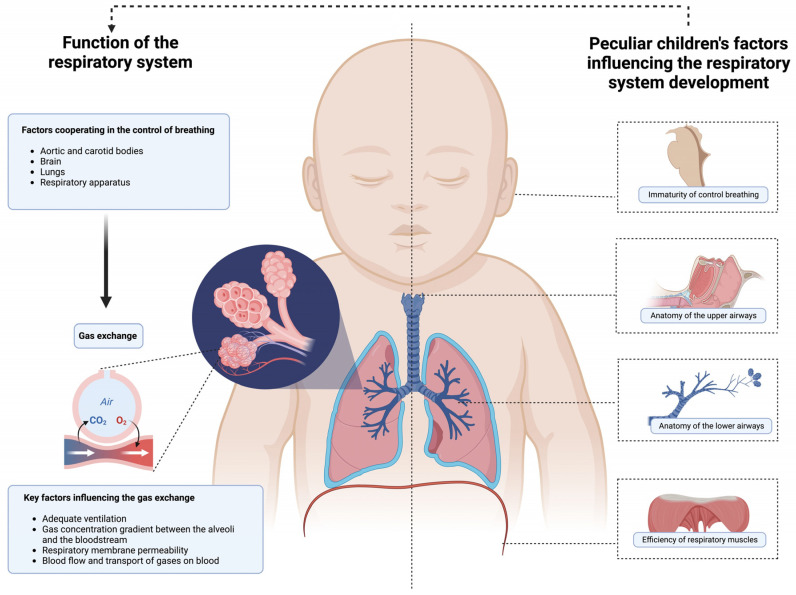
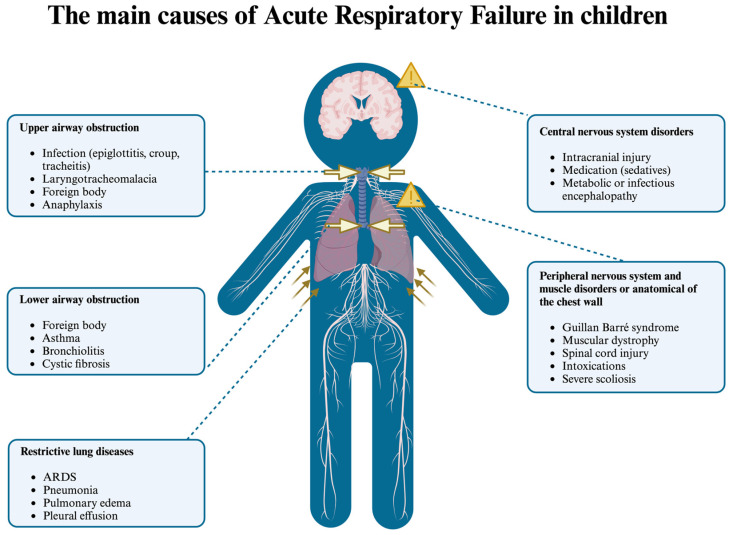
Acute respiratory failure (ARF) is a sudden failure of the respiratory system to ensure adequate gas exchanges. Numerous clinical conditions may cause ARF, including pneumonia, obstructive lung diseases (e.g., asthma), restrictive diseases such as neuromuscular diseases (e.g., spinal muscular atrophy and muscular dystrophy), and albeit rarely, interstitial lung diseases. Children, especially infants, may be more vulnerable to ARF than adults due to anatomical and physiological features of the respiratory system. Assessing respiratory impairment in the pediatric population is particularly challenging as children frequently present difficulties in reporting symptoms and due to compliance and cooperation in diagnostic tests. The evaluation of clinical and anamnestic aspects represents the cornerstone of ARF diagnosis: first level exams (e.g., arterial blood gas analysis) confirm and evaluate the severity of the ARF and second level exams help to uncover the underlying cause. Prompt management is critical, with supplemental oxygen, mechanical ventilation, and the treatment of the underlying problem. The aim of this review is to provide a comprehensive summary of the current state of the art in diagnosing pediatric ARF, with a focus on pathophysiology, novel imaging applications, and new perspectives, such as biomarkers and artificial intelligence.
急性呼吸衰竭(ARF)是呼吸系统突然无法确保充足气体交换的情况。许多临床病症可能导致ARF,包括肺炎、阻塞性肺病(如哮喘)、诸如神经肌肉疾病(如脊髓性肌萎缩症和肌肉萎缩症)等限制性疾病,以及间质性肺病(尽管很少见)。由于呼吸系统的解剖学和生理学特征,儿童,尤其是婴儿,可能比成人更容易患ARF。评估儿科人群的呼吸功能损害特别具有挑战性,因为儿童在报告症状方面经常存在困难,并且在诊断测试中存在依从性和配合度问题。临床和既往史方面的评估是ARF诊断的基石:一级检查(如动脉血气分析)可确认并评估ARF的严重程度,二级检查有助于找出潜在病因。及时处理至关重要,包括补充氧气、机械通气以及治疗潜在问题。本综述的目的是全面总结目前诊断儿科ARF的最新技术水平,重点关注病理生理学、新型成像应用以及新的视角,如生物标志物和人工智能。