Lozano Ibañez Adrián, Pulido Paloma, López Díaz Javier, de Miguel María, Cabezón Gonzalo, Oña Andrea, Zulet Pablo, Jerónimo Adrián, Gómez Daniel, Pinilla-García Daniel, Olmos Carmen, Sáez Carmen, Pérez-Serrano Javier B, Vilacosta Isidre, Gómez-Salvador Itziar, San Román J Alberto
Servicio de Cardiología, Instituto de Ciencias del Corazón (ICICOR), Hospital Clínico Universitario de Valladolid, 47003 Valladolid, Spain.
Centro de Investigación Biomédica en Red de Enfermedades Cardiovasculares (CIBERCV), 28029 Madrid, Spain.
J Clin Med. 2024 Oct 18;13(20):6222. doi: 10.3390/jcm13206222.
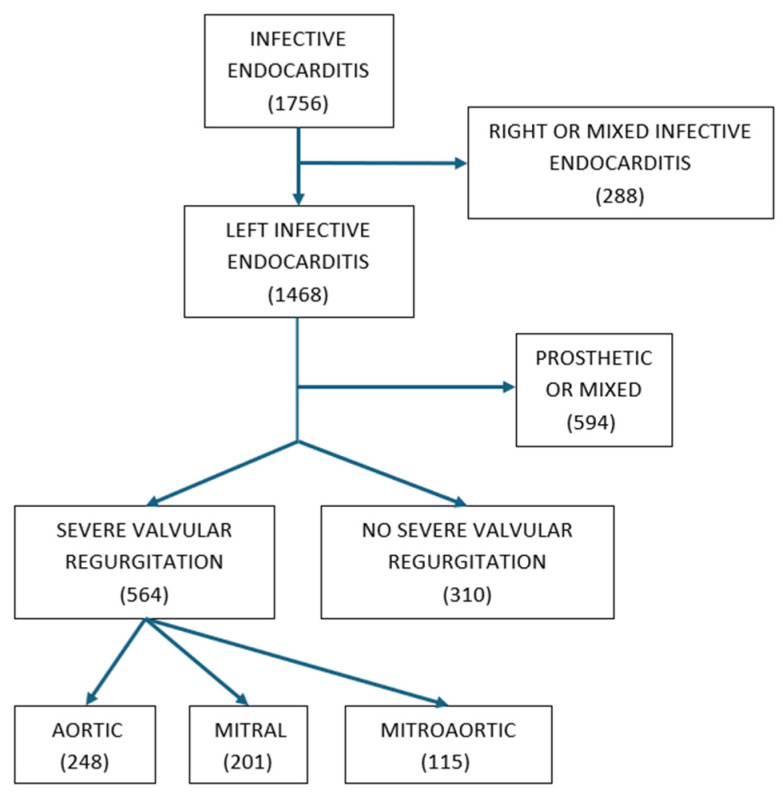
Heart failure worsens the prognosis of patients with infective endocarditis (IE) and is mainly caused by severe valvular regurgitation. The aim of our investigation is to describe the clinical, epidemiological, microbiological, and echocardiographic characteristics of patients with native left-sided infective endocarditis (NLSIE) with severe valvular regurgitation; to describe the prognosis according to the therapeutic approach; and to determine the prognostic factors of in-hospital mortality. : We prospectively recruited all episodes of possible or definite NLSIE diagnosed at three tertiary hospitals between 2005 and 2022. Patients were divided into two groups: patients with severe valvular regurgitation at the time of admission or during hospitalization and patients without severe valvular regurgitation. We analyzed up to 85 variables concerning epidemiological, clinical, analytical, microbiological, and echocardiographic data. : We recovered 874 patients with NLSIE, 564 (65%) of them with severe valvular regurgitation. There were no differences in mortality among patients with and without severe regurgitation (30.2% vs. 26.5%, = 0.223). However, mortality increased when patients with severe regurgitation developed heart failure (33% vs. 11.4%, < 0.001). Independent factors related to heart failure were age (OR 1.02 [1.01-1.034], = 0.001), anemia (OR 1.2 [1.18-3.31], = 0.01), atrial fibrillation (OR 2.3 [1.08-4.89], = 0.03), -related IE (OR 0.47 [0.3-0.73], = 0.001), and mitroaortic severe regurgitation (OR 2.4 [1.15-5.02], = 0.019). : Severe valvular regurgitation is very frequent among patients with NLSIE, but it does not worsen the prognosis of patients unless complicated with heart failure.
心力衰竭会使感染性心内膜炎(IE)患者的预后恶化,且主要由严重的瓣膜反流引起。我们研究的目的是描述伴有严重瓣膜反流的原发性左侧感染性心内膜炎(NLSIE)患者的临床、流行病学、微生物学和超声心动图特征;根据治疗方法描述预后情况;并确定住院死亡率的预后因素。我们前瞻性地纳入了2005年至2022年期间在三家三级医院诊断出的所有可能或确诊的NLSIE病例。患者被分为两组:入院时或住院期间伴有严重瓣膜反流的患者和无严重瓣膜反流的患者。我们分析了多达85项有关流行病学、临床、分析、微生物学和超声心动图数据的变量。我们共纳入了874例NLSIE患者,其中564例(65%)伴有严重瓣膜反流。有严重反流和无严重反流的患者死亡率无差异(30.2%对26.5%,P = 0.223)。然而,当伴有严重反流的患者发生心力衰竭时,死亡率会升高(33%对11.4%,P < 0.001)。与心力衰竭相关的独立因素有年龄(OR 1.02 [1.01 - 1.034],P = 0.001)、贫血(OR 1.2 [1.18 - 3.31],P = 0.01)、心房颤动(OR 2.3 [1.08 - 4.89],P = 0.03)、静脉药物滥用相关的IE(OR 0.47 [0.3 - 0.73],P = 0.001)以及二尖瓣主动脉瓣严重反流(OR 2.4 [1.15 - 5.02],P = 0.019)。严重瓣膜反流在NLSIE患者中非常常见,但除非并发心力衰竭,否则不会使患者预后恶化。