Sovetova Sofya, Charaya Kristina, Erdniev Tamerlan, Shchekochikhin Dmitry, Bogdanova Alexandra, Panov Sergey, Plaksina Natalya, Mutalieva Elmira, Ananicheva Natalia, Fomin Viktor, Andreev Denis
City Clinical Hospital Named After S. S. Yudin, Kolomensky Passage 4, 115446 Moscow, Russia.
Department of Cardiology, Functional and Ultrasound Diagnostics, First State Moscow University Named After I.M. Sechenov, Trubetskaya 8/2, 119991 Moscow, Russia.
J Clin Med. 2024 Oct 21;13(20):6272. doi: 10.3390/jcm13206272.
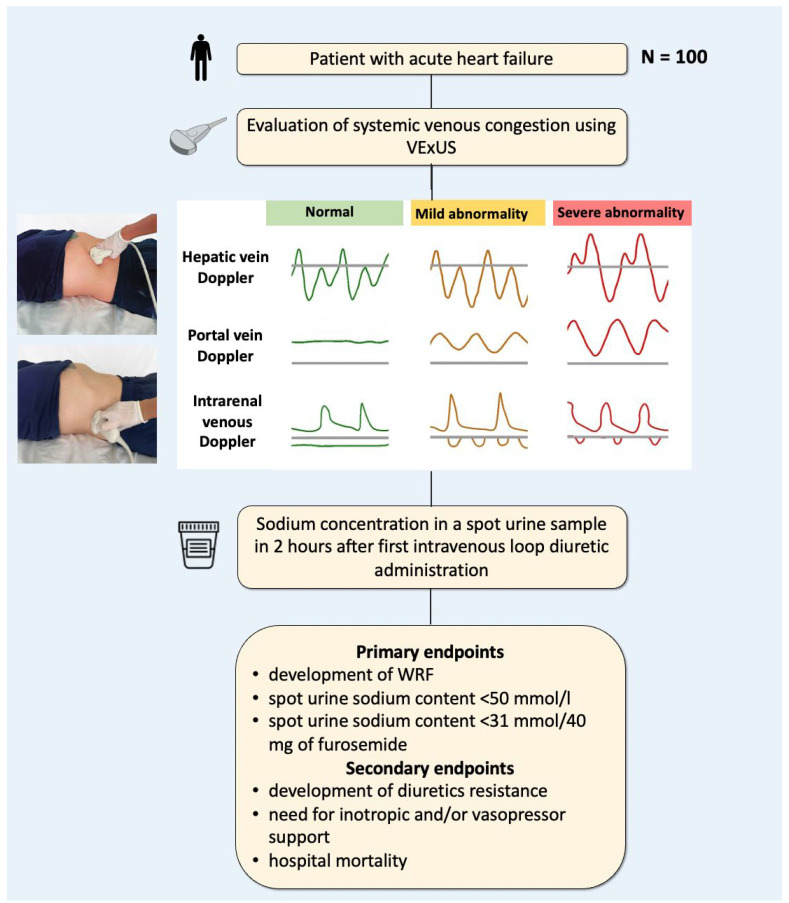
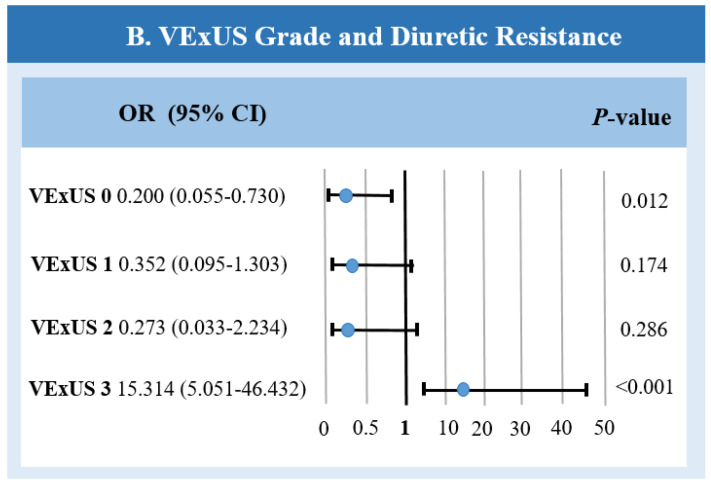
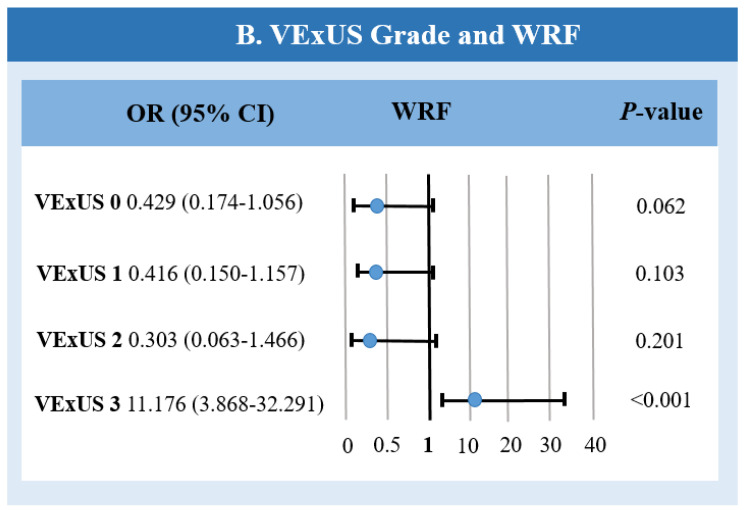
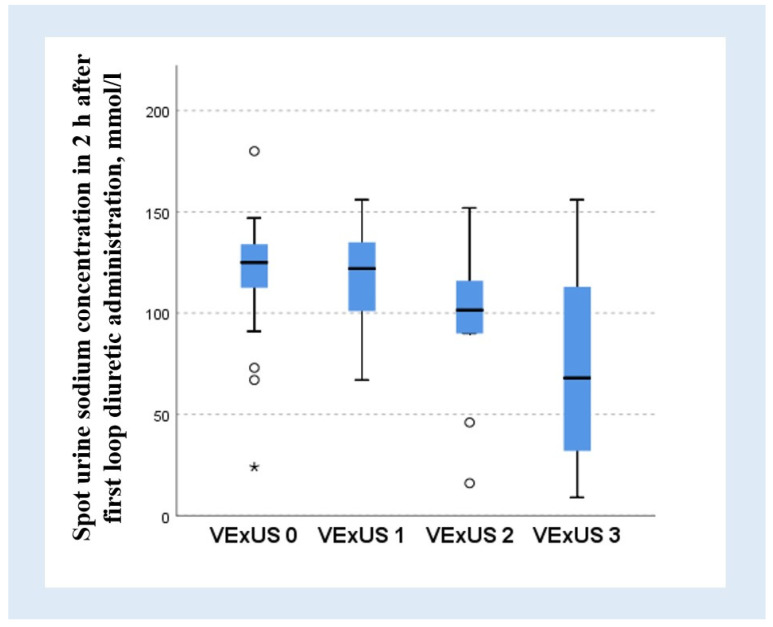
The venous excess ultrasound score (VExUS) is used to objectify systemic venous congestion. The aim of the paper was to determine the association between VExUS grades and worsening renal function (WRF), reduced natriuretic response, diuretics resistance, and mortality in patients with acute heart failure (AHF). One hundred patients were included, and Doppler ultrasound of hepatic, portal, and renal veins was performed. Severity of congestion was graded using the VExUS score (grade 0, 1, 2, or 3). Sodium concentration in a spot urine sample was assessed in 2 h after the first loop diuretic administration and was adjusted for the prescribed dose of furosemide (31 mmol/40 mg). Diuretics resistance was defined as the need to double the starting dose of intravenous furosemide in 6 h. Patients with VExUS grade 3 showed a higher incidence of WRF (OR: 11.17; 95% CI: 3.86-32.29; < 0.001) and a decreased natriuretic response: a spot urine sodium content of <50 mmol/L (OR: 21.53; 95% CI: 5.32-87.06; < 0.001) and an adjusted spot urine sodium content of <31 mmol/40 mg (OR: 9.05; 95% CI: 3.15-25.96; < 0.001). The risk of diuretic resistance (OR: 15.31; 95% CI: 5.05-46.43; < 0.001), as well as the need for inotropic and/or vasopressor support (OR: 11.82; 95% CI: 3.59-38.92; < 0.001), was higher in patients with severe congestion. The hospital mortality rate increased in patients with VExUS grade 3 compared to in patients with other grades (OR: 26.4; 95% CI: 5.29-131.55; < 0.001). Patients with AHF and VExUS grade 3 showed a higher risk of developing WRF, a decreased diuretic and natriuretic response, a need for inotropic and/or vasopressor support, and a poor prognosis during their hospital stay.
静脉淤血超声评分(VExUS)用于客观评估全身性静脉淤血情况。本文旨在确定急性心力衰竭(AHF)患者中VExUS分级与肾功能恶化(WRF)、利钠反应降低、利尿剂抵抗及死亡率之间的关联。纳入了100例患者,并对肝静脉、门静脉和肾静脉进行了多普勒超声检查。使用VExUS评分(0级、1级、2级或3级)对淤血严重程度进行分级。在首次给予袢利尿剂后2小时评估随机尿样中的钠浓度,并根据呋塞米的规定剂量进行校正(31 mmol/40 mg)。利尿剂抵抗定义为在6小时内需要将静脉注射呋塞米的起始剂量加倍。VExUS 3级患者的WRF发生率更高(比值比:11.17;95%置信区间:3.86 - 32.29;P < 0.001),且利钠反应降低:随机尿钠含量<50 mmol/L(比值比:21.53;95%置信区间:5.32 - 87.06;P < 0.001),校正后的随机尿钠含量<31 mmol/40 mg(比值比:9.05;95%置信区间:3.15 - 25.96;P < 0.001)。严重淤血患者发生利尿剂抵抗的风险(比值比:15.31;95%置信区间:5.05 - 46.43;P < 0.001)以及需要使用正性肌力药和/或血管升压药支持的风险(比值比:11.82;95%置信区间:3.59 - 38.92;P < 0.001)更高。与其他分级的患者相比,VExUS 3级患者的医院死亡率增加(比值比:26.4;95%置信区间:5.29 - 131.55;P < 0.001)。AHF且VExUS 3级的患者发生WRF的风险更高,利尿剂和利钠反应降低,需要正性肌力药和/或血管升压药支持,且住院期间预后较差。