Resler Katarzyna, Lubieniecki Pawel, Zatonski Tomasz, Doroszko Adrian, Trocha Malgorzata, Skarupski Marek, Kujawa Krzysztof, Rabczynski Maciej, Kuznik Edwin, Bednarska-Chabowska Dorota, Madziarski Marcin, Trocha Tymoteusz, Sokolowski Janusz, Jankowska Ewa A, Madziarska Katarzyna
Clinical Department of Otolaryngology, Head and Neck Surgery, Wroclaw Medical University, Borowska Street 213, 50-556 Wroclaw, Poland.
Clinical Department of Diabetology and Internal Disease, University Hospital, Wroclaw Medical University, Borowska Street 213, 50-556 Wroclaw, Poland.
Microorganisms. 2024 Oct 13;12(10):2060. doi: 10.3390/microorganisms12102060.
The aim of this study was to see if the CHADS-VASc score (Cardiac failure or dysfunction, Hypertension, Age ≥ 75 [Doubled], Diabetes, Stroke [Doubled]-Vascular disease, Age 65-74 and Sex category [Female] score) could have potential clinical relevance in predicting the outcome of hospitalization time, need for ICU hospitalization, survival time, in-hospital mortality, and mortality at 3 and 6 months after discharge home.
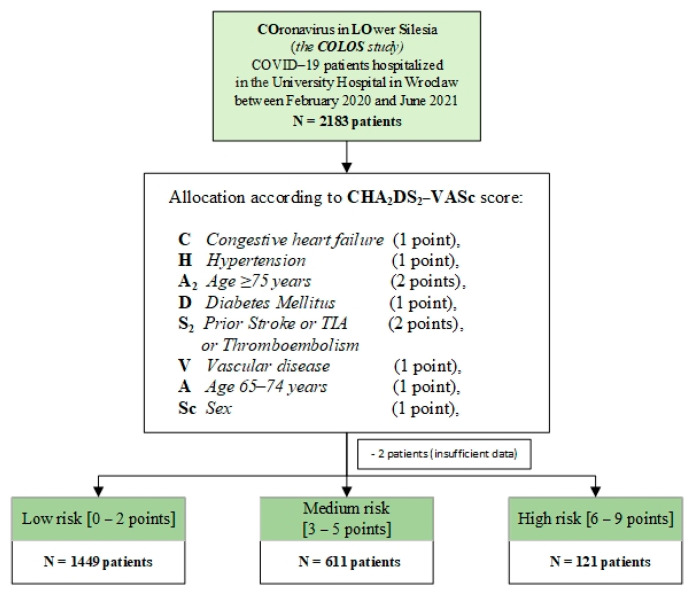
A retrospective analysis of 2183 patients with COVID-19 hospitalized at the COVID-19 Centre of the University Hospital in Wrocław, Poland, between February 2020 and June 2021, was performed. All medical records were collected as part of the COronavirus in LOwer Silesia-the COLOS registry project. The CHADS-VASc score was applied for all subjects, and the patients were observed from admission to hospital until the day of discharge or death. Further information on patient deaths was prospectively collected following the 90 and 180 days after admission. The new risk stratification derived from differences in survival curves and long-term follow-up of our patients was obtained. Primary outcomes measured included in-hospital mortality and 3-month and 6-month all-cause mortality, whereas secondary outcomes included termination of hospitalization from causes other than death (home discharges/transfer to another facility or deterioration/referral to rehabilitation) and non-fatal adverse events during hospitalization.
It was shown that gender had no effect on mortality. Significantly shorter hospitalization time was observed in the group of patients with low CHADS-VASc scores. Among secondary outcomes, CHADS-VASc score revealed predictive value in both genders for cardiogenic (5.79% vs. 0.69%; < 0.0001), stroke/TIA (0.48% vs. 9.92%; < 0.0001), acute heart failure (0.97% vs. 18.18%; < 0.0001), pneumonia (43% vs. 63.64%; < 0.0001), and acute renal failure (7.04% vs. 23.97%; < 0.0001). This study points at the usefulness of the CHADS-VASc score in predicting the severity of the course of COVID-19.
Routine use of this scale in clinical practice may suggest the legitimacy of extending its application to the assessment of not only the risk of thromboembolic events in the COVID-19 cohort.
本研究的目的是探讨CHADS-VASc评分(心力衰竭或功能障碍、高血压、年龄≥75岁[加倍]、糖尿病、卒中[加倍] - 血管疾病、年龄65 - 74岁和性别类别[女性]评分)在预测住院时间、入住重症监护病房的需求、生存时间、住院死亡率以及出院回家后3个月和6个月死亡率的结果方面是否具有潜在的临床相关性。
对2020年2月至2021年6月期间在波兰弗罗茨瓦夫大学医院COVID-19中心住院的2183例COVID-19患者进行了回顾性分析。所有医疗记录均作为下西里西亚地区冠状病毒 - COLOS注册项目的一部分收集。对所有受试者应用CHADS-VASc评分,并观察患者从入院到出院或死亡之日的情况。入院后90天和180天前瞻性收集患者死亡的进一步信息。通过生存曲线差异和对我们患者的长期随访得出新的风险分层。测量的主要结局包括住院死亡率、3个月和6个月全因死亡率,而次要结局包括因非死亡原因终止住院(出院回家/转至另一机构或病情恶化/转至康复机构)以及住院期间的非致命不良事件。
结果表明性别对死亡率无影响。CHADS-VASc评分低的患者组住院时间明显更短。在次要结局中,CHADS-VASc评分在男女两性中对心源性(5.79%对0.69%;<0.0001)、卒中/短暂性脑缺血发作(0.48%对9.92%;<0.0001)、急性心力衰竭(0.97%对18.18%;<0.0001)、肺炎(43%对63.64%;<0.0001)和急性肾衰竭(7.04%对23.97%;<0.0001)均显示出预测价值。本研究指出CHADS-VASc评分在预测COVID-19病程严重程度方面的有用性。
在临床实践中常规使用该量表可能表明将其应用范围扩展至不仅评估COVID-19队列中血栓栓塞事件风险的合理性。