Department of Medicine III, Clinical Division of Gastroenterology and Hepatology, Medical University of Vienna, 1090 Vienna, Austria.
Department of Anesthesia, Intensive Care Medicine and Pain Medicine, Medical University of Vienna, 1090 Vienna, Austria.
Nutrients. 2024 Oct 18;16(20):3534. doi: 10.3390/nu16203534.
Gastrointestinal dysfunction is a common complication of medical nutrition therapy in critically ill patients. Whether prone positioning leads to a deterioration in gastrointestinal function has not been fully clarified. Thus, we aimed to analyze the influence of prone positioning on the tolerance of medical nutrition therapy.
We conducted a retrospective analysis of 102 SARS-CoV-2 infected patients with venovenous extracorporeal membrane oxygenation support (VV ECMO). Gastric residual volume (GRV) was used to assess the tolerance of enteral nutrition.
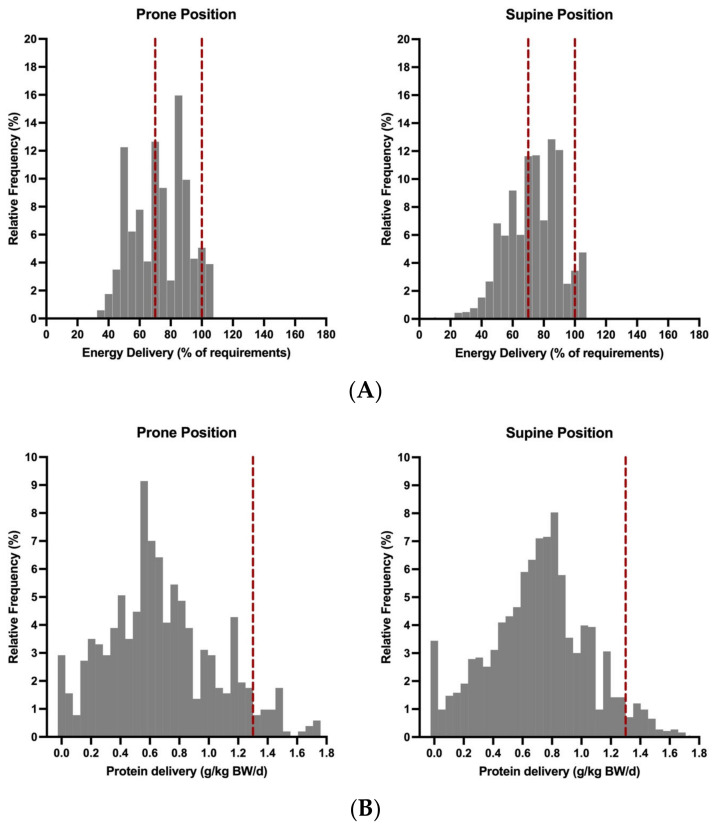
Nutritional data were collected for 2344 days. Undernutrition was observed in 40.8%, with a significantly higher incidence on days in prone position (48.4% versus 38.6%, < 0.001). On days in supine position, significantly more calories were administered enterally than on days in prone position ( < 0.001). The mean GRV/24 h was 111.1 mL on days in supine position and 187.3 mL on days in prone position ( < 0.001). Prone positioning was associated with higher rates of GRV of ≥500 mL/24 h independent of age, disease severity at ECMO start, ECMO runtime and ICU length of stay (adjusted hazard ratio: 4.06; 95%CI: 3.0-5.5; < 0.001).
Prone position was associated with lower tolerance of enteral nutrition, as indicated by an increased GRV. As a result, reduced enteral nutritional support was administered.
胃肠道功能障碍是危重症患者医学营养治疗的常见并发症。俯卧位是否会导致胃肠道功能恶化尚未完全阐明。因此,我们旨在分析俯卧位对医学营养治疗耐受性的影响。
我们对 102 例接受静脉-静脉体外膜肺氧合(VV ECMO)支持的 SARS-CoV-2 感染患者进行了回顾性分析。胃残留量(GRV)用于评估肠内营养的耐受性。
共收集了 2344 天的营养数据。营养不良发生率为 40.8%,俯卧位时发生率明显更高(48.4%比 38.6%,<0.001)。仰卧位时,肠内给予的热量明显多于俯卧位(<0.001)。仰卧位时的平均 GRV/24 h 为 111.1 mL,俯卧位时为 187.3 mL(<0.001)。俯卧位与 24 h 内 GRV≥500 mL/24 h 的发生率较高有关,与年龄、ECMO 开始时的疾病严重程度、ECMO 运行时间和 ICU 住院时间无关(调整后的危险比:4.06;95%CI:3.0-5.5;<0.001)。
俯卧位与肠内营养耐受性降低有关,表现为 GRV 增加。因此,减少了肠内营养支持。